

In the past, countries have adopted federal systems to address a number of inherent institutional problems, whether it is to resolve various forms of ethnic conflicts or internal economic imbalances. [break]
For instance, the creation of a federal system in the United States and its subsequent development was motivated by an effort to provide a more cohesive structure to the national government, and to address emerging weaknesses to the Articles of Confederation, the guiding constitutional government in the US after the country attained independence from Britain.
In the concrete case of Nepal, however, it appears to me that there is no consensual expectation as to how and what a federal Nepal would look like nor how a federal structure in Nepal would offer a political and administrative solution to the ongoing chaotic political situation that prevails here. Hence a debate about the possible structure of federalism in Nepal, in the midst of a festering constitutional crisis, seems to be a misguided allocation of priorities.
Even though I hardly agree with most of the strategic objectives made by the Maoists in Nepal or elsewhere, the proposed draft map with ethnically cohesive populations may be a good starting point to design a federal structure for Nepal. Such a structural arrangement should, in theory, enable historically disadvantaged minorities to have an opportunity to design policies that don’t marginalize them further. Many countries, including India or Spain, for instances, have adopted a similar range of federal arrangements that are based on some form of linguistic and cultural differentiation.
The key weakness in the Maoist proposal lies in the underlying details of their federal scheme. In my view, as a scholar of comparative federalism, that to guarantee representation in a given province by individuals from a protected community in that specific jurisdiction lacks merit or commonsense. In a democratic federal system, the majority of citizens select their chosen candidates based on their ability to best represent their interests. By limiting the pool of potential candidates who may represent a given province, you are limiting the range of options for voters to select the best alternative. More importantly, efforts to engineer a given electoral outcome are likely to backfire.
Preselecting candidates to regional offices on the basis of specific ethnic attributes almost always invariably leads to a lack of effective electoral competition, and to corruption and cronyism.

Moreover, the Maoist proposal to link federalism to specific ethnic representations is flawed in another way. There is no clarity that the constituent units’ boundaries being established, primarily based on ethnicity, actually reflect the ethnic configuration of Nepal, or the way that individuals identify themselves ethnically. It appears that various draft proposals of a federal map are attempting to construct ethnic identities in areas where none exist. Wouldn’t it make more sense to draw the constituent units’ boundaries on the basis of other factors instead, such as economic viability and availability of natural resources? Although ethnic differentiation is a socially constructed category, there is no denying that many individuals attach a great deal of importance to some forms of heritage or ascriptive group traits. In the case of the Maoists’ draft proposal for an ethnically fragmented federal system, however, the ethnic boundaries appear to be somewhat arbitrary, and not in accordance to the way that Nepalis in different regions identify themselves.
As with any facet of political life in Nepal, the question of federalism has become deadlocked on the basis of who is making a proposal, rather than on the merits of the proposal. The vague opposition by the Nepali Congress to the Maoists’ 14-state map (or whatever other draft proposal map is floated in the coming months) reveals that there is lack of clarity on the purpose of a federal system of governance. Is it an instrument to reduce ethnic conflict, is it to provide greater administrative efficiency, or is it to decentralize political authority? No one seems to know.
In the absence of a consensus of what the structure of federalism in Nepal should be, the second weakness in the debates about a federal structure in Nepal revolves around the expected effects of federalism. Some commentators have attempted to imagine federalism as a mechanism to resolve Nepal’s inherent regional economic disparities. While it is true that federal arrangements could diminish regional economic disparities, the experience in most federal countries has been the reverse.
A properly designed federal system provides a degree of economic policy autonomy to sub-national units, both at the provincial and municipal levels. Under this arrangement, some sub-national units are likely to adopt economic policies that will make them more prosperous. Other such units, in contrast, are likely to engage in a range of (typically populist) measures that will lead to their continued impoverishment.
In my view, a true federal system encourages sub national units to emulate the economic policy initiatives of the more successful sub national units. In essence, federalism is a laboratory for the effectiveness of specific policy agendas. Nepali politicians of different political stripes have already demonstrated their incapacity to govern at national level, so the appeal to transfer some political and administrative authority to sub national units is strong. In a federally reconstructed Nepal, the Maoists, for instance, could enact specific economic policies in the provincial governments that they would control, thus signaling their capacity to govern. Should they fail, other political actors could try to encourage the voters to adopt other policies.
From the perspective of an outsider, there are many adjectives to describe Nepal’s current political landscape: sclerotic, shambolic, chaotic. I am sure that Nepalis have a plethora of more colorful terms to describe their own political system and its politicians. Rather than anguish, perhaps Nepalis should see the debate about federalism in a more lighthearted way, as yet another form of political theatre. I am sure that many readers of this distinguished newspaper will be familiar with the work of the famous Romanian playwright, Eugène Ionesco. He had a wicked sense of humor about the absurd, and had he lived in Kathmandu, he would have certainly had ample material to draw upon in Nepal to write one of his brilliant plays.
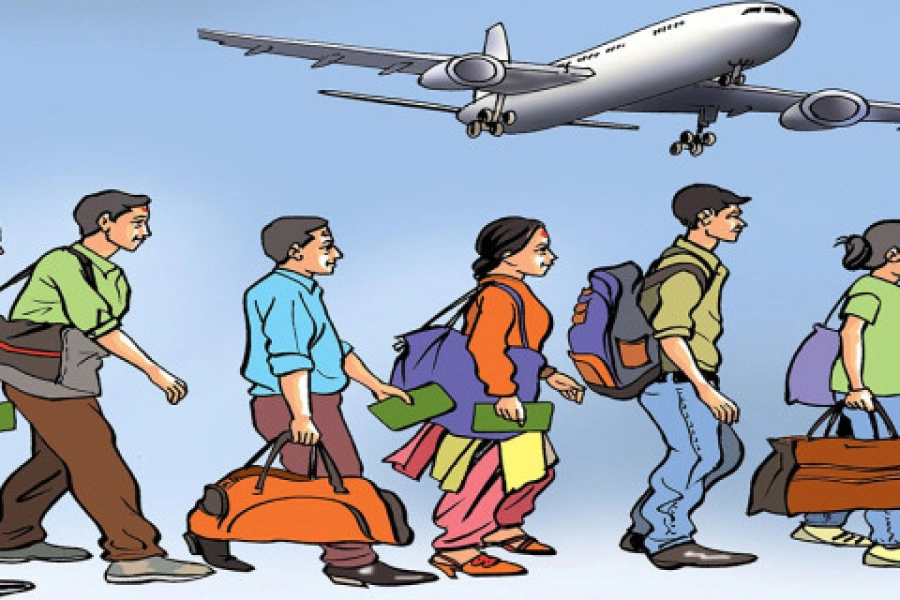
It is encouraging to note that some Nepalis have maintained a sense of humor amidst the absurd political situation that Nepal faces. For instance, the current campaign to declare 2011 as Nepal tourism year shows that, at least some bureaucrats in Nepal’s Ministry of Tourism & Civil Aviation have an Ionescoesque sense of the absurd. The reality is that Nepal is not developmentally equipped to handle tourists. The country is shockingly polluted, tourist shopping districts (like Thamel) are not pedestrianized, and dangerous to circulate on account of the traffic, the smell from open sewers mar any visit to important religious and cultural heritage sites, there is not enough electricity, streets have no visible names on plaques, its road infrastructure system is in tatters, Nepal’s visa regime and foreign currency requirements is incomprehensible, its airports are a sad caricature of banana republics. Is the Ministry of Tourism so blind? Should we then celebrate 2010 as the year of the complete constitutional meltdown of Nepal?
Nepal is a failed state, held aloft by a string of self-important international NGOs, disjointed developmental assistance programs, and a thinning stream of middle-aged German and Austrian trekkers. This situation is unsustainable.
As a political scientist, I envision that Nepal’s constitutional deadlock will continue in May, through the summer, and well into the start of winter, perhaps longer if politicians had their way. What this means is that the most likely short term outcome for Nepal will be for a soft military seizure of power, or, what some people have termed, a bloodless coup d’état, something equivalent to what happened in Bangladesh a few years back. I would be surprised if Nepal’s government is not suspended by the military by the end of November 2010.The other, less plausible alternative will be for the former Maoist insurgents to take up arms in 2011 (coinciding with Nepal’s tourism year).
Whether viewed externally or internally, the outlook for Nepal is not a positive one. Therefore discussing the nuances of establishing a federal system of governance for Nepal is akin to evaluating whether a terminally ill cancer patient should have cosmetic surgery.
I think that an effectively designed federal system could offer a practical political and economic solution to some of Nepal’s problems. However, federalism should not be seen as a panacea to Nepal’s most intractable political problem, namely, the absence of a functioning national government. Many Nepalis may resent that their country is commonly viewed as a failed state, but I am certain that few in Nepal would agree that the ongoing political deadlock is in any way an optimal situation. Therefore, I am not optimistic that a federal solution to Nepal will be effective because the problems facing Nepal are greater than the capacity of Nepali politicians to solve them.
Related story
'Political solution on consensus'


















-1200x560-1779450784.webp)

