“Every time I contacted the blood bank, they asked me to find donors, saying they didn’t have blood of the required group in stock,” says Kunwar. The A+ blood that Kunwar’s father needed was never available at the blood bank despite being a common blood group.[break]
Kunwar’s case is definitely not a one off.
Pradeep Thapa scoured around for donors for four pints of blood when his wife was scheduled for a uterus fibroid surgery a few months back.
“I had requested my colleagues to donate blood and had lined up three donors but the blood bank couldn’t even help me with the one pint I couldn’t manage,” says Thapa.
People who have hospitalized family members or friends throng the blood bank desperately seeking blood but have to return empty handed. The condition is apparent. There is a huge gap between the demand and supply of blood in Nepal. With the increase in diseases and accidents, the need for blood has rocketed in recent times.

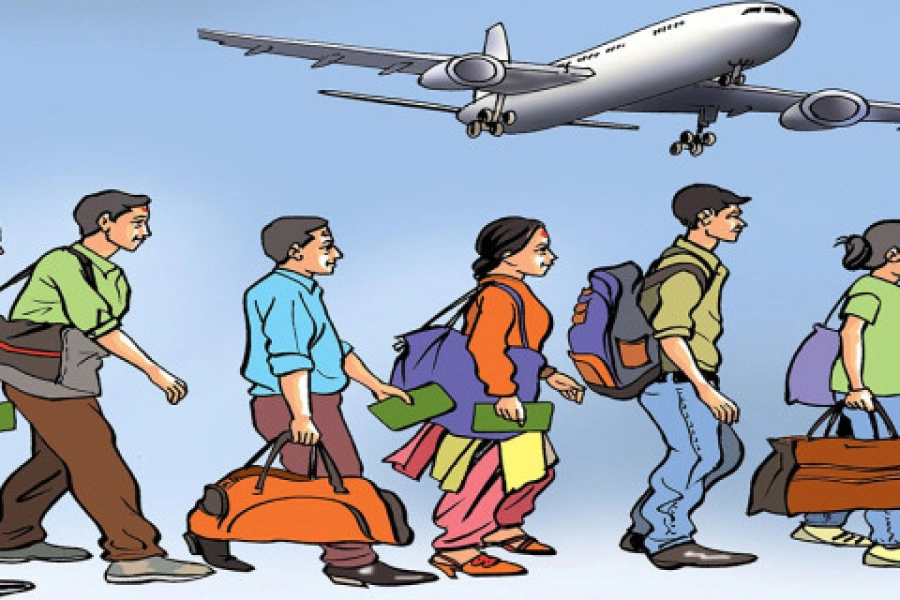
Illustration: Sworup Nhasiju
And the situation at the blood bank looks indeed grim. Without a systemized database to keep track of donors who can be contacted in case of emergencies and the lack of proper planning where donation camps are concerned, the situation has further worsened. Add to that the growing healthcare facilities and the hospitals’ demand for large quantities of blood for even low-risk surgeries as a safe measure, and the blood bank has almost dried up.
The Kathmandu-based Blood Bank at Nepal Red Cross Society at Brikuti Mandap, the sole government authorized supplier of blood, is at a quandary on how to tackle the ever increasing demand for blood. The daily demand is as high as 500 pints per day whereas the blood bank is able to dispense only 300 pints on a daily basis.
Hundreds of glum, expressionless faces with cooler boxes in hand and straining their ears to hear their names being called out by the staff behind the “cross match and supply unit” counter is the daily scene at the Blood Bank. Dilip Magar commuted all the way from Biratnagar to Kathmandu, hoping to get four pints of B+ blood for his ailing mother.
“I’ve been waiting for four days. On the first day, the staff at the blood bank told me to come the next day. On the second day, I was told to come after
five in the evening when their collection team would be back. When I reached the blood bank at quarter past five, they told me I was late,” says a visibly frustrated Magar.
Shova Bista, public relations officer at the blood bank, blames the current situation on the recently concluded festivities.
“The demand doesn’t stop and in fact increases during the festival season. We have no donation programs organized during that time and also no voluntary donors come to us for donation,” says Bista as an explanation as to why the blood bank is currently facing dire shortages.
Bista goes on to add that sometimes patients are misled by healthcare workers into believing that they can easily buy blood at the blood bank. The nominal charge they levy – Rs 675 for a pint of blood – is actually transfusion and packaging cost and they are not selling blood.
“If healthcare workers themselves ask patients to look for donors within their family and friends circle before visiting the blood bank, then there wouldn’t be such a huge crisis like the one we’re facing now,” says Bista, adding that patients’ infuriation at the blood bank is not completely justifiable.
However, it is interesting to note that one pint of blood can be processed into three components and used accordingly instead of using whole blood. A burn case needs plasma; pregnant women need RBC, whereas a malaria patient needs platelets. But in many cases, whole blood ends up being used, leading to shortage when the need for a certain component arises. Perhaps better management on the blood bank’s part could curb the crisis to a certain extent.
Adding to the problem of shortage is wastage of blood. Since blood has a limited shelf life, expired blood needs to be discarded. Hospitals almost always send out requests for a larger amount of blood than needed and don’t return the extra till it has crossed its expiration date. Also, temperature isn’t always maintained during storage at the hospital and the blood becomes useless.
Dr Kamal Raj Thapa, MD Internal Medicine at Bir Hospital, says that blood scarcity has also hit the nation’s largest government hospital. Though Bir Hospital has a blood bank of its own, it doesn’t store more than a few pints of blood and gets their supply from the one at Bhrikuti Mandap. But since the blood bank is reeling under dire shortage, the hospital’s requirement is unmet.
“We need a daily supply of 40-50 pints but are only getting around 20,” says Thapa, adding that this has posed a massive threat to the lives of many patients during emergency cases.
Hospital-based blood banks like that at Bir Hospital and Teaching Hospital find it easier to ask the patients to visit the Central Blood Bank rather than getting in the hassle of having the patient bringing in relatives and friends for donation. So, as people flock the premises of the blood bank, the authorities seem to have no option but to ask them to come at a later date.
There are donation camps being organized frequently. One sees a camp set up along New Road and in Patan ever so often. Where does all the blood go then? According to the Blood Bank authorities, donation camps have been clustered together, leading to a larger collection than needed at times which has even led to wastage of blood.
“There comes a season when donation camps are held left, right and center and then it dries up and leads to acute shortage. I’ve been calling organizations that have held donation programs before but it doesn’t look like they can help at the moment,” says Bista.

According to WHO, Nepal needs a minimum stock of blood equal to two percent of its population. But according to Bista, the blood bank is far away from achieving that with the current stock at less than 0.6 percent. Bista is quick to add that the goal can only be achieved through awareness about blood donation.
“A lot of people who come to us in search of blood aren’t willing to donate. Some give lame reasons like headache to ward off donation and we can’t force such people to give blood,” says Bista.
Awareness about blood donation could be an effective step towards ensuring that the problem of shortage the nation is now facing is timely managed. Magar, who is desperate for blood for his mother, has been a donor for over ten years and has given blood 30 times.
“I wish more people donated blood. And furthermore, I wish blood banks came up with ways to effectively manage blood that is being collected besides keeping a record of the donors,” says Magar.
The lack of donor database is a huge roadblock during emergency conditions. When questioned about the lack of a proper database listing all previous donors, Bista admits that though they do have a few lists it has not been updated.
“There are voluntary donations at the Blood Bank and besides that there are donation camps being organized every now and then. Keeping a record of the donors’ blood groups along with other relevant information should be of paramount importance,” says Magar.
Blood grouping is mandatory during a driving license application. The government already has database listing the blood groups of all the license applicants. It is just about managing the resources already at their disposal. The blood bank authorities however are skeptical about the blood grouping done during the license application and say that it is not absolutely authentic but agree that sourcing their database could be a step towards compiling a concrete list of donors.
With the increasing demand of blood, it looks there will be no respite and people will have to continue their frantic search unless there is awareness about blood donation among the public besides an effort to compile and keep an updated database of donors by the Blood Bank. Also the need for timely donation programs at fixed intervals instead of a season of donation programs could help. It is also necessary to remember that donating blood is every healthy individual’s responsibility. Save a life and have your loved ones or even yours saved in return someday!
Related story
World Blood Donor Day 2019: ‘Safe blood for all