Nepal stands today at a familiar, and yet strangely unfamiliar, junction. The scene feels new, while the script is old. Politics is noisy, restless, and crowded, but stripped of purpose. New parties emerge, old and new regroup, and coalitions are stitched and unstitched in a race to decide who governs next and for how long. Meanwhile, the so-called “mystical” March elections remain uncertain on the horizon. The musical chairs of power have begun again, only this time the faces are younger, the habits unchanged.
Issue-based politics has eroded, replaced by the tunes of ambition. Everyone claims change, yet little changes in substance. Beneath the noise, the country waits, uncertain not of what is happening, but of where it is headed.
This is not the first time Nepal has found itself here. What makes the present moment different is not the intensity of the crisis but the absence of direction. Politics has grown theatrical, even moralistic in appearance, while substance has faded. It is not the collapse of politics but its dilution. And in that lies the danger.
Robert Frost’s The Road Not Taken offers a useful metaphor. “Two roads diverged in a wood, and I - /I took the one less traveled by.” The poem is often misread as a celebration of individualism. In truth, it is about choice and consequence. The traveler knows that choosing one path forecloses the other. The weight of the poem lies not in rebellion, but in responsibility. Nepal today faces a similar moment.
One road is familiar. It is paved with habit, convenience, and caution. It is the road of muddling through, of short-term fixes, of substituting slogans for strategy. It is a road where politics is driven by personalities rather than institutions, where foreign policy reacts rather than anticipates, and where survival is mistaken for success.
The other road demands more. It requires clarity about national purpose and the courage to act upon it. It asks whether Nepal is content to remain a passive space shaped by external forces, or whether it can become an active shaper of its own destiny. This road is harder because it requires discipline, continuity, and restraint. It requires choosing direction over inertia.
Let us grow yams

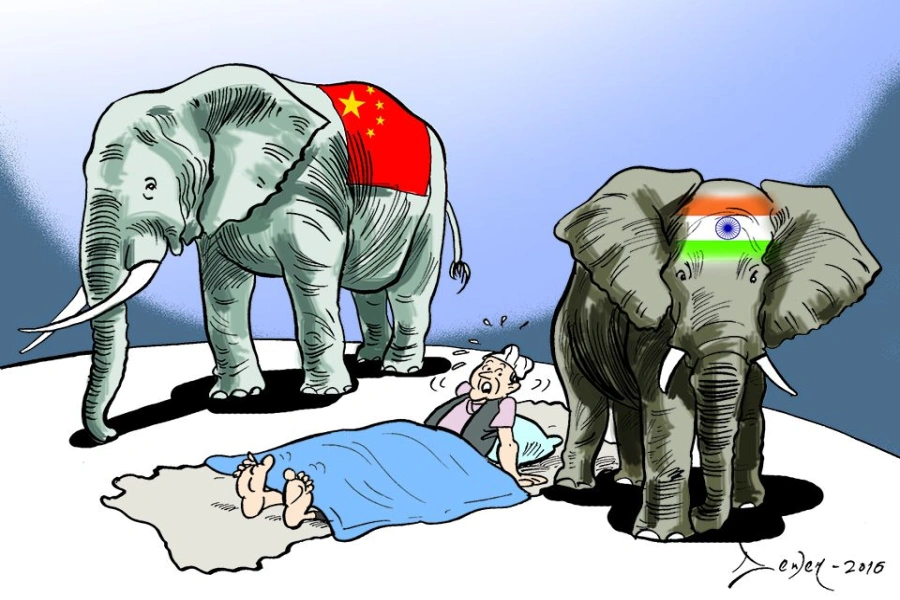
Nepal’s history offers important lessons in both action and inaction. When Prithvi Narayan Shah called the country a yam between two boulders, he was issuing a strategic warning: survival required restraint, neutrality, and careful positioning. The yam survived by staying still, avoiding provocation, knowing when not to move.
But that interpretation belongs to another era. In today’s shifting geopolitical landscape, the same metaphor demands rethinking. A motionless yam risks being crushed. Survival now demands calibrated movement, strategic adjustment, and the ability to act with purpose. The lesson is not passivity, but adaptation; not withdrawal, but responsiveness.
This understanding shaped some of Nepal’s most consequential decisions. King Tribhuvan’s alignment with India during the struggle against the Rana regime was not driven by ideology, but by strategic necessity. It was a calculated move rooted in survival. BP Koirala later advanced the idea of active internationalism, arguing that Nepal’s security lay in engagement rather than isolation. Even King Mahendra’s much-debated outreach to China after the 1962 war reflected the same instinct. It was less an act of defiance than an effort to widen Nepal’s strategic space and preserve autonomy in a changing regional order.
These decisions were imperfect, often contested but guided by a shared logic. The leaders disagreed on many things, but they understood that foreign policy is about leverage, not loyalty. It expands room to maneuver, not permanent allegiance. That strategic sensibility, however, began to erode in the decades that followed.
After 1990, political openness brought pluralism but also fragmentation. Coalition politics weakened coherence. Foreign policy became reactive, shaped more by domestic rivalries than by long-term strategy. Government rose and fell, each recalibrating external relations to suit immediate political needs. Over time, diplomacy lost continuity and purpose.
The 2015 border disruptions and blockade exposed the cost of this complacency. For many Nepalis, it was the moment when geopolitics ceased to be abstract and became painfully real. Yet even this shock failed to produce lasting structural reform. Nationalist rhetoric intensified, but institutional capacity remained weak. The language of sovereignty grew louder, even as the foundations needed to sustain it remained fragile.
Today, Nepal speaks of multi-alignment, strategic autonomy, and connectivity. These ideas matter, but without strong institutions they remain slogans. Diplomacy needs continuity. It needs institutions that outlast governments, diplomats who are empowered rather than micromanaged, and political leaders who understand foreign policy is not an extension of party rivalry. In a world shifting from globalization to selective interdependence, ambiguity no longer protects. Major powers are impatient. Transaction replace trust. Non-alignment worked in a bipolar age. Today’s multipolar disorder demands clearer priorities.
What should those be? First is economic realism. Foreign policy must be tied to domestic production, energy security, and employment. Diplomacy that does not translate into roads completed, power exported, or jobs created will lose public legitimacy. Second, predictability. Neighbors and partners do not expect Nepal to choose sides, but they do expect consistency. Third, humility. Nepal does not need to punch above its weight. It needs to stop punching itself.
The irony is that Nepal has more goodwill internationally than it often realizes. Its peace process, despite flaws, is studied. Its UN peacekeeping role earns respect. Its diaspora is growing and is increasingly influential. Yet these assets remain underutilized because they are not grounded in a coherent national vision.
Nepal’s challenge is not choosing between India and China, or between East and West. It is between hesitation and decision. Between continuing to manage decline with rhetoric, or committing to the slow unglamourous work of building lasting institutions. It is about professionalizing diplomacy, not personalizing it.
This brings us to a long-neglected necessity: the creation of a serious, well-funded, merit-based, and inclusive diplomatic service. A country that seeks respect abroad must invest in those who represent it. A national school of foreign service, open to diverse talent and insulated from patronage, is not a luxury. It is a requirement. Diplomacy cannot be improvised. It must be learned, practiced, and respected.
Sir Henry Wotton once famously described an ambassador as “an honest man sent to lie abroad for the good of his country.” The line is witty, but it carries a deeper truth. Diplomacy requires persuasion without deceit, firmness without arrogance, and flexibility without surrender. Nepal needs diplomats who understand this balance, not emissaries chosen for loyalty alone.
At its core, Nepal now faces its own version of Frost’s poem. The roads are visible. One leads to continued drift, managed decline, and rhetoric nationalism. The less-travelled road is not glamourous. It offers no instant rewards. But it holds something rarer: the possibility of agency. Of choosing rather than reacting. Of shaping history rather than being shaped by it.
The yam between the boulders has survived because it learned when to bend, when to resist, and when to grow quietly. That lesson has never been more relevant. The pressures will not ease. The world will not slow down. The only question that remains is whether Nepal will finally decide how it wants to move.
The road is there. The choice, as always, is ours.
(The author is a youth leader of Nepali Congress and Emmy-nominated former journalist.)