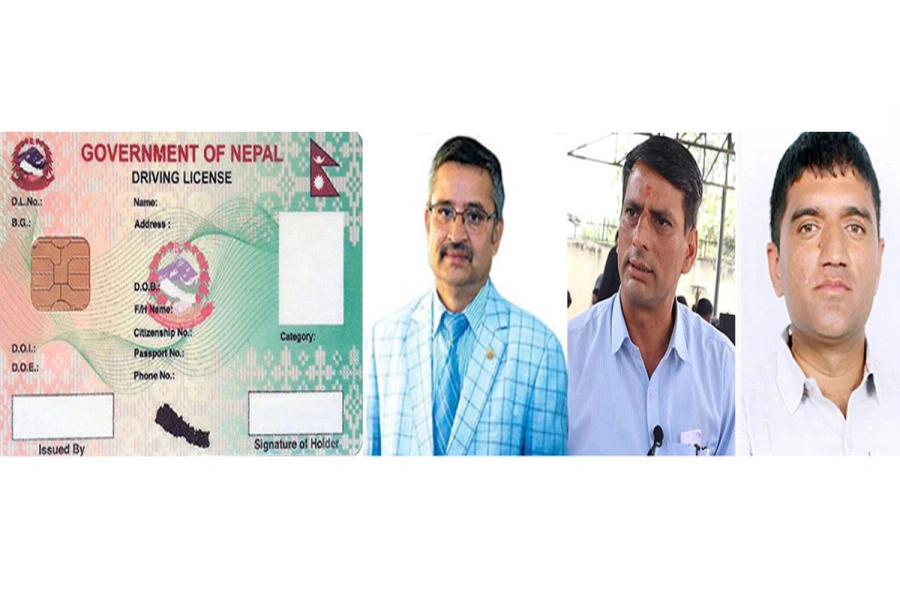
KATHMANDU, Jan 2: For Buddharam Tamang of Ramechhap, obtaining a driving licence has become a years-long ordeal. It has been three years since he paid the required fee and received a receipt at the Ekantakuna Transport Management Office in Lalitpur for his smart driving licence card—but the card is still nowhere in sight.
With no clear timeline for delivery, Tamang continues to drive by showing only the revenue payment receipt. “I paid the full amount, yet I still don’t have the licence card after three years,” he said. “That is nothing but shameful.”
Despite the government’s decision to introduce technologically advanced smart driving licence cards, it has failed to print and distribute them. As a result, thousands of drivers across the country are forced to rely on payment receipts instead of official licence cards.
The crisis stems from a policy decision taken without adequate preparation. Although driving licences were converted into smart cards, applicants who passed their trials as long as three-and-a-half years ago are still waiting. While the task of printing was assigned to the Security Printing Centre, its limited capacity has caused prolonged delays.
Smart driving license backlog piles up due to high volume of se...

An estimated 2.6 million applicants are currently awaiting licence cards, yet only around 500 cards are being printed daily. At this pace, many drivers may have to wait several more years. Even the much-touted Gen-Z government, which promised swift service delivery and good governance, has failed to address growing public frustration.
Keshav Khatriwada, IT chief of the Department of Transport Management (DoTM), acknowledged that licence cards pending since May 2022 remain unprinted. “Around 2.6 million licence cards are still pending,” he said, citing limited printing capacity. The department receives over 3,000 new licence applications every day.
Meanwhile, transport offices continue to conduct licence exams and collect fees from successful candidates, issuing only receipts in place of licence cards. Even applicants seeking licence renewals are sent home with receipts, despite paying the prescribed charges. For many, years of waiting have become the norm.
Consumer rights activist Madhav Timilsina described the situation as a clear case of state failure. “What could be more embarrassing than collecting fees and failing to issue licence cards for three or four years?” said Timilsina, president of the Consumer Rights Investigation Forum. “This reflects sheer administrative incompetence.”
Government officials attribute the delay to multiple factors, including the need to import smart cards, chips, and equipment, as well as the limited capacity of domestic machines. Secretary at the Ministry of Physical Infrastructure and Transport, Keshav Prasad Sharma, said tender processes were repeatedly stalled due to disputes and complaints.
“The delay is also because Nepal opted for high-tech licences beyond its capacity,” Sharma said. “Tenders have been announced and suspended time and again.”
He added that arrangements have been made to issue licence cards on an urgent basis when required. Critics, however, argue that administrative inefficiency remains the root cause of the prolonged delay.
Since mid-October, only 9,000 licence cards have been printed. On October 29, the DoTM and the Security Printing Centre reached an agreement to prioritise licence card printing.
Under the agreement, the DoTM has been supplying applicant data to the centre. While licence cards have been issued to those travelling abroad for employment or studies, thousands of applicants remain stuck in limbo.
The situation worsened after a fire damaged the DoTM’s licence card printing machines and systems during the Gen-Z movement, bringing all licence-related services to a halt. The disruption severely affected migrant workers and students heading overseas. Although the department later signed an agreement with the Security Printing Centre to resume limited printing, the backlog remains daunting.