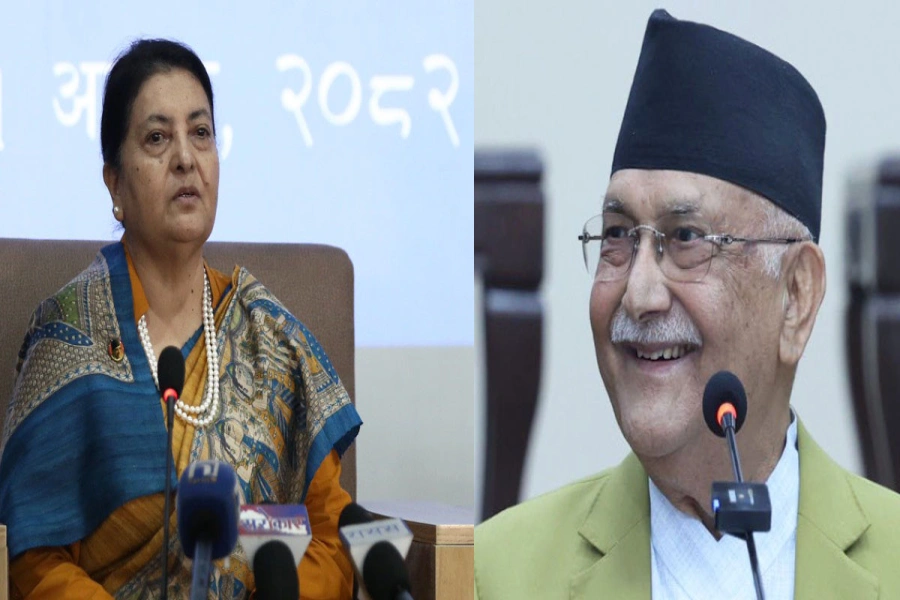
After taking oath of office under the new secular constitution President Bidya Devi Bhandari went to offer special pooja in Pasupatinath and Janaki temples. As a Hindu she has every right to practice her faith. But hasn't the head of the state breached universal norms of secularism by spending state resources to offer pooja?The President's action is against the spirit of secularism. While visiting Janaki temple on the occasion of Bibaha Panchami she was accompanied by Chief of Army Staff Rajendra Chhetri, Deputy Speaker Ganga Prasad Yadav, Minister of Land Reform Ram Kumar Subba and Nepali Congress Parliamentarian Kiran Yadav. Likewise, Home Minister Shakti Basnet accompanied her to Pasupatinath.
Misusing state coffers to promote one faith is against the constitutional provision of secularism. Bidya Bhandari's twin trips to Janaki temple and Pasupatinath have once again made religious minorities doubt the state's commitment to secularism.
Nepal was declared a secular state in 2006 by the reinstated House of Representatives after the second People's Movement abolished feudal monarchy and led the country on path of a new federal democratic republic. It's about a decade since secularism has been enshrined in Nepal's constitution. But nothing has been done from the government's side to implement secularism.
Thus it can be argued that the new constitution has taken us a step back instead of taking us towards more progressive and egalitarian society, especially when it comes to religion. Political leaders aren't committed to secular values. The new constitution's definition of secularism is vaguer than that of Interim Constitution. It describes secularism as "protection of religion and culture being practiced since ancient times, and religious and cultural freedom." Religion and culture since "ancient period" explicitly means Hindu religion. This is the reason non-Hindus doubt the new brand of secularism provided for in the new charter. The narrow definition has made Nepal a de facto Hindu state.
Nepal is the country of great diversity: in language, religion and culture. Failing to recognize this diversity and honor all faiths equally will polarize the country even more. You cannot doubt people's nationality if they speak a language other than Nepali, profess other faith than Hindu or adopts a different culture to the dominant Khas Arya culture.
It is disheartening that some are still trying to promote King Mahendra's narrow nationalism backed by Hindu religion.
A secular state is where the state remains neutral in matters of religion. It does not promote one religion. But in Nepal state actors have failed to guarantee this neutrality.
Nepal can flourish only when it treats all religions equally. Though Nepal is a secular state, millions of rupees are spent from state coffers to promote Hindu festivals while religious minorities like Christians are still struggling for a piece of land to bury their dead.
Until recently Christian deceased were buried at Bankali forest but after Pasupati Area Development Trust (PADT) imposed a ban on such burials they have had to run from pillar to post in search of burial grounds. It is hard for them even to bury the deceased in privately purchased graveyard of Churches due to complaints from locals and government's failure to provide them security. It is hard to believe this is happening under the watch of a constitutionally secular government.
As secularism has been enshrined in the preamble of the new constitution, the state must honor this. Simply retaining secularism doesn't make country secular. Religious minorities are facing a number of problems, ranging from lack of proper graveyard to paucity of places to worship. The government does not seem serious about this.
According to the Christian Federation, an alliance of mainstream churches in Nepal, they have requested all governments formed since 2006 to provide them graveyards but their demand has not been met as yet. The government failed to allocate a place for graveyard even after Christians staged hunger strikes. Religious minorities like Buddhists, Kirats and Christians as a result have no place to bury their loved ones.
The government must understand the plight of religious minorities and treat them with equality if Nepal is to become a truly inclusive and secular state.
The author is a social activist and freelance writer
dk7030@gmail.com
Related story
Unholy and unsecular