The new wave of art – the individualistic, creation-oriented and technique-driven contemporary art world – owns it origins to the distant shores of Europe. Its influence and ascendance is paradoxically a legacy of colonial subjugation and imperial aspirations. Here, the British school of art and education has long held sway. Nepal’s first documented western-style painter, Raj Man Singh Chitrakar, painted under the tutelage of Brian Hodgson in the first half of the 19th century. Later painters including Tej Bahadur Chitrakar and Chandra Man Maskey learnt their craft at fine art schools established by the British to “civilize the primitives of India.” This tendency to associate the western style with the civilized, progressive (development-oriented in Nepal’s case) and modern continued in Nepal through the establishment of the Lalit Kala Academy in Nepal. Throughout the second half of the 20th century, a growing number of Nepali painters learnt their craft in India (and further afield) and came back to become celebrated contemporary artists. Over 700 years of art production in Europe was adopted by Nepali avant-garde in less than half a century. From classical paintings to installations and conceptual art, the contemporary art world formulated its sphere.[break]

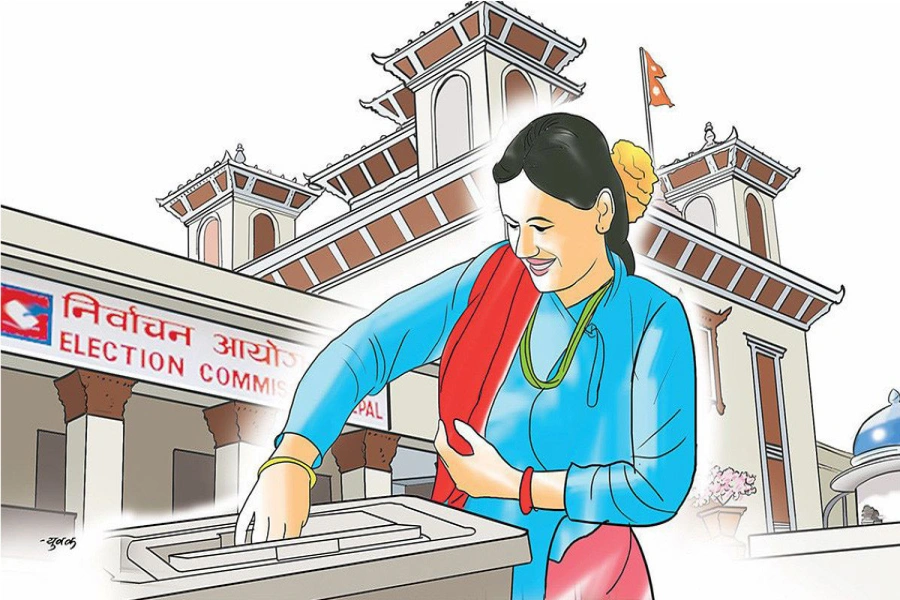
Illustration: Sworup Nhasiju
By the 1950s, the traditional arts in Nepal were looking anything but lucrative. By traditional, the reference goes to traditional work by Newar artists – Paubha. Over a century of declining commissions and waning traditions had placed them in a precarious position. The opening up of Nepal after the fall of the Rana Regime was to initiate a minor revival. Foreign scholars keen on Nepal’s historical traditions, art collectors and dealers, and some astute buyers, were quick to see the potential for an international market for Nepal’s exotic paintings. As a result, much of Nepal’s older Paubha work is no longer in Nepal and are installed in museums and galleries around the developed world. Unfortunately, Paubha has largely been ignored within art education in Nepal. The traditional arts were relegated to their medieval methods of learning and production. A clear educational divide was formed and a lack of communication and understanding between the contemporary and traditional arts continued.
Traditional artists faced the schism of modern Nepal acutely. On one hand, master Paubha painters were gaining international recognition and in turn securing lucrative commissions while on the other end, mass produced Paubha works became a continuing fad among backpacking tourists who started to visit Nepal. The latter works, disassociated from their traditional significance and increasingly relying to mass produced replicas, came to represent more product than art. In selling its exotic nature, these works were to quickly provide stiff competition to western-style works by contemporary artists.
Contemporary artists had the freedom to choose from a variety of different isms and often sought to dip into Nepal’s socio-cultural iconography to capture a Nepali essence. This proved a challenge, given the static and strong Nepali identity that Paubha was easily able to capture both locally and internationally. Delving into a variety of western art traditions and thought processes, contemporary art often appears to lack the intellectual rigor required for translocating and internalizing this discourse within a still traditional Nepali society. Most of the conceptual art produced lack a believable justification or viable interpretation.
This is not to dismiss all of contemporary art, however, but to highlight the evident weakness in most.
One possible explanation for the lack of complexity in much of Nepal’s contemporary art must be its hesitancy in dealing with its traditional art. All contemporary art is produced in the backdrop of the traditional. No matter how radical the change, iconoclastic the composition, or sound the unity, it must address to the resounding flatness and immobility of traditional Paubha. From the other end, it can also be argued that it is the Paubha tradition of replication, repetition and static space that has largely hindered the production of a genuinely Nepali visual language. There is a popular perception that links all Paubha painting to religion. However, a number of Paubha works on secular themes dating as far back as the 14th century are available and contest this link. It is perhaps time for traditional artisans to explore in fuller depth the sources that influenced Paubha during the late Malla period, including Mughal and Rajput styles combined with Tibetan and Chinese motifs.
The schism between the traditional and contemporary forms cannot be maintained if artists are to truly explore the sources of and for their creative expression. A greater degree of communication between the two forms is essential, and a vested interest in transcending dogmatic values is necessary from within the art producing community. Not to include the traditional arts within art education in today’s Nepal reeks of a blind adherence to South Asia’s colonial legacy. To dismiss the modern world in favor of an idealized past reveals an intellectually debilitating ignorance. In addition to this, the artist community must really invest in the question of what it means to be Nepali and what it means to produce art in Nepal.
It would be wise to challenge the very notion that Paubha is the traditional art of Nepal, as it would be wise to challenge the usage of any random ism for the sake of expressing the anxiety of being Nepali. Articulating an idea, never spoken, is difficult but not impossible. The western tradition shows this to be within the limits of human intellect. Our traditions give us the tools to reach these realizations.
Related story
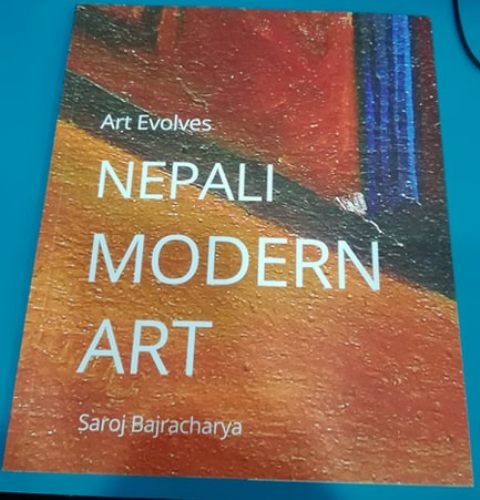
‘Art Evolves: Nepali Modern Art’: Review