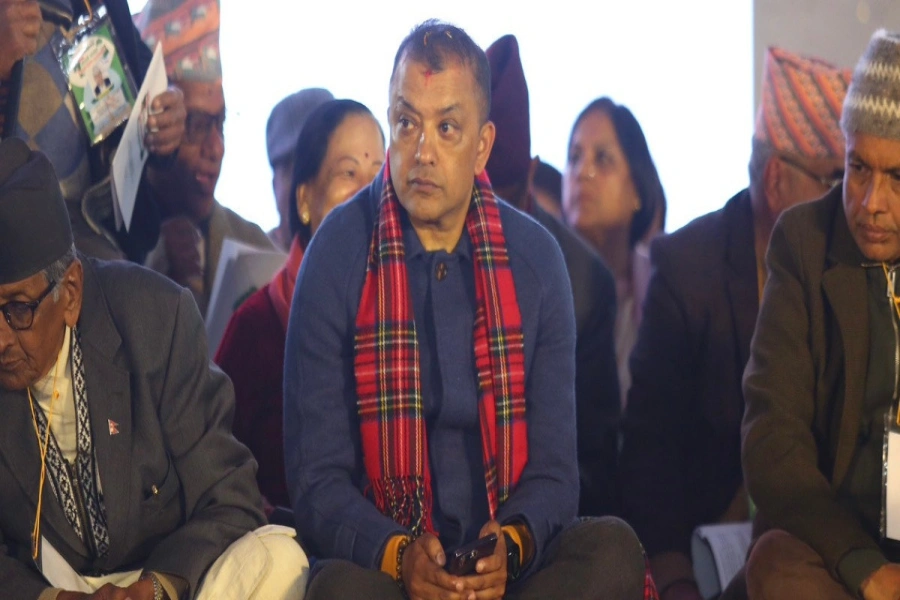
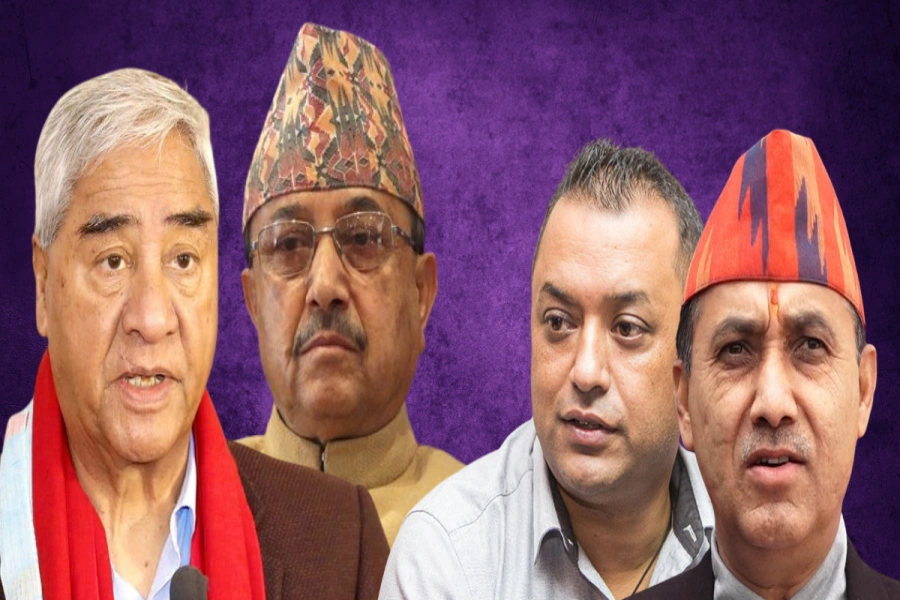
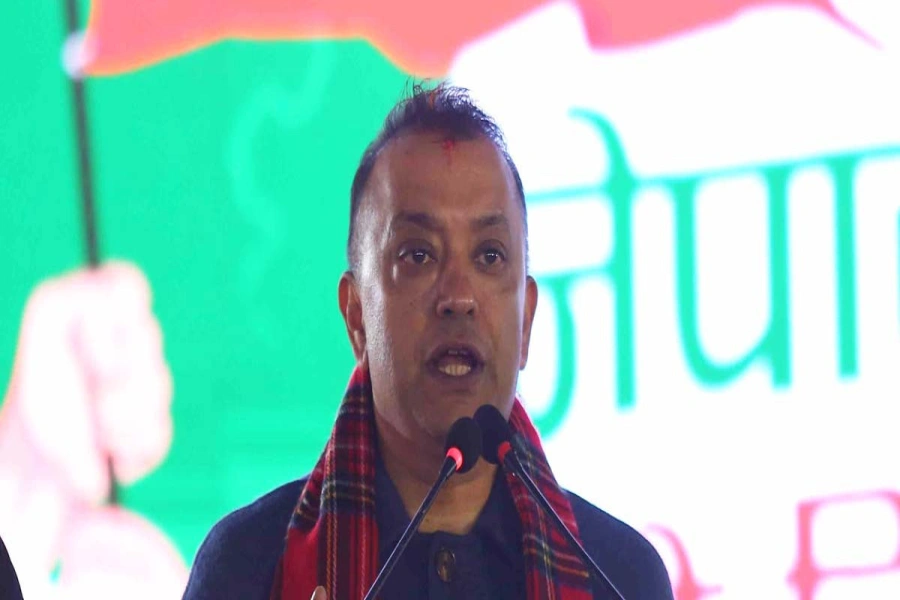
Kamal Thapa, the one-time national tennis champion, still sweats it out in the tennis court every morning. And it shows. During a recent meeting the Minister for Foreign Affairs, a recent sexagenarian, appeared fit as a fiddle. The political success of the well-built chairman of RPP-Nepal, the only party in Nepal that still pitches for constitutional monarchy, is no fluke either. In many ways, he is the perfect politician, as skilled in using his commanding voice to whip up a crowd into a frenzy as he is in chatting up, ever-so-softly, journalists whose puny egos he likes to stokes by recalling their first names and sharing the inside dope.The elevation of an openly royalist politician, someone accused of suppressing the second Jana Andolan no less, to the post of a deputy prime minister with an important cabinet portfolio hints at the peculiarities of parliamentary democracy in this neck of the woods. But if we are to ignore Thapa's checkered past (and Nepal's recent rollercoaster democratic ride) for a bit, how does he stack up as a blockade-saddled foreign minister? In my reckoning, he hasn't done too badly.
When he joined the government around three months ago, the country was already reeling under a crippling economic embargo. As foreign minister Thapa was from the get-go in constant touch with the Indians and has already visited New Delhi twice, first time in October and then in early December. The first visit was a pure pulse-taking excursion. His second visit proved to be more meaningful. In the capacity of Prime Minister KP Sharma Oli's emissary, Thapa presented to the Indians a clear roadmap for the amendment of the new constitution in line with the demands of the protesting Madheshi parties. Thapa also successfully employed Track II diplomacy—with everyone from industrialist Binod Chaudhary to spiritual guru Ravi Shankar thrown into the mix—to persuade the Indians that the Oli government was acting in good faith.
Paying court
Kathmandu soon got New Delhi's green signal and the new constitution was amended as per this roadmap, thereby addressing two of the key demands of Madheshi parties—proportional representation of all ethnic groups and delineation of electoral constituencies primarily on population basis. By the time of Thapa's second Delhi visit the Indian establishment was beginning to realize that Kathmandu was not giving in to its coercive tactics easily and the blockade, instead of making Oli and company bow down before their Indian masters, as intended, was actually pushing Kathmandu establishment closer to China. So the Indians grabbed this opportunity with both hands and cleared the border blockade. In the process the Madheshi parties were once again reminded that in the broader geopolitical game the rights of the Madheshi people means little to India.
So does this mean that India-Nepal relations will return to status quo ante? It looks that way. Kamal Thapa is a keen student of Mahendra's nationalist school. Panchayat-era politicians like him strongly believe that Nepal's national interests will be best served through a judicious balancing of relations between India and China. For the traditionally India-dependent country, this means doing more to tilt the balance in favor of China. So despite his recent actions aimed at lifting the Indian blockade, Thapa, at heart, seems to believe that Nepal must bolster its ties with China to safeguard its interests.
But that is not how his current boss, Prime Minister KP Sharma Oli, sees things. On the surface it appears that the prime minister is also keen on greater cooperation with China to offset India. But unlike Thapa, Oli, traditionally one of India's most-trusted point men in Nepal, believes that the China card can be used only to spook the Indians—and no more. Ultimately, geopolitics triumphs and Nepal has no option but to improve its ties with India.
It's also a matter of self-interest for the prime minister. In Oli's reckoning the best way to ensure the continuity of his government is to stay in India's good books. So as much as he likes to project an image of a true nationalist courageously standing up to the big bully, no one should be surprised if his anti-India posturing proves to be as durable as Rajendra Mahato's abiding commitment to the Madheshi cause. But to give Oli his due, he did manage to successfully call India's bluff by appearing to invite China to come play in the traditional Indian playground.
Backhand topspin
But Prime Minister Oli knows his limits. If he was really keen on diversifying Nepal's trade relations, he would have lapped up China's recent overtures. Yes, this time also the Chinese told Oli that Nepal had no option but to improve its relations with India. But government officials who have dealt with the Chinese after the blockade also confide that had Oli been serious about closer ties with China, the northern neighbor would have been happy to reciprocate. After the blockade the Chinese feel that if India is ready to use coercion to undercut Chinese influence in Nepal, they too will not desist from playing it dirty.
King Mahendra represented an odious regime, but as far as Nepal's foreign policy was concerned, he had the right ideas. It is not in Nepal's national interest to so heavily rely on one country.
But the problem so far has been that our political leaders who have come to power after 1990 have either been servile India servants or, at the other extreme, they have tended to demonize everything connected with India. We need a more nuanced foreign policy than one based on such empty posturing. But for this Nepal needs to first clearly articulate its foreign policy priorities in the changed context and put in place mechanisms to ensure their long-term continuity. If we are clear about where we want to go, that would also make the job of India and China and any other member of the international community that want to do business with us that much easier.
As foreign minister Thapa told us in a recent interview, it is not in Nepal's interest to play either India or China card. The tennis ace believes we should rather be looking to position ourselves to benefit from the rapid economic progress of our two giant neighbors. He couldn't have put it better. If only Nepal's rules of engagement with the outside world were as straightforward as the rules of his favorite pastime.
biswasbaral@gmail.com
Related story
Youth at the Helm