

KATHMANDU, Jan 15: Nepal’s oldest democratic party, the Nepali Congress (NC), has formally split after months of internal tension escalated into an open leadership struggle. Party President Sher Bahadur Deuba’s alleged refusal to step aside amid demands for leadership change triggered the division.
The Deuba-led faction on Wednesday suspended General Secretaries Gagan Thapa and Bishwa Prakash Sharma, along with Joint General Secretary Farmullah Mansoor, for five years over alleged violations of party rules and attempts to challenge the leadership. Supporters of the Special General Convention, led by Thapa and Sharma, have pressed ahead with plans to elect Thapa as the new party president, challenging Deuba’s authority.
NC Central Working Committee member Ajaya Babu Siwakoti described the disciplinary action as “unauthorized,” warning that it undermines efforts to maintain party unity. The split follows repeated calls from younger leaders for a Special General Convention, citing Deuba’s inability to guide the party effectively ahead of crucial upcoming elections. Despite mediation by senior leaders—including Shekhar Koirala, Minendra Rijal, Pradeep Paudel, and Ramesh Lekhak—the two sides failed to reach a compromise.
Nepal’s oldest democratic party splits as leadership rift turns...
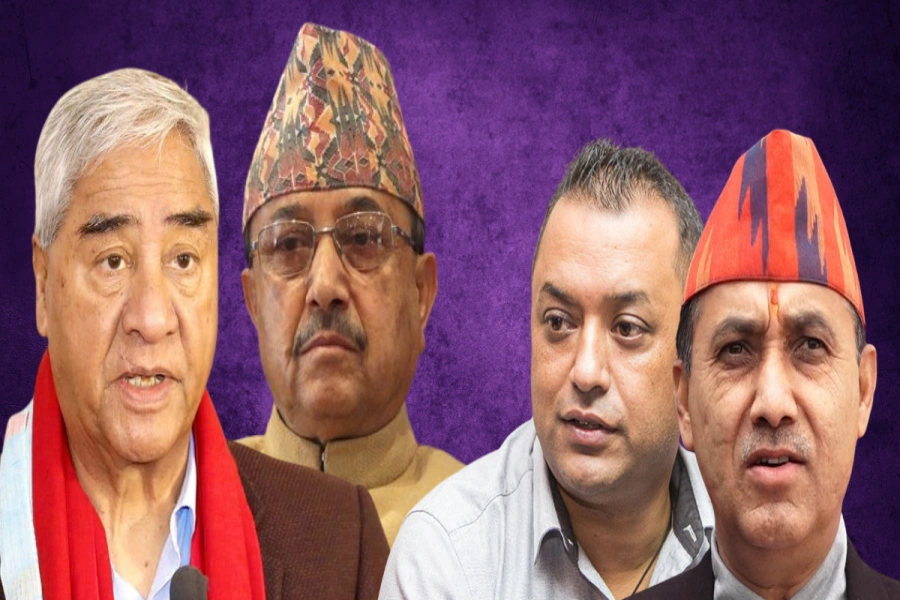
Thapa and Sharma demanded Deuba’s resignation, restrictions on his candidacy, and assurances that Thapa would be projected as prime minister after the next election. When these conditions were rejected, the split became inevitable.
The NC has thus fractured for the third time in its history. One executive committee remains under Deuba, while Thapa’s faction is forming a parallel leadership. With elections for the House of Representatives(HOR) approaching, the division threatens to create uncertainty over party legitimacy ahead of the polls scheduled for March 5 and opening a constitutional and political vacuum.
Historically, the party first split in 1952 due to disagreements between B.P. Koirala and Matrika Prasad Koirala over government formation. The second split came in 2002 amid disputes over extending the state of emergency during the Maoist insurgency, which led Deuba to form the Nepali Congress (Democratic). Both factions later reunified in 2007.
The NC was established on March 27, 1950, following the merger of the Nepali Praja Parishad Congress and the Nepali National Congress. Under its leadership, the party ended the 104-year Rana regime, spearheaded the 2006/07 People’s Movement that abolished the monarchy, and guided Nepal through major political, social, and economic transformations. Over decades, internal rifts, leadership struggles, and factionalism have repeatedly tested the party’s unity.
Following the 14th General Convention in 2021, Deuba was re-elected president while Thapa and Sharma assumed key general secretary positions. Hopes for party unity were raised, but unmet expectations and dissatisfaction, exacerbated by political upheaval on September 9, 2025, culminated in the current crisis—marking the NC’s third major split in nearly eight decades.





-1200x560-1783083574.webp)




