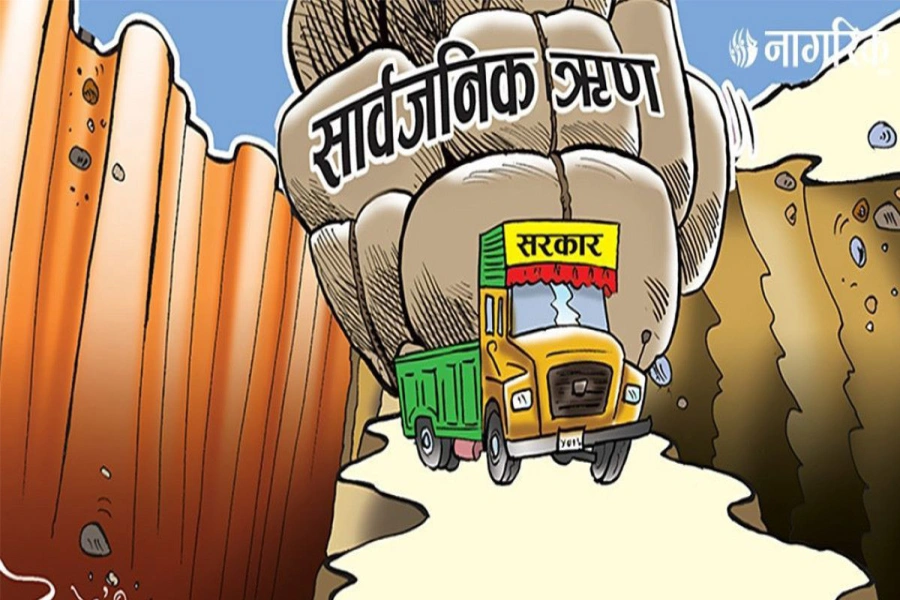
A report titled 'Nepal: Recent Fiscal Developments' unveiled by International Monetary Fund (IMF) on Friday shows that Nepal's public debt is on a downward trend since over the past decade while the median for 45 low income countries has seen a sharp increment since 2012. The reason behind this situation is low capital spending in the past three years despite revenue growth.
Commenting on the report, Gopi Nath Mainali, joint secretary of the National Planning Commission (NPC) said that the trend is not encouraging as assistance pledged by foreign donors is remaining unspent. "This shows that our economic activities are not dynamic. Despite this, the government's liability keeps on increasing every year," added Mainali. "Most of the resources of public debt are loans taken from development partners. Such debt remains unspent as they are tied to results of development projects which often misses deadline."
Mainali further added that government's direct taxation contract in such situation.
Revenue target for Fiscal Year 2015/16 is Rs 475 billion. Revenue is growing, but at a very slow rate compared to expansion in budget size. Government's internal borrowing was only Rs 42 billion against the targeted Rs 52 billion in the last fiscal year. In its mid-term review of the budget, the government has announced to collect Rs 88 billion as targeted in the budget announcement. But the fund is not for direct economic activities. It is to meet requirement of funds for distributing housing grants to quake-hi families.
Country's annual budget increased to Rs 819 billion in this fiscal year, including Rs 91 billion earmarked for reconstruction works, compared to Rs 618 billion of the past fiscal year. But capital spending over the first six months of 2015/16 shows less than 10 percent of the allocated Rs 208 billion has been spent.
The IMF report further says strong revenue growth combined with subdued capital spending has kept budget in a surplus situation in the past three years. Unspent Rs 52 billion from Fiscal Year 2013/14 was transferred to Fiscal Year 2014/ 2015. Similarly, unspent Rs 48 billion was transferred to fiscal budget of 2015/16. In the first six months of 2015/16, government budget on a cash basis remained on a surplus of Rs 28.93 billion. Such surplus was Rs 64.95 billion in the corresponding period of the previous fiscal year.
In the review period, capital expenditures dropped by 1.5 percent to Rs 13.63 billion as various important projects were stalled because of the earthquake. The projects were affected also because of Tarai unrest and Indian blockade which created shortage of fuel and construction materials, Nepal Rastra Bank said in its six-month microeconomic report unveiled last week. Capital expenditure in the review period stood at only 6.5 percent of annual budget estimate of Rs 208.88 billion.
Economists have termed the government's failure to cash in on low interest rates through internal burrowing as very unfortunate.
Related story
Public debt hits Rs 2.8 trillion mark



-1768720371.webp)