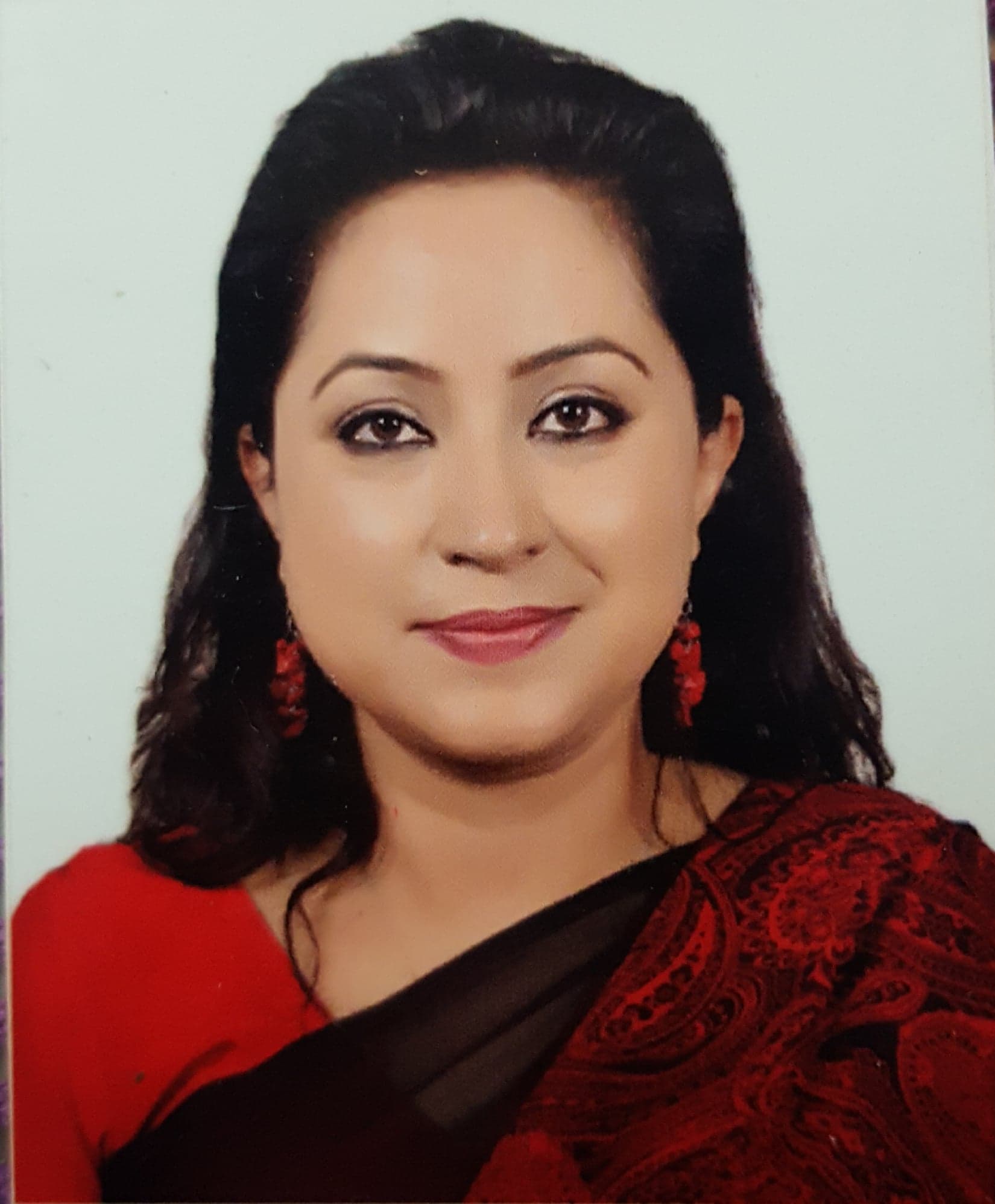
The owner and designer has her hands full and is loving every minute of it. A graduate of Fashion Design from South Delhi Polytechnic for Women, Dangol is a self-professed workaholic who’s willing to work very hard to go far.
Oodni is very popular these days. Did you foresee this popularity?
Not at all. I was just a regular young girl one day and now I have a big responsibility. I started Oodni two and a half years ago, and I was taking in any work I could take up. I was dedicated and my customers liked my work. [break]
Then a few people gave me some really heavy pieces to work on, and they loved my work after which they suggested that I should focus on bridal wear. Kathmandu doesn’t exactly have a bridal store where one has the option of choosing from a lot of heavy and elaborate designs. People have money but the stores don’t provide customers with a lot of options. So, here I’m now, with a good staff.
We bring the fabrics and all the raw materials from India. We dye the fabrics ourselves and also work on the embroidery and the pattern. We’re conscious of what’s in trend.
You studied fashion at college. Was designing always your ultimate goal?
I went to Delhi to be with my friends. I was never into clothes or designing, though sketching and colors have always fascinated me. My books would be covered in drawing during my schooldays. I actually wanted to be a photographer, like the ones from National Geographic.
What are the unique selling points of your boutique?
I consider the quality of work we present our customers to be the most special factor of Oodni. We don’t compromise on quality. If there’s something wrong with the product, we start again. The embroidery, fabric and patterns at Oodni are good. Stitching is very important. That’s what gives a product that perfect look. One can find a good design anywhere but if the stitching is poor, then the whole outfit will look bad. My staff are trained and experienced and I’m always supervising them to see that they do their jobs perfectly.
What do your customers love the most?
We sell a lot of bridal wear but Oodni’s blouses are quite popular. People are willing to pay anything from 15 to 18 thousand Rupees for an elaborate and heavy blouse which has beautiful cuts. It’s all handmade and very pretty.
What’s your personal favorite?
I like lehengas and I think they make a girl look like a princess. My specialty is wedding lehengas which have beautiful embroidery. A girl can wear sari on other occasions too but she should wear lehenga at her wedding. It’s easier than wearing a sari, too, and even bridesmaids can wear them. It’s picking up in Kathmandu now.
What are the things you look at when you design for a bride?
A bride comes with her own ideas of what she would like to wear. She’ll usually walk in with about a hundred different samples of something she would like. It usually takes two sittings for about two to three hours where I sit down with the bride and ask her for the details of what she has in mind, any mandatory color, and the jewelry she’ll be wearing. I note down her complexion and the colors according to the season. We work on all these details.
During bridal season, we don’t take normal orders. We work according to the season.
What’s your usual designing process like?
I make the main design and pass it on to my staff. If they have good suggestions to make, I incorporate them into the initial design. Customers can choose from either the main design or make a few changes to it.
In what ways has your work changed you?
I was just enjoying my free time when my mother got angry and ordered me not to waste my time. Also, studying in Delhi is quite tough and I didn’t want to waste those years. When that big transition from being a starting designer to being a popular choice for bridal wear happened, it was a difficult time. I had to deal with a lot of things and I felt buried in work. Now my partners look after the accounts and online services while I do the designs and manage the store. I’m very responsible now.
My work has taken me to a certain point and I never take it for granted. I’m a workaholic; I reach work till eight o’clock and return home. My employees don’t hesitate to work, seeing that I’m dedicated myself.
How important are fashion shows and what are some of the advantages of participating in these shows?
Fashion shows are important for a designer because it’s all about marketing and promoting your work in a large scale. I’ve participated in many fashion shows, like Fashion Parade, Trendsetters, and TGIF. It’s really hectic when I have to present at shows but it’s worth all that work. At one show, I had 15 outfits to present and I sold 12 of them after it was over. People get to know you and your work.
Any designer you look to for inspiration?
Sabyasachi Mukherjee, as his creations are ethnic and have that antique look.
Will you ever expand to western wear?
I believe I’ll stick to what I’m doing as this is what I’m good at. Also, there are already good designers like Tenzin Tseten Bhutia and Astik Sherchan who focus on western wears.
I will perhaps expand to designing wedding outfits for men. However, that’s still far off as I don’t think I have enough skills required for that yet.
Something you’re looking to do in the future?
I’m looking forward to expanding with branches in the UK and Hong Kong. Many of my clients are from abroad, mostly from London, Belgium, Hong Kong and a few from America. Due to the lack of variety there, they order from me.
My ultimate dream is to organize a fashion show of my own.
Related story
Desperate search for missing girls as nearly 80 dead in Texas f...