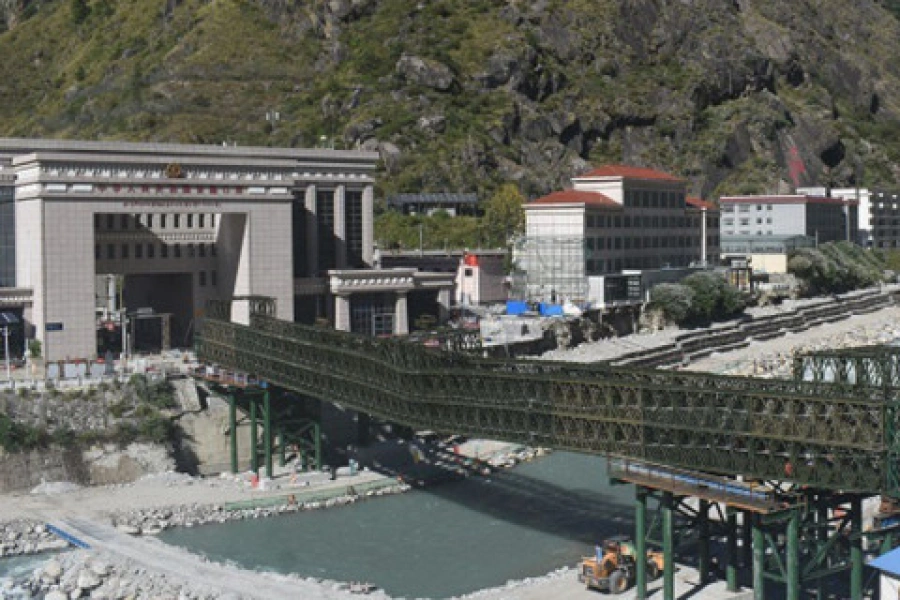
In the past, whenever Nepal reached out to China, the Indian establishment tried to discipline Kathmandu for using the 'China card'. There were many reasons behind the recent four-month-long blockade of Nepal. One was the perception in New Delhi that Kathmandu was getting uncomfortably cozy with Beijing. Without China's tacit backing, the Indians felt, the major political actors in Nepal would not have dared bring a constitution against its wishes—and hence the blockade. We hope that from now on the question of China card—which is understood as Nepal trying to be close to China whenever India resorts to coercive tactics like embargos—becomes redundant. For we would like to believe that after the historic trade and transit treaties inked between Nepal and China on Monday, Nepal will in the future use actually Chinese territories to trade, however little, with third countries. This would mean that the proverbial 'China card' is now a 'Chinese reality' in Nepal.We believe using China for transit will ultimately be in the interest of all three countries: Nepal, China as well as India. This is because India will now get to see that the Chinese have no greater designs on Nepal besides ensuring that Nepali territories are not used for anti-China activities. Less dependence on India will also make Kathmandu more comfortable in its dealings with New Delhi. Up until now people here felt they had no alternative to putting up with the temper tantrums of the Indian establishment: either the vital necessities had to be imported via India, or not at all. So the new trade and transit treaties with China come as a big boost to the Nepali psyche. We thus hope Nepal will waste no time in clearing the legal and logistics hurdles for third-country trade via China. There should also be no delay in securing the promised Chinese help for important projects like extension of the Chinese railway (that is scheduled to come up to Keyrung by 2020) to Kathmandu, Pokhara and Lumbini. The upgrading of the main roads to Tibet should also now take place on a war-footing.
That is what we hope. But our biggest fear is that no sooner does Prime Minister KP Sharma Oli comes back to Nepal, the recent agreements with China will be conveniently forgotten and the political establishment in Kathmandu will once again start sliding towards India. This would be most unfortunate, for in that case we would not have learned anything from history. That said we are also mindful that Nepal-China relations cannot improve at the cost of Nepal-India relations. Our geopolitical location is such that we cannot afford to have bad relations with India. This is why we find the suggestion of President Xi Jinping that Nepal explore trilateral cooperation with both India and China meaningful. We could not agree more. With India-China bilateral trade approaching US $100 billion a year, there is no reason the two countries cannot conduct a part of their trade via Nepal. Such a modality can be a win-win for all three sides. So, do Monday's agreements amount to a game-changer for Nepal or just another instance of the playing of the self-defeating China card? It is up to our major political parties to decide. The onus is now on them to prove that they are mindful of the country's long-term interests.
Related story
'Social Welfare Act' to be amended as an umbrella act