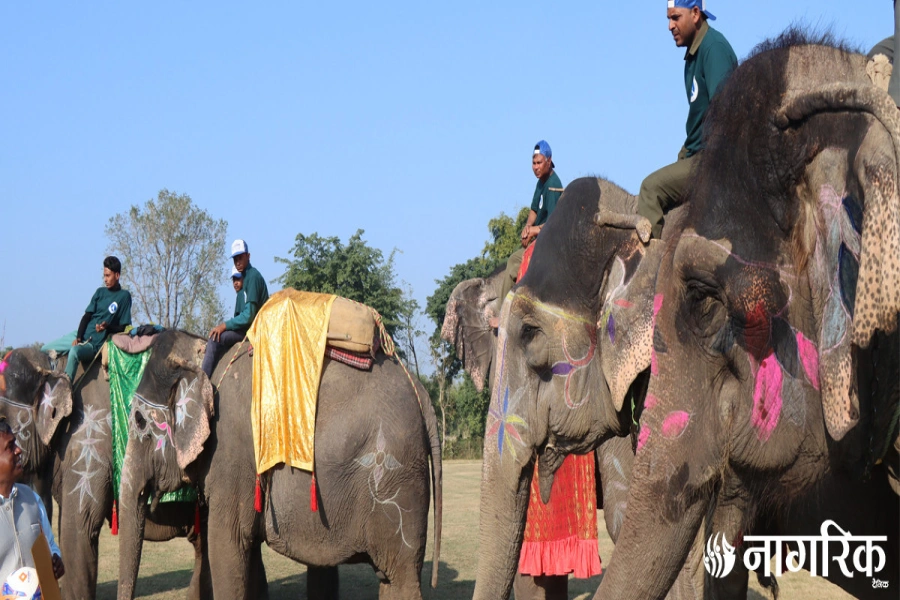
KATHMANDU, Dec 27: Tourism entrepreneurs in Nepal’s prime wildlife destination, Sauraha, have launched a three-day-long Elephant and Tourism Festival, featuring more than 50 captive elephants in events including games such as football penalty shootouts, rallies, and beauty pageants.
Organizers say the festival, now in its 19th edition, is vital for reviving tourism and local livelihoods. However, animal rights activists argue it reflects the persistence of outdated and unethical practices that prioritize entertainment over animal welfare.
The festival coordinator and tourism entrepreneur Gunaraj Thapaliya argues that the festival is a major attraction aimed at boosting visitor numbers in Chitwan.
“These events are organized to promote tourism and are completely free for the public,” Thapaliya said, adding that elephants are cared for by veterinarians and handled under existing laws. He rejected allegations of cruelty, calling them “foreign-influenced narratives” intended to damage Chitwan’s tourism image.
“We love our elephants more than anyone else. We have paid millions to raise and maintain them, and any misuse would harm our own livelihoods,” he said.
Twist of fate: Wild elephant invades Elephant Festival

Animal rights activist Shristi Singh Shrestha, however, strongly criticizes the festival, calling captive elephant tourism an “outdated and inhumane system.” She argues that such practices normalize the use and mistreatment of animals in the name of culture and tourism.
“From birth to death, captive elephants are subjected to harsh training regimes. What is presented as entertainment masks a deeper reality of suffering,” she said.
Even if generations of elephants are born in sheds, almost all newborn calves must go through a harsh process of isolation, intimidation, and physical force known as ‘phajaan’. The word phajaan originates from Thailand and is widely used across the Indian subcontinent, including Nepal, and means to “break the spirit.”
“Scars behind the ears of elephants from sharp hooks, fear-based training, and chaining are not conservation. Football games and beauty pageants are a circus, not culture,” she said.
There are around 150 captive elephants in Nepal, along with others managed by government agencies. However, only 67 are registered with the government as required by existing laws. Around 50 government-owned captive elephants are kept at Hattisar (elephant sheds), mainly in Chitwan National Park and Bardiya National Park.
The government uses these elephants for various purposes, including wildlife safaris, tiger and rhino censuses, and occasionally disaster rescue operations. Activists argue that even this practice should be phased out, as modern technology and artificial intelligence can be used for wildlife monitoring, disaster response, and rhino censuses.
They argue that the ideal way to manage these elephants is through sanctuary-based models, where elephants live in near-natural habitats with minimal human control, supported jointly by the state and private owners. “These animals can still help generate income through sanctuaries, where visitors can see them without disturbing them,” Shristi said.
According to animal rights activists, many captive elephants were brought into Nepal from neighboring India until a few years ago, with a surge during the Covid-19 period, when security was weak along the porous Nepal–India border. Others are offspring whose ancestors were captured in historic times.
Festival coordinator Thapaliya countered that human–elephant relations are deeply rooted in Nepal’s history, from royal hunts to modern tourism, and said activists unfairly compare Nepal with practices abroad. “If enjoying animal rides is wrong, why do such events still exist elsewhere?” he asked.
Ahead of the festival, animal rights groups had formally appealed for its reconsideration. A total of 27 animal rights organizations signed a petition calling for an end to the festival, arguing that training elephants for rallies, sports competitions, and decorative displays is inherently unnatural and stressful, causing long-term physical and psychological harm. The groups urged authorities and tourism stakeholders to prioritize conservation and natural behavior over entertainment, calling for a shift toward ethical, elephant-friendly tourism.
Rights groups were able to halt elephant gaming events for four years, until their resumption in 2024.
Animal welfare advocates stress that elephants are deeply social beings who live in matriarchal family groups, travel long distances daily, and form strong emotional bonds. In captivity, they argue, these social structures are broken early through coercive training, leaving lasting emotional and behavioral scars.