

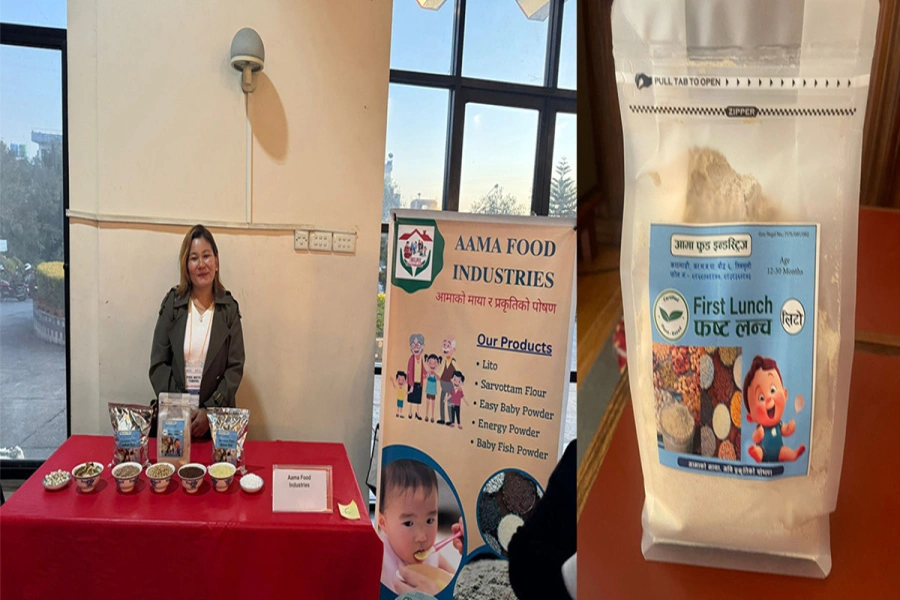
KATHMANDU, Dec 28: Phoolmaya returned to Nepal from South Korea without significant savings, but with values that would later shape her career—discipline, integrity and a strong work ethic.
She went to South Korea in 2012 for foreign employment and returned five years later. After coming home, she became a mother to a son and a daughter, devoting nearly eight years to childcare and household responsibilities.
Her entry into entrepreneurship began with a personal challenge. When her children turned six months old and needed complementary food, Phoolmaya relied on packaged infant food available in the market. “Making lito, a nutritious infant food, at home is time-consuming, so I started buying it,” said Phoolmaya, who hails from Solukhumbu.
However, she soon noticed adverse reactions in her child, including vomiting and indigestion. Conversations with other mothers revealed similar experiences, convincing her that the problem was widespread.
Regional Consultation Meeting on “Promoting Nutrition Sensitive...

Concerned about food safety, she decided to produce nutritious and hygienic children’s food herself. “There can be no compromise when it comes to a child’s food,” she said.
Driven by that belief, Phoolmaya began producing lito in Kathmandu after studying nutrition and consulting mothers. She said her products follow standards set by the Department of Food Technology and Quality Control (DoFTQC) and national child nutrition guidelines.
She emphasized that balanced nutrition depends on the right proportion of calories, protein, carbohydrates, fats, minerals and vitamins—not price. She established a dedicated production facility designed to maintain hygiene, using UBI plastic structures to protect ingredients from sunlight, pollution and contamination. Pulses are dried, processed and stored under controlled conditions.
Phoolmaya said cleanliness was her top priority from the start. “Everything—from ingredients to processing—follows official standards,” she said.
While the enterprise is still small, she is currently focused on packaging, branding and quality testing. Limited market access and weak marketing networks remain challenges, but she said patience and consistency have helped her continue.
Her business has expanded beyond children’s food. She has started producing sattu for elderly consumers and plans to introduce baby fish powder, rich in protein, calcium and essential minerals.
She plans to launch the baby fish powder next year and is also preparing to introduce a Cerelac-like product that can be consumed simply by adding hot water.
The enterprise currently employs eight people, including Phoolmaya, covering production, quality control and marketing.
She acknowledged that balancing domestic responsibilities and entrepreneurship remains difficult, noting that household duties consume much of women’s time. “Creating something within that limited time is a major challenge,” she said.
Phoolmaya’s journey reflects how returnee migrant workers, particularly women, can create opportunities at home. What began with low-paid work abroad has evolved into a small but growing food enterprise focused on safe and nutritious products for children and the elderly alike.



_20220130160610.jpg)












-1200x560-1779450784.webp)