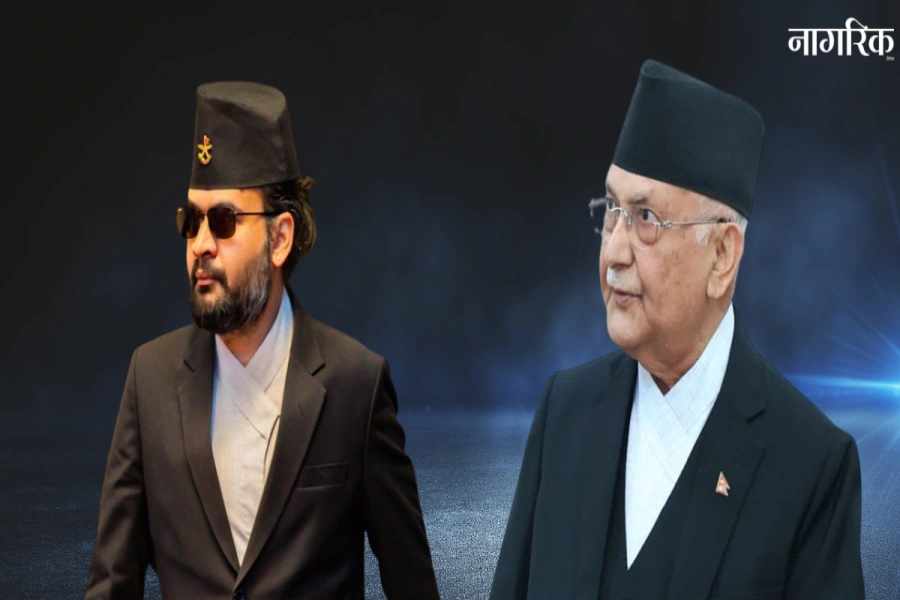
The purpose of KP Sharma Oli's recent India visit was clear enough. He wanted to remind the suspicious Indians that his old fealty for India was uncorrupted. The 38th prime minister of Nepal is well aware that no government head in Nepal, if he wants to stay in office for any length of time, can afford to alienate India for long. Though Oli struck a defiantly nationalist tone prior to his India trip—for instance insisting that he would not go if the four-month-old blockade was not lifted first—the truth is that he was lucky: New Delhi, after badly botching the constitutional endgame in Nepal, was desperately looking for a safe-landing.The twin amendments of the new constitution on January 23rd provided the perfect pretext for the Indian establishment to lift the embargo, the rationale for which was being increasingly questioned even within India. Then there was China. One of the main reasons for the blockade was that the Indian establishment felt Kathmandu was getting uncomfortably cozy with Beijing. Without China's backing, Modi and co felt, the political class in Kathmandu would not have dared to bring a constitution without first consulting India.
Since Nepal near completely relies on India for daily necessities, the thinking (particularly in the defense establishment) in New Delhi was that blocking vital supply lines to Nepal would bring Kathmandu to its knees—within weeks, or a couple of months at the most. But this strategy backfired, as substantiated in our recent interview with Rajendra Mahato, the chairman of Sadbhawana Party, one of the constituent parties of Madheshi Morcha that had been holding border-centered protests. According to Mahato, the harsh blockade, instead of making people question the Kathmandu-based national leaders for their supposed failure to address Madheshi demands, paradoxically made them more and more suspicious about the real intent of Morcha.
Also, instead of plucking Kathmandu out of the embrace of Beijing, as intended, the warmth between Kathmandu and Beijing seemed to be growing post-blockade. An agreement was signed for the import of a third of Nepal's fuel from China, breaking India's monopoly; all nine road-links with Tibet are now being upgraded; and after the recent depredations of the big brother due south, there is now a well of public support in favor of greater engagement with the northern neighbor.
Remember China
In this backdrop, the Nepali prime minister embarks on his maiden China visit later this month. What can we expect? A long-term oil deal in line with the memorandum of understanding between Nepali Oil Corporation and PetroChina is a near certainty. During the visit Nepal will also explore new transit routes through Tibet in order to trade with third countries, again to break the Indian monopoly. But there are unlikely to be many more goodies for Nepal. The Tatopani road, blocked since the earthquakes, won't be opened due to Chinese sensitivities regarding its misuse by Free Tibet activists. There could also be a few more token trade agreements. But it is also hard to see China conceding more than that.
This is because Nepal is still a part of an overarching Chinese policy in South Asia; it doesn't have a unique Nepal policy as such. Moreover, China still hesitates to openly challenge India in the region and needlessly complicate its ties with a mammoth country with which it enjoys a hefty trade surplus.
If only the Chinese foreign policy were so straightforward! Wherever India falters in the SAARC region, China looks to quickly wrest the initiative, be it in Sri Lanka or the Maldives or even Bhutan, India's closest ally in the region. This suggests that while China will hesitate to directly challenge India in the neighborhood, it will not let a good crisis go to waste anywhere. This is why the Chinese have been courting the likes of KP Sharma Oli and Pushpa Kamal Dahal, their communist cousins in Nepal.
So while I agree with Rajan Bhattarai, prime minister Oli's close confidante on foreign policy, that it is Nepal which needs China, and not the other way around, the artificial-island-building Chinese are far too cunning to let a great opportunity to spread its influence in a strategically important country like Nepal pass easily.
Forget China
For Nepal, what the Indians or the Chinese want here should be less of a concern than how the country can best benefit from its challenging but also advantageous geostrategic location. It's in Nepal's interest to diversify its trade away from India and deal more with China and the rest of the world. I think prime minister Oli and his foreign minister, Kamal Thapa—who is currently on his fourth India visit after assuming office—are right in trying to take India into confidence over China. Nepal must make every effort to convince New Delhi that diversifying Nepal's trade is a normal course of action in this globalizing world and it is not in any way inimical to Indian interests.
Likewise, while in China, Messrs Oli and Thapa should make the Chinese feel that Nepal is genuinely interested in substantive long-term agreements and the current overtures to the Middle Kingdom do not amount to another use of the self-defeating 'China card.' The Chinese have come to believe, not without reasons, that Nepalis court them only when they are pushed away by India.
On India's part, it should stop being so paranoid about the Chinese in Nepal. The extensive ties between the two sets of peoples in Nepal and India can never be matched, however close Kathmandu gets to Beijing. Its geostrategic goals notwithstanding, if China tries too hard in Nepal, there will be a backlash, something India is finding out the hard way after the blockade.
Beijing likes dealing with strong state actors. For the longest time the monarchy was its most reliable partner in Nepal. After the abolition of monarchy, China has been groping for reliable partners in Nepal. This is also the reason it has in recent times chosen to overlook its strategic competition and to place more faith on India to do the right thing in Nepal.
Geostrategic rivalries are seldom straightforward. Nor is this one. But the Chinese have been consistently telling Nepali leaders, including the likes of Dahal and Oli, that in the long run Nepal has no option but to improve its relations with India. Could they be any clearer?
@biswasktm
Related story
What Nepal can learn from China