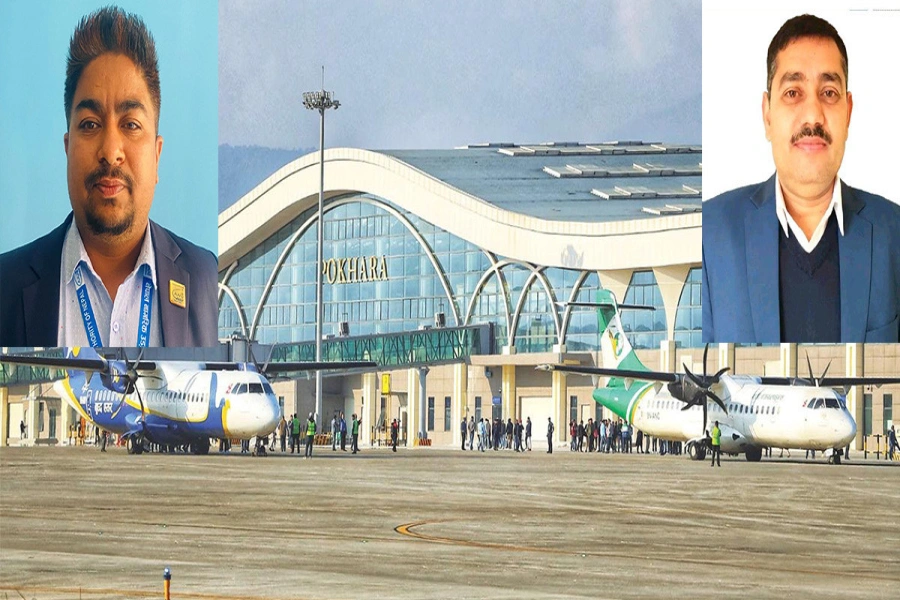
KATHMANDU, Dec 21: The government has failed to repay the principal and interest installments of the loan taken to construct Pokhara Regional International Airport (PRIA). Although the airport was built with the intention of repaying the debt through revenue generated from regular international flights, the absence of such flights has left the Civil Aviation Authority of Nepal (CAAN) unable to service the loan.
CAAN was required to pay an annual installment of 106.56 million Chinese yuan (approximately Rs 2.17 billion at the current exchange rate) in two installments through the Ministry of Finance. However, it has been unable to even pay the interest. In 2015, CAAN signed an agreement to borrow 1.33774 billion Chinese yuan from China’s Exim Bank, under a government guarantee—equivalent to approximately Rs 22.5 billion at the then prevailing exchange rate. At the current rate, the loan amounts to around Rs 28.25 billion.
According to CAAN, despite the completion and operation of Pokhara International Airport, the lack of international flights has made it impossible to repay the loan from airport revenue. Allegations of corruption have further complicated the situation. A case has been filed against five former ministers and 55 individuals, including CAAN Director General Pradeep Adhikari, claiming Rs 8.26 billion in damages related to corruption in the airport’s construction. As a result, the project now faces a dual crisis: corruption allegations on one hand and the inability to generate international flights on the other.
CAAN spokesperson Gyanendra Bhul confirmed that the authority has been unable to pay the loan installments. “There is no situation where we can earn and repay the installments,” Bhul said. “At present, the installment payments have been halted.”
CAAN begins repaying loan for Pokhara Airport, pays first insta...

Pokhara Airport Chief Jagannath Niraula said the airport currently generates only around Rs 350 million annually. “The annual operating cost is about Rs 210 million,” he said. “It is difficult to repay the loan from this income.”
At present, PRIA operates only one regular international flight per week, Niraula added. Most of the airport’s income comes from domestic flights. Himalayan Airlines operates a weekly flight to Lhasa, China.
Although the loan agreement was signed in 2015, construction was completed, and the airport became operational in January 2023. Loan repayment began on March 15, 2023, with a deadline to complete repayment by October 16, 2035.
Based on the current exchange rate, around Rs 2.17 billion must be paid annually for the next ten years. The repayment burden has increased due to the appreciation of the dollar and the yuan. China’s loans have also drawn criticism for being expensive, with the interest rate now reaching 5 percent.
As public debt continues to rise, the government’s inability to repay the Chinese loan taken for Pokhara Regional International Airport has added to fiscal challenges. The government has requested China to convert the loan into a grant, but no response has been received so far.
Senior officials at the Ministry of Finance say that corruption allegations have created a moral dilemma. “There is an allegation that corruption occurred in a project built with loans,” one official said. “This has created an additional ethical crisis when requesting that the loan be converted into a grant.”
Nevertheless, a formal proposal requesting loan conversion has already been sent to the Chinese government. China has maintained that the Pokhara Airport loan falls under the Belt and Road Initiative (BRI).
Compared to loans from other development partners, China’s BRI loans have been widely criticized for carrying higher interest rates. This loan is significantly more expensive than financing provided by institutions such as the Asian Development Bank and the World Bank.


-1781882999.webp)