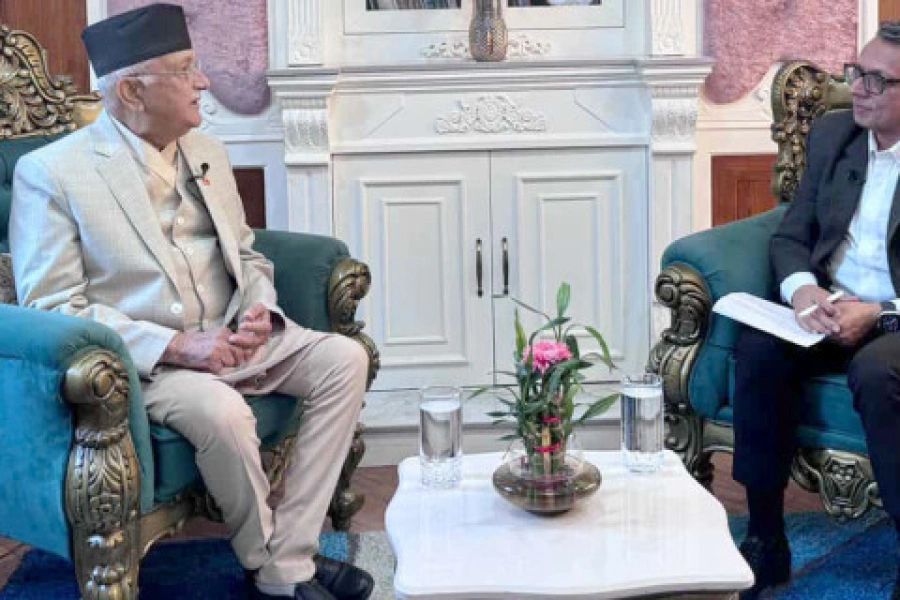
CPN-UML Chair and former Prime Minister KP Sharma Oli has in recent days been advocating for the reinstatement of the dissolved House of Representatives (HoR). After resigning on September 9, a day after the Gen Z movement and the vandalism, arson and destruction that took place under its cover, Oli spoke with Editor-in-Chief Guna Raj Luitel for over an hour and a half for Nagarik Frontline—a weekly show hosted by Nepal Republic Media Limited, on Wednesday at his residence in Gundu, Bhaktapur. Excerpt:
Until September 8, you were the country’s chief executive. It has now been nearly three months since you left Baluwatar for Gundu after the Gen Z uprising. Looking back, how do you recall those events?
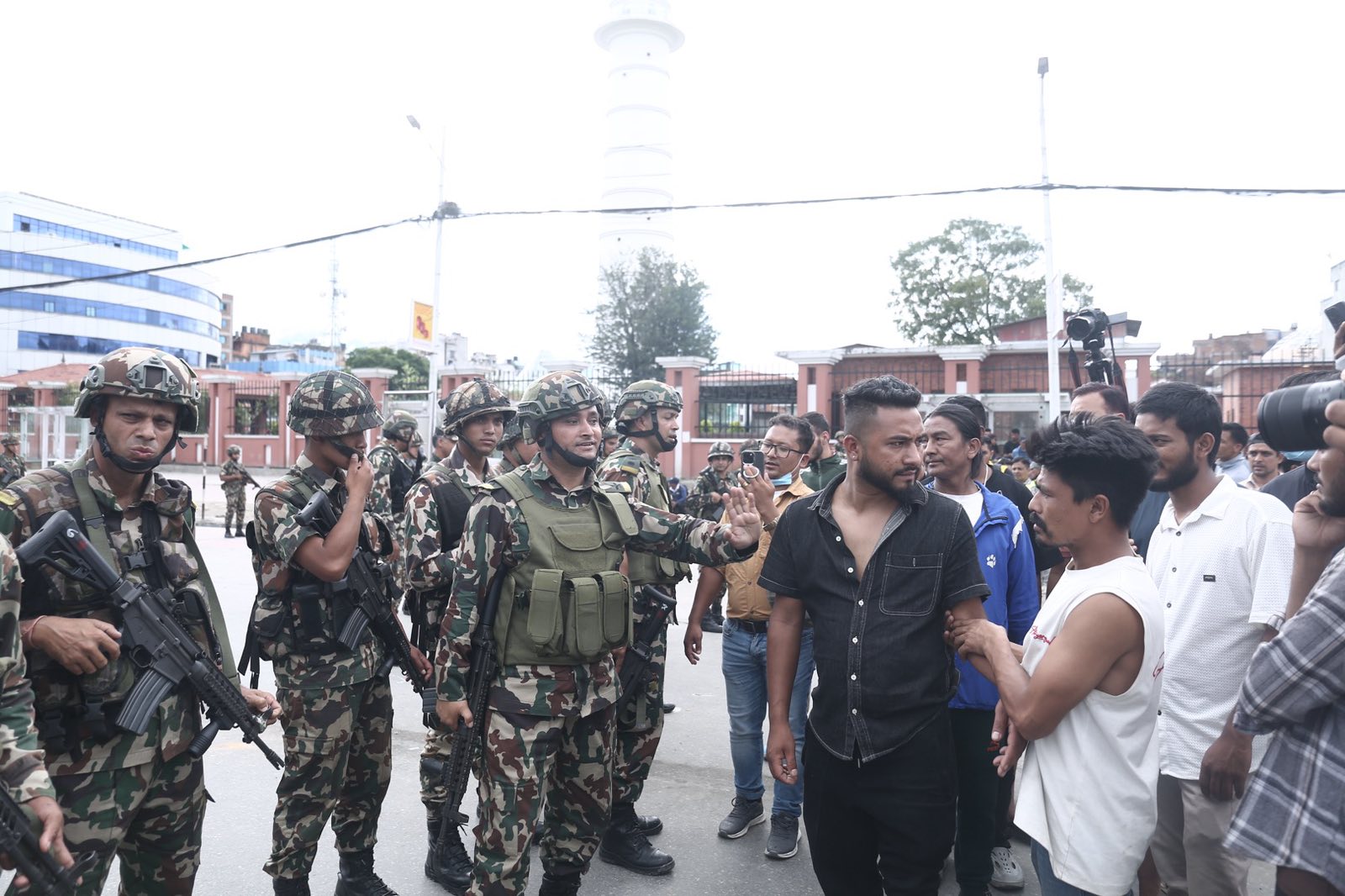
That should never have happened. The protest on September 8 was held with clear demands, slogans, prior notices and commitments. It marched from Maitighar Mandala to the Everest Hotel. It was described as a youth-led movement and up to that point it indeed remained a movement of young people. After that, as they themselves admitted, their demands were hijacked, the movement was hijacked, and certain infiltrators—one might even call them “alien elements”—took it over.
The situation then changed entirely. The stated demands and slogans disappeared, replaced by sheer disorder. You do not need violence to demand action against corruption. You do not need to burn down the Parliament building. Nor do you need to attempt breaking into it to burn it. Was there a water tap inside they needed to reach? Were they trying to get tea because they were hungry? Did they cut the iron bars for that? All this indicates careful preparation beforehand. It shows an intent to create an unpleasant situation and escalate it into even greater unrest.
Could the shooting have been prevented in any way?
Had there not been an extreme attempt to commit arson at the International Convention Centre—the Parliament building—the situation that required the use of firearms would never have arisen. The organizers had already announced: “Our protest is over. We have succeeded. Now there is infiltration. Our movement ends here. Let’s disperse quickly.” They made this announcement on loudspeakers and left.
What followed was terrifying. Those leading the movement went into hiding for seven days. They faced threats. The leaders were intimidated, terrified, driven underground, and then the violence erupted. Who were those elements? I don’t want to go into that. Security arrangements exist to protect structures. When security personnel face an attack they cannot contain, will they not respond? Will they not defend?
Shouldn’t there be an order for that?
Such orders are issued in advance. I’m not a security expert, nor have I ever served in the security forces.
But you oversaw everything as prime minister.
I wasn’t even promoted to the rank of a corporal. I wasn’t the Kathmandu Valley commander, nor the chief of Kathmandu. The Chief District Officer, from whom orders are said to come, does not issue orders on the spot; instructions are often pre-written. And I wasn’t on the security committee either. The prime minister does not sit on the security committee; the prime minister only receives reports.
But the prime minister leads the National Security Council.
Tiny Nevada town near secretive Area 51 braces for alien hunter...

Yes, but that relates to the army. The army is mobilized during war or similar emergencies. There are two types of mobilization: standby deployment and broader mobilization during natural disasters or major crises. If a curfew is imposed, it is the CDO who mobilizes the army, not the prime minister.
For national-level security deployment, the army can be mobilized, but that situation never arose. The Gen Z protesters’ demands did not justify deploying the army. The army is deployed for deterrence, not combat. The Armed Police Force may be used, but primarily it is the police. The prime minister is considered the head of all organs as the executive head.
But the constitution does not designate the prime minister as the supreme commander of the army; that role belongs to the president. The prime minister may recommend mobilization, but only with presidential approval. Therefore, no such permission was sought. There was no civil-war-like situation requiring army deployment.
Nepalese people do not engage in such destruction—burning others’ houses, mapping targets, preparing chemicals for arson. Various forces were undoubtedly active. I did not believe Nepalese youths were capable of those acts. I trusted too much.
Did the government not have this assessment beforehand?
It did not.
Can a prime minister claim credit for development works but deny responsibility when things go wrong?
During my tenure, we rebuilt the stadium, bridges, Dharahara, Rani Pokhari. If someone falls off a cliff in Jajarkot, I may not know. That’s reality. How can the prime minister know everything? Did calls for my resignation begin only after September 8? Were people shouting “Oli resign” only after that day? Did calls to kill KP Oli appear only after September 8? Those shouting “leave the country” were not new. If people truly cared about the youth who died, would they have allowed the circumstances that led to their deaths?
We are deeply saddened. This should never have happened. Our youths should not have died. The arson on national property, the burning of the headquarters of all three state organs, the destruction of industries, development works, and representative institutions—this is an attack on democracy. It is a rejection of development, good governance, and stability. Looting apples is not revolutionary. Stealing beer bottles is not revolutionary. Did Gen Z youths do all this? Certainly not. Criminal elements did.
Security officials had warned that incidents similar to Sri Lanka and Bangladesh could occur in Nepal. Was that part of the assessment?
Yes, that analysis existed. But Nepal has two unique factors: our social values and norms do not permit such acts; and grievances had not reached a scale to justify such violence. Had the situation been controlled from the beginning, all this could have been avoided. But I don’t know what happened.
It is said that security agencies even prepared for your possible airlifting.
Where did this “airlifting” story come from? I’m hearing it from you. Nobody discussed airlifting with me.
On September 7, our party’s statute convention was in Godavari. I called the home minister afterward. He said a security committee meeting was underway. I asked him to come to Baluwatar. I had been busy for three days, but I wanted a briefing. He told me the main Gen Z demands—they would march peacefully from Maitighar to the Everest Hotel. So we did not need major preparations. Still, I instructed: If they try to deviate, stop them early. I was told nothing of that sort would happen. Where does the helicopter story fit in? It did not exist. But yes, we were monitoring global trends.
We were also analyzing which forces might seek instability, who benefits from chaos, and what their interests might be. These discussions were normal. But no one ever said we would just let things burn. Yet arson, vandalism, and looting still occurred. The state machinery was paralyzed. There were lapses in security deployment. Why were things not controlled early? How did people enter the International Convention Centre? These are serious questions. A curfew could have been imposed that evening. The army could have been deployed.
It is said the security agencies were ready to deploy the army from 11 pm on the 8th. But no deployment was seen the next day.
There was a plan to deploy from 11 pm on the 8th. But earlier that day, no one expected such events. I asked the security chiefs—the home minister, chief secretary, an army general, and the heads of all three security agencies were present.
Now retaliatory actions are being discussed—restricting officials from leaving their homes or limiting their movements. This looks like revenge against those who tried to maintain order. Why is action being taken against the police? Why is there hostility toward security personnel? Does this mean Nepal doesn’t need the army, police, or intelligence? If structures cannot be protected even at the cost of human lives, then what is the army stationed across the country for? To guard against mice?
If violent mobs attack in an uncontrollable manner, should security personnel not fire? This is not just about this incident. Principles must be set for the future. Policies must be framed for various possible scenarios.
From the beginning of your tenure, there were protests at public events you attended. Do you think this environment was manufactured?
Yes, certainly. Some groups wanted to create such an atmosphere. Athletes liked me; fans liked me; sports institutions appreciated me because I supported sports. No athlete today celebrates destruction. I had great affection for athletes and artists. Fans chanted in my favour. Some groups could not tolerate this and ran campaigns against me—even at cultural events, even during Gai Jatra at Tundikhel. The then-Maoist Centre, out of jealousy, spent all its time attacking me with false accusations.
There were disturbances even when I was prime minister. Shots were fired. I don’t know who fired. I don’t know the individuals. Whether the police fired, or someone from outside, or some infiltrator—I do not know. No one has admitted to it. Perhaps the police fired; they were responsible for protecting the ICC. They are given loaded guns for that purpose.
Do you think the violence was intended to make it easier to remove you?
Yes, partly. But it is bigger than that. This concerns Nepal’s nationalism, existence, sovereignty, territorial integrity, independence, and dignity. These are being weakened. Efforts are underway to turn Nepal into a dependent, unstable, externally directed state. The attacks on democratic institutions show this. I am merely a symbolic figure in that larger design.
Are you referring to domestic forces or external ones?
I don’t know which “Bahadur.” But isn’t it clear which institutions were backing these elements? Even the Gen Z protesters said, “There are powerful institutions behind this.” A probe committee has been formed. That committee seems to believe KP Oli and Ramesh Lekhak must be held responsible, arrested, and jailed.
If the probe committee led by Gauri Bahadur Karki summons you, what will you do?
I have already expressed my views. Whether they summon me is their decision. But since he (Gauri Bahadur Karki) has already publicly declared who is guilty, I am under no obligation to consider his commission impartial. I am a free citizen. I have seen and heard their statements and biases. Such a commission should have been dissolved. Or they should deny having made such statements—which they cannot. Therefore, the commission should have resigned or been replaced. That did not happen.
If other members were appointed, would you accept them?
I had myself decided to form a commission under a former judge to investigate the events of the 8th. That decision was made the night before; the events of the 9th had not yet occurred. Of course a commission is necessary. But the conduct and prejudgment of this commission has made it unacceptable. UML will not accept it. We will not participate in a flawed process.
Has Nepal fallen into a geopolitical game? Is there a link between your meetings with Xi Jinping, Vladimir Putin and Narendra Modi and your removal?
I met Vladmir Putin, Xi Jinping, Narendra Modi and many other leaders. That is a matter of pride for a sovereign nation. Modi was preparing to visit Nepal; I was preparing to visit India. Putin was preparing to visit Nepal; I was preparing to visit Russia. We visit countries we believe serve our national interests. This is what sovereignty and independence mean. Nepal will remain a sovereign and independent country. We are proud of our nationalism and our history.