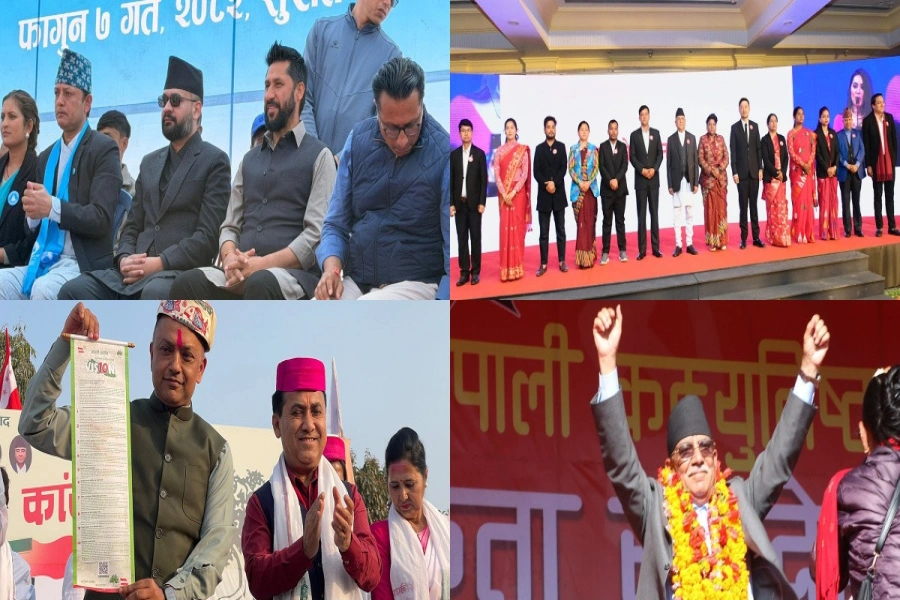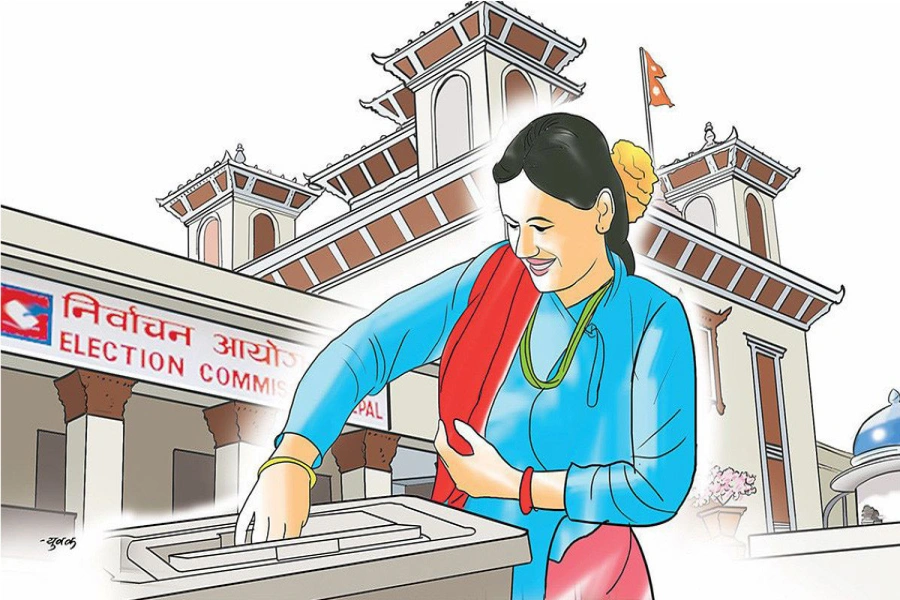
Nepal goes to polls today, with political parties facing the strongest test from voters. Several of about 19 million voters will cast their votes for a new House of Representatives (HoR), which is expected to elect a prime minister—hopefully a fresh, young face—who will lead a new government. This election is taking place following unrest, public anger, and uncertainty triggered by the Gen Z movement. Since then, the country has passed through a tense, testing period.
This is not just another routine election; it has posed a stronger test for political parties, leaders, and the system itself. Over the past 35 years, Nepal has held seven national elections. Each time, parties made big promises—they spoke about prosperity, jobs, development, and good governance. They asked for one more chance. But they failed miserably in delivering, as evident from the sluggish economy and lack of visible improvement in the lives and living standards of ordinary citizens.
We know that the current election has taken place under special circumstances. The Gen Z movement shook the political class and exposed the anger of the youth. It showed frustration with old leadership and traditional politics. It forced an early election. That alone tells us something is deeply wrong.
Major parties’ position
Unlike previous polls, this time there are no big political and electoral alliances. Major parties are largely contesting alone.
The Nepali Congress has fielded candidates in all 165 constituencies. It replaced long-time leader Sher Bahadur Deuba with Gagan Thapa as its prime ministerial face. Its message is simple: We changed leadership; we will change the country. But the oldest democratic party is facing a test from youth voters after electing a new face, Gagan Thapa, through its special convention. The party fears that some of its own leaders could play spoilsport for Thapa in becoming the next prime minister.
Province 2 polls a litmus test for Madhes parties

The CPN-UML has framed the election around the rule of law, order, and what it calls the protection of the nation from foreign forces that have interfered in the country’s affairs by backing certain parties and candidates. Party Chair KP Sharma Oli, the party’s prime ministerial candidate, has argued that the September unrest was destructive and harmful to public institutions. The party has stated that it stands for stability and development.
However, several voters have asked pertinent questions: Why did they fail to deliver during the past 35 years? They also asked, "Stability and development for whom?" Because despite their promises, young people are still leaving the country in record numbers, and the economy and development remain in tatters.
The position of the Nepali Communist Party (NCP) is no different. It has flip-flopped on the Gen Z movement, and its party coordinator and de facto chief, Prachanda, has called for unity among traditional parties to counter the RSP and its leaders, labelling the party as backed by foreign powers. Among the four key parties, the NCP is facing an uphill task in performing better. The Madhesh-centric parties too may not fare well due to fragmentation before this election and declining appeal among the masses in Madhesh, where the RSP and Nepali Congress have emerged as new forces.
Meanwhile, the Rastriya Swatantra Party (RSP) has tried to tap into lingering public anger. By declaring former Kathmandu mayor Balen Shah as its prime ministerial candidate, it has positioned itself as a fresh alternative to traditional parties that have so far ruled the country. During its nationwide election campaign, the party has spoken about retiring old leaders and giving the country a new direction. Many young voters, it appears, are listening.
Still, even parties like RSP and other new faces must answer hard questions—it is easier to make attractive slogans, but running a country is easier said than done. After the election, when the elected scramble to form a government, these questions remain pertinent: Can they build jobs? Can they reform education? Can they strengthen health care? Can they reduce corruption in daily government services? These are the issues that affect the real lives of common Nepalis.
No majority to any party?
Some parties also talk about leading coalition governments after the election by referring to constitutional provisions that make it difficult for parties to win a majority. Some speak about left unity, while others have kept their options open. This shows another long-standing problem in Nepali politics: leaders often focus more on forming governments than on delivering results. Power becomes the goal, while the idea of service to the people and the nation is pushed to the back seat.
As the day of reckoning arrives, the truth remains uncomfortable. For decades, political leaders have fought for positions, not performance or delivery. Due to their negligence, the nation has struggled with a weak production system, slow job creation, and heavy dependence on remittances, which are likely to be hit badly following the outbreak of war in the Middle East. A massive number of young people leave the country every year. They go to the Gulf, Malaysia, Korea, Australia, and the United States. About six million Nepalis live abroad for work or study, and many never return. They build lives elsewhere because they do not see a future here. This is the real report card of our politics, leaders, and parties.
This election is a litmus test because people are watching more closely than ever. This is the era of social media, where information spreads faster, making people more aware than before. Young voters have questioned narratives, while citizens will compare present promises with past records.
Expectations from new government
Although the Election Commission and security forces have declared foolproof security during election time, and poll outcomes will start coming within 24 hours of voting, elections are not only about smooth voting. They are also about what happens the day after.
The next government, whoever leads it, cannot afford business as usual. Besides focusing on addressing citizens’—especially the youth’s—demands, the new government needs to pay serious attention to the economy, corruption control, and delivery of people-oriented programs and policies. Leaders should understand this clearly. This is not 1990, 2008, or 2017. Public patience has thinned owing to the poor performance of parties and their leaders. The youth are more aware—they have seen other countries. They know what is possible.
Meanwhile, the choice before voters is serious. It is not only about personality or performance. It is about whether parties can finally move beyond speeches and start delivering measurable change.
If this election fails to produce results aligned with the aspirations of the people, the cost will be high. Trust in parties and leaders will further erode. This time, the ballot is not only for electing a government but also for judging 35 years of unfinished promises.