Before the election of Constituent Assembly, Nepali leaders’ objective was supposed to be an inclusive and decentralized model of governance achieved through correcting structural and historical discriminations. This process of restructuring socio-political contours of Nepal captured mass imagination and became an emotional subject. Although this initial euphoria seems to be withering now, the broader community is still optimistic about it. Right now, this historical task resembles a war where blaming and shaming each other in dramatic ways is the ultimate strategic choice. In such a contest, ideology is being bounced between two opposite poles (‘proletariat’ vis-à-vis ‘bourgeois’), and the word ‘ideology’ itself has become a lost expression.
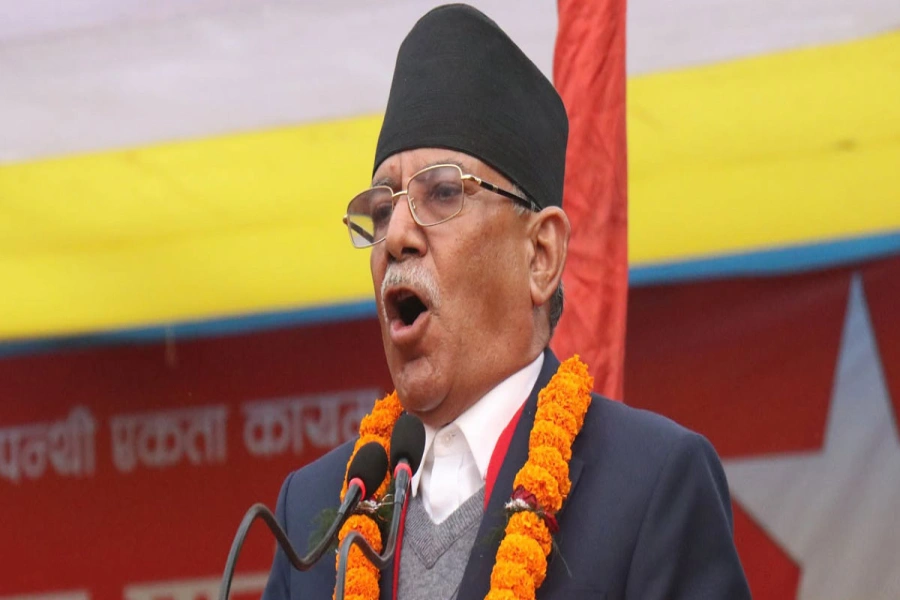
This chaos has created a mundane kind of normalcy in the day to day functioning of political leaders’ tussle for power. Meanwhile, registering protest or disagreement by physically intimidating and embarrassing political leaders (J N Khanal, S Koirala, PK Dahal) has also attained a mundane kind of normalcy. The fate of democracy seems to be left to mobocracy; there is a lack of trust across the political spectrum; and the ‘national consensus’ is as elusive as ever. In this context, do ideologies of political parties hinder constructive politics?

PHOTO: STATIC4.DEMOTIC.COM
Let us focus on the term ‘ideology’, and if it applies at all to the two biggest political forces – the ruling Unified Communist Party of Nepal (Maoist) and major opposition Nepali Congress (other political parties are believed to be modified versions of these two major streams). Anyone would be perplexed to find NC pitching themselves on the streets with anti-government establishments when the government has announced elections, which liberal democrats like NC should be hailing as a glorious event of democracy. What would happen if their protests ended up capsizing the government, with a constituent assembly nowhere in sight? If national consensus is the most preferred solution, then why is it attainable only when a particular political party leads the government and keeps the rest of the parties out of power?
Even if national consensus was achieved, how would all the parties negotiate cabinet positions? Since the constituent assembly’s stipulated time has already lapsed, how legitimate is it to form a government comprised of disqualified members of the assembly? Moreover, the support of civil society is being sought for anti-government movements. At this point, one could ask who is this civil society, and what is their credibility? There is reason enough to be skeptical, since civil societies are believed to be apolitical. Above all, the President seems to be pushing the boundaries of the constitution. How wise is it to have the democracy at the mercy of the President at a time when our democracy itself is struggling to institutionalize?
If we think extensively about these questions, it seems that NC’s longstanding ideology of advocating for liberal democracy is crumbling. If liberal democrats like NC start believing in state apparatuses instead of people’s power, then perhaps they themselves are undermining the institution of democracy. (Un)fortunately, it is now members of the ruling party UCPN(M) who are championing themselves as liberal democrats. Their obsession with Foreign Direct Investment and liberalization of policies itself is proof that the UCPN (M) is in the process of an image makeover. Where, then, does Ideology stand?
As Terry Eagleton argued, a single satisfactory definition of ideology has not been found yet. Post-modern theorists abandon the concept of ideology altogether, replacing it with ‘discourse’. Ideology is merely “a function of the relation of an utterance to its social context”. In case of Nepal, it is difficult, if not impossible, to locate the ideologies of political parties. This does not mean that NC and UCPN (M) are akin, but though their means, their ends are the same (to be in government). With NC going against liberal democracy by advocating on the streets while UCPN(M) staunchly defends the opposite, ipso facto it suggests that Nepal has reached an end of ideology. If not, then certainly the political parties are stretching their ideologies. Recent dialogues and discourses of politicians have made it clear that ‘ideology’ has been abandoned for good.
Perhaps, the locus of the problem is not ‘ideology’ but something else, i.e. ‘discourses’. These discourses are reminiscent of ‘Sisyphus’, an ancient Greek who offended the gods. His punishment was to roll a huge boulder to the top of a hill that would roll down as soon as it reached the top, forcing him to start over. This metaphor seems especially true for Madhesi leaders who built their political movement up from the plain regions of Nepal to the high hills of Kathmandu. Their hope for an epochal transition seems to fail every time it reaches near completion.
Currently, the political discourses seem to be too divided to be constructive. The discourses are mainly on two fronts. First, if the government of the day gives themselves a monopoly on power, then how can the people trust any leaders? Second, if the incumbent government wants to extend its tenure for the fear of election, then how can democracy be upheld? In both these discourses, it is best if our political leaders did away with zero-sum mentality (if one gains, other loses). Hitherto, whenever political parties have reached an elusive ‘consensus’, it has meant that they enter the government with better cabinet portfolios. This cannot be a win-win situation— too many chases too few positions. Today, if any consensus is required, it is for national election. Politicians should sincerely go to the people to get a new mandate through free and fair elections, as there is no alternative to election. The polity (or discourses) that are divided can be narrowed down only by the sovereign people of Nepal. Instead of a few political leaders monopolizing the wisdom for people, can we not ask our political leaders to abide by democratic norms and values?
The author is a research scholar at the Centre for Studies in Science Policy, Jawaharlal Nehru University
Related story
Ideology and Politics in Nepal