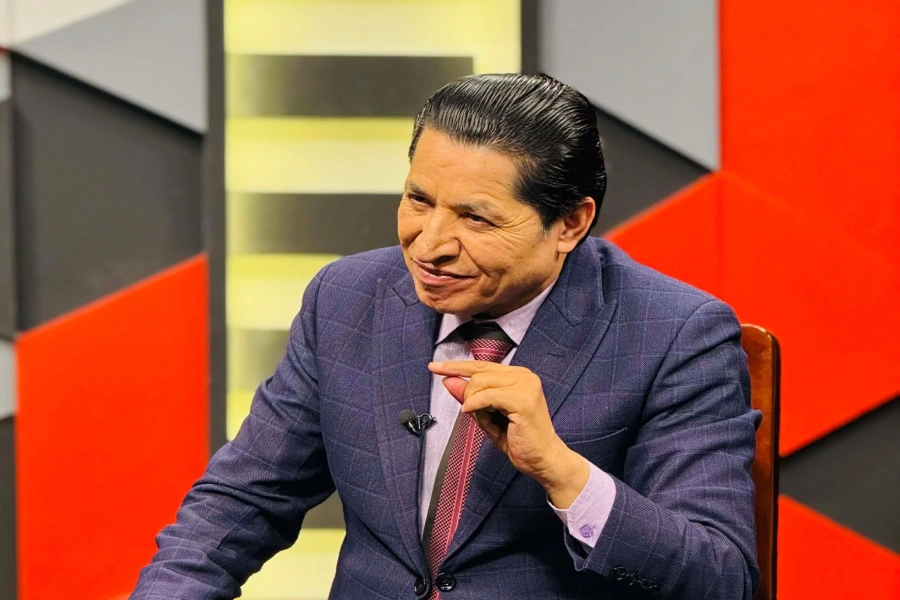
First of all, how do you evaluate the current state of Nepali economy?
If you look at the macroeconomic indicators, the economy looks more or less okay. The major concern is that the growth performance of industries, agriculture and even the service sector is sluggish. Moreover, the ratio of total consumption to GDP is steadily climbing, while the ratio of savings to GDP is declining. This hints at structural deficiencies. Take the case of Foreign Direct Investment (FDI). While the number of joint ventures has increased, the total amount of investment has declined significantly. In terms of inflation, last year the average inflation in consumer price index was 8.3 percent. If you take the average of the first two months of this fiscal year, inflation is above 12 percent. The foreign trade regime is not very satisfactory as well and the country’s trade deficit has been steadily rising. All these hint at structural problems in Nepali economy.
You said the economy looks okay. Do you imply the overall state of our economy is satisfactory despite some of the negative trends you point out?
I wouldn’t say it is satisfactory, because like I said, there are structural problems. If you take the country’s trade with China, for the first time in Nepal’s history the number of Chinese joint ventures in Nepal has overtaken the number of Indian joint ventures. But if you assess the data of last seven years, you find that the average annual trade deficit with China still exceeds 21 percent, whereas the corresponding figure for India is under 14 percent. This is the kind of structural problems I am talking about. We need to evaluate the long-term trade deficit trends with our two big neighbors for policy considerations. There is huge surplus in Nepal’s balance of payment regime, but what you should also consider is that in under a year the exchange rate fluctuation of the rupee with the US dollar was more than Rs 17 per dollar. The reason remittance earnings increased was because the Nepali currency depreciated vis-à-vis US dollar. Our current account and BOP surplus are not the result of injection of fresh capital or because of an increase in employment opportunities. Considering all these factors, I wouldn’t call our modest economic growth satisfactory.
The government is reportedly planning to bring a complete budget. What we would like to know is how the national budget impacts overall economy.
The annual budget is extremely important. But where Nepal has traditionally failed is that there is a tendency to link budget with political issues. Under so condition should people be deprived of their annual budget. The budget is extremely important to give confidence to domestic investors and to prove our credibility to prospective foreign investors. In Nepal’s case, the budgetary behavior of political parties is motivated by their partisan interests. The country cannot be run this way. There has to be inter-party consensus on annual budget. The Supreme Court has also clearly said that the government can bring a budget with political consensus. But now, there is no political consensus.
What kind of an impact does the failure to bring a full budget have on the economy?
It will have a major impact on our investment climate. So long as the government makes no investment, the private sector too will hesitate to invest. In that case, there will be no possibility of employment generation, or of increasing wages and aggregate demand in the economy. The economy will contract. Already, we are faced with a situation of skyrocketing regular expenditure and the government’s failure to spend earmarked budget on development projects. This situation could get worse. Thus I would recommend the political parties to establish consensus on complete budget. The only constitutional clause that could block the budget is if the President is not fully satisfied with cabinet recommendations, but the President has already clarified that he would not block any consensus proposal. Once again, I would like to request the political parties not to link budget with political issues. Look at India which comes up with an annual budget on February 18 every year, whosoever is in power. Similar inter-party consensus on budget is needed in Nepal.
A hypothetical and a slightly political question: What will happen if the President refuses to endorse the budget ordinance? How do the country’s finances operate under those circumstances?
In that case the country will be a failed state. Already we don’t have a constitution-making body, we are short of Supreme Court judges, the government is a caretaker one, every political party is interpreting the interim constitution as it likes. On top of that if there is no budget, the county will surely be labeled a failed state. And if that happens, our development partners would have major concerns in financing just about any kind of activity here. As it is, the state of FDI inflow is poor. Nepal’s GDP is three times that of Laos and five times that of Mongolia. But if you look at total foreign investment, Laos’ FDI inflow is five times and Mongolia’s seven times that of Nepal. Nepal is a country where 60 percent of development budget comes through development partners. Now if you don’t even have a budget, there is no question of any budgetary assistance from any of our international partners or the World Bank.
WEEKLY INTERVIEW

- Remittance increase is the result of Nepali currency’s depreciation against US dollar. The cause of current account and BOP surpluses is not injection of fresh capital or job growth.
- Nepal’s GDP is three times that of Laos and five times that of Mongolia. But Laos’ FDI inflow is five times and Mongolia’s seven times that of Nepal.
- On the basis of amounts spent under specific heads in last four months, the President’s Office can suggest some basic guidelines for the new budget.
- Given its failure to spend, the government might not even need Rs 150 billion for the next partial budget.
If there is no consensus on full budget or if the President has some reservation with the budget ordinance, even in that case some kind of a budget is a must. One of the approaches would be to obtain disaggregated data on both recurrent and development expenses in the last four months. On the basis of amounts spent under specific heads, the President’s Office can suggest some basic guidelines for the new budget. We are informed that capital expenditure in the last four months is extremely weak, in fact it is abysmal. If so, there might not be a case for a full budget. I personally think some kind of budget is inevitable, either through an ordinance (for the next four months) or through consensus (for the next eight months of the current fiscal year).
Since you have been closely studying the economic policies of the Maoist-led government, what kind of a budget are you expecting?
I believe that the Ministry of Finance has identified around two dozen priority areas, which includes assuring foreign investors of their investment. The issues that MoF has raised with us during our recent discussions would, in my view, be agreeable to most political parties. But the 201 new programs that were recently announced by the Prime Minister’s Office are different to my understanding of the programs being prepared by the finance ministry. On the nitty-gritty of the new budget, I have not privy to that information.
Now that some kind of election is imminent, is there a danger of the government introducing a populist budget?
First, we have to decide if we are going to authorize this government to bring a full-fledged budget, which means a budget for the remaining eight months of the current fiscal year. At this point, my recommendation would be to go for a conditional budget. Before endorsing the budget ordinance, the President can put forth certain conditions based on the disaggregated data on the expenditure on recurrent and development activities. You cannot do without paying the salaries to government employees. Such expenses are indispensible. But since there has been very limited expenditure in development activities, the government might not even need Rs 150 billion for the next partial budget. During that time, the political parties might arrive at consensus on a third round of budget. But before signing any budget ordinance, the President must make sure that the budget meets people’s basic needs like clean drinking water, basic health services and primary education. Second, he must make sure that the budget addresses the concerns of our development partners.
Related story
What is missing in budget for agriculture?