KATHMANDU, Jan 22: Long-standing organizational confusion and division within the Non-Resident Nepali Association (NRNA) South Korea has finally come to an end, following a successful unity initiative led by NRNA ICC President Mahesh Kumar Shrestha.
During his visit to South Korea, President Shrestha, who traveled from Japan with the sole objective of resolving the dispute, held a series of continuous dialogues with both factions. His efforts culminated with the signing of a “Comprehensive Unity Agreement” between the two parallel committees, aimed at uniting the Nepali community in South Korea under the guiding principle of “Nepalis for Nepalis.”
SC dismisses both committees of NRNA

Under the agreement, the executive committee led by Parvati Lama, elected through the 10th General Convention, and the committee led by Bipin Kumar Gurung, elected through the Broad Unity Convention, have mutually recognized each other’s legitimacy and agreed to move forward together.
NRNA South Korea stated that the unity process has been driven by a shared commitment to channel the knowledge, skills, and capital of Nepalis living in South Korea toward Nepal’s economic and social development. As per the agreement, both sides will jointly lead the organization, acknowledging each other’s leadership and existence, and work collectively to strengthen institutional unity.
To advance the unification process, an eight-member Steering Committee will be formed, comprising four representatives from each side, including the President, Senior Vice President, and General Secretary. It was also agreed that the Steering Committee meetings will be chaired alternately by the presidents of both factions. The committee will coordinate with the NRNA Central Facilitation Committee to draft procedures for completing the remaining phases of unity and addressing technical matters.
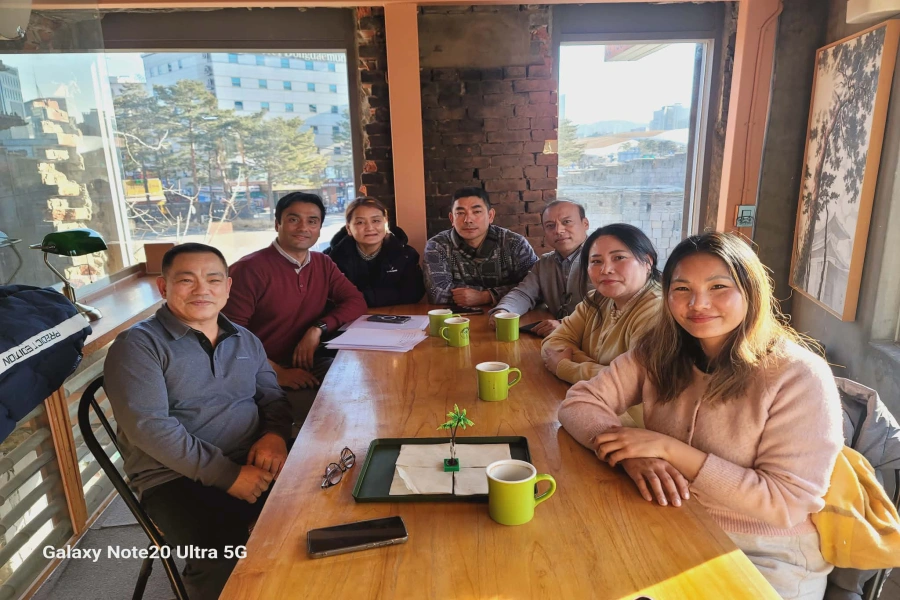
The unity agreement signing ceremony was attended by NRNA ICC President Mahesh Kumar Shrestha, Regional Vice President Junnu Gurung, Facilitation and Coordination Committee member Prakash Dhamala, and NRNA Korea patron Bhim Gurung.
With the unity achieved, stakeholders believe the path has now been cleared to transform the organization into a more philanthropic and creative force, dispelling uncertainty among non-resident Nepalis in South Korea.