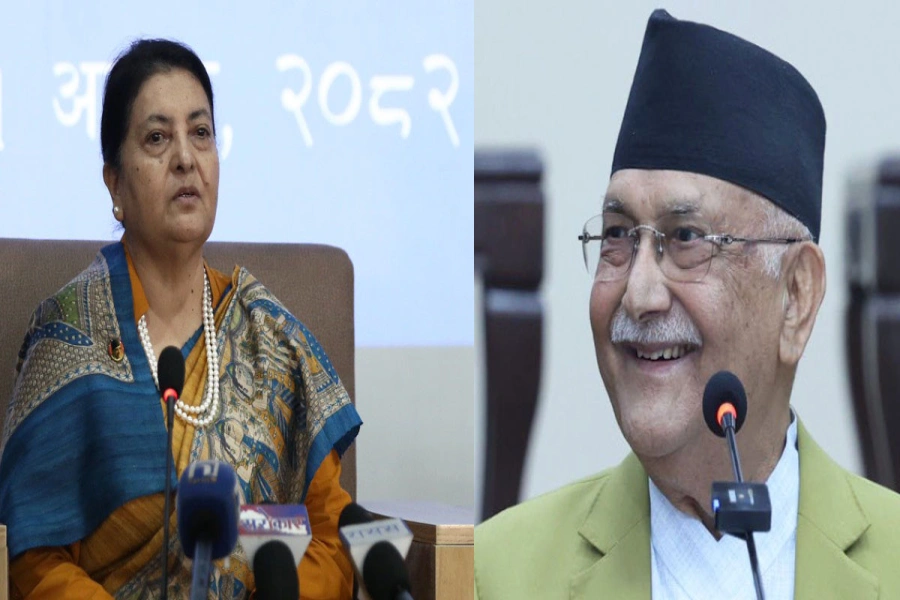
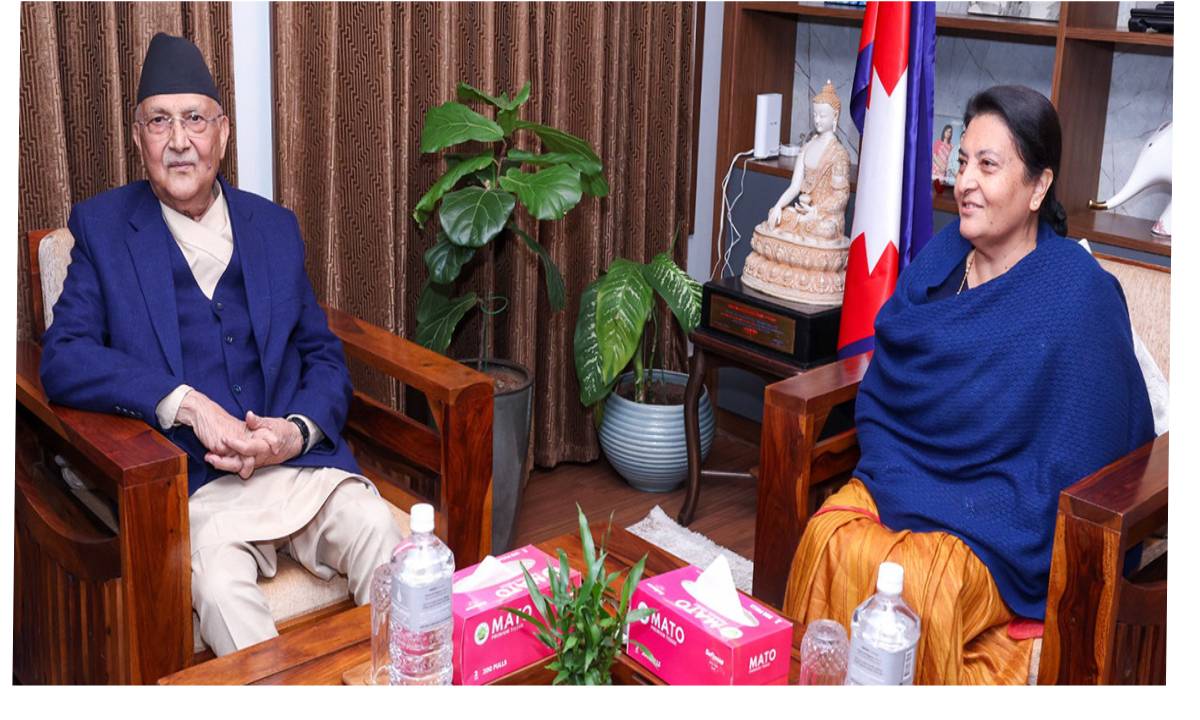
KATHMANDU, July 25: Amid speculation over her next move following the party's decision not to renew her membership, former President Bidhya Devi Bhandari has made it clear—party membership or not, she is not backing down from CPN-UML politics.
In a press conference in the capital on Friday, Bhandari reappeared not as Nepal’s former head of state, but in her previous avatar: “Former Vice Chairperson of CPN-UML.” The deliberate omission of her presidential title in the press conference was telling—she has stepped back into the political battlefield on her own terms.
After completing her two terms as president, Bhandari re-entered party politics, officially renewing her membership with UML– something UML leadership now denies. She publicly announced her return on June 28, 2025, coinciding with the 74th birth anniversary of her late husband and UML ideologue, Madan Bhandari. “I am now active again in my old party, CPN-UML,” she declared at the time.
But her return has not been welcomed by all. In a move that sparked internal controversy, UML’s Central Committee recently decided not to renew her membership. Yet, instead of retreating, Bhandari has doubled down—choosing defiance over silence.
At Friday’s press meet held under a banner featuring only Madan Bhandari’s portrait and noticeably lacking UML’s election symbol "sun", Bhandari stood alone. No supporters flanked her. Even at the party’s recent Central Committee meeting that decided her political fate, none were allowed to speak.
But despite her isolation, Bhandari’s words on Friday carried the weight of confrontation—and conviction. She dismissed UML’s decision as an emotional overreaction led by a few individuals. “A handful of people made the decision driven by mob mentality,” she said, without naming party Chairman KP Oli but leaving little doubt about her target.
“I have been a party member for 45 years. I have renewed my membership. A few people cannot annul it based on emotion and agitation,” she said. “The party has its own system. It is not proper for anyone to do whatever they want whenever they feel like it.”
Bhandari also indicated she is ready for a prolonged political struggle within UML, stressing, “I have returned to UML’s political life.” Despite the Central Committee barring her from party activities and removing her name from the official website, she declared, “I am still part of the UML family. Just because someone says so doesn’t mean my membership can be revoked.”
Bhandari was equally strategic in invoking her political roots. Throughout her remarks, she returned to the doctrine of People’s Multiparty Democracy (popularly known as Janatako Bahudaliya Janabad or JaBaJa in Nepali), championed by her late husband. “It is the deep faith, trust and dedication of UML leaders, cadres and general members toward JaBaJa that has led to the party’s current achievements,” she said, adding, “Under this ideology, developed in the soil of Nepal, UML can ensure long-term political stability and lay the foundation for socialism.”
Bhandari’s rhetoric was both nostalgic and aspirational. “Now is the time to strengthen the party ideologically and unify it organizationally,” she urged. “Only then will it be possible to implement Madan Bhandari’s vision and build a prosperous nation.”
In a subtle but pointed jab at Chairman Oli, Bhandari also reclaimed the slogan “Prosperous Nepal, Happy Nepali”—a phrase Oli has prominently used in his political campaigns. “This slogan was envisioned by Madan Bhandari under the JaBaJa framework,” she said, asserting that her late husband’s legacy was being co-opted.
While Bhandari stopped short of outlining her exact political plans, her message was unmistakable: she may have been sidelined by the UML leadership, but she is far from done. “This commitment and determination of mine is a voice from my inner conscience,” she stated. “I will not be shaken by this decision.”
Bhandari also warned that the leadership’s recent actions risk damaging the party’s credibility. “I am saddened by the immature decisions made in a way that restricts or controls my constitutional right and freedom to engage in politics,” she said. “Such decisions will ultimately harm the party’s reputation.”