Public debt has been steadily rising in recent years, with growing concern that every Nepali effectively bears a share of this burden. Faced with limited domestic resources for development and infrastructure, the government has increasingly relied on both internal and external borrowing. As this trend persists, questions are mounting over the long-term trajectory of the economy. According to the Public Debt Management Office, Nepal’s total public debt liability had exceeded Rs 2.878 trillion by mid-March in the current fiscal year—equivalent to around 47 percent of the country’s gross domestic product (GDP). The increase of more than Rs 200 billion in just eight months underscores the accelerating pace of borrowing. Based on the 2021 population census, the per capita debt burden now stands at approximately Rs 98,691—close to Rs 100,000 per person. Borrowing, in itself, is not unusual. Most countries use debt to finance development, expand infrastructure and stimulate economic activity, and Nepal is no exception. However, as debt levels rise, concerns over its effective utilisation are becoming increasingly pressing. A key driver of rising debt is weaker-than-expected revenue collection. When economic activity slows, tax revenues inevitably fall short. At the same time, mounting recurrent expenditure—including salaries, administrative costs, social security payments, subsidies and other routine obligations—has placed significant strain on public finances. This leaves the government with little choice but to borrow to fund development initiatives.
Large-scale investments in infrastructure—such as roads, energy, irrigation, education and health—are also largely financed through concessional foreign loans. While such borrowing can be essential, its benefits depend on whether funds are channelled into productive sectors. Misallocation risks compounding economic vulnerabilities. A critical concern is where the borrowed funds are going. Government data show that a substantial portion of new borrowing is being used not for fresh development projects but to service existing debt. In the current fiscal year alone, more than Rs 400 billion has been allocated for principal and interest payments, with about Rs 242 billion already spent by mid-March. This suggests that a significant share of new loans is effectively being used to repay old ones—raising concerns about a deepening debt cycle. Exchange rate fluctuations further complicate the situation. As the Nepali currency weakens, the burden of foreign-denominated debt increases. Indeed, exchange rate movements alone have added nearly Rs 100 billion to Nepal’s external debt. Compared to other South Asian countries, Nepal’s debt-to-GDP ratio remains relatively moderate. India’s debt exceeds 80 percent of GDP, Pakistan’s is over 70 percent, and the Maldives’ has surpassed 130 percent. Nepal’s ratio, at around 50 percent, is generally considered manageable.
Public debt hits Rs 2.8 trillion mark
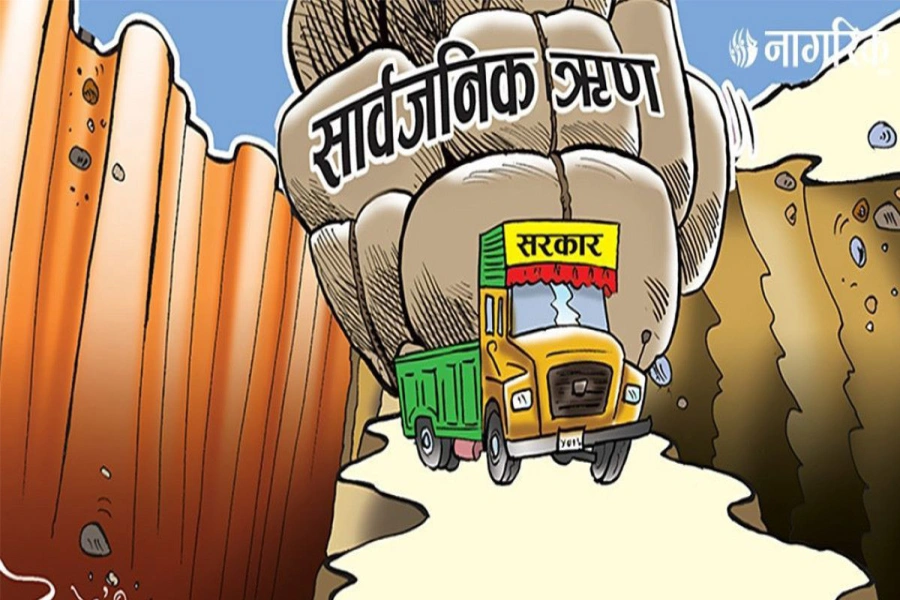
However, the real concern lies in the pace of growth rather than the absolute level. Over the past decade, Nepal’s debt ratio has nearly doubled, raising serious questions about long-term fiscal sustainability. This trend heightens the risk of a debt trap. Economists consistently emphasise that the impact of borrowing depends on its use. When directed towards productive sectors, debt can spur growth, generate employment and enhance repayment capacity. Conversely, if it is channelled into administrative expenses, short-term populist programmes or inefficient projects, it yields little economic return and increases vulnerability. Nepal has long struggled with project delays, cost overruns and underperformance—factors that further complicate debt management. The pressing question now is how to move forward. Strengthening the revenue system is a crucial first step in turning debt into an opportunity. Reforms in tax administration, expansion of the tax base and policies that stimulate economic activity can help boost revenues. Equally important is a thorough review of government spending. Without curbing recurrent expenditure, dependence on borrowing will persist. Above all, prioritising investment in productive sectors—such as energy, agricultural modernisation, industry and infrastructure—is essential to ensure that debt contributes meaningfully to sustainable economic growth.