“For me, archiving is a political act. I am opposing the politician who wants me to have a myopic view. When I am making the film (about the destruction of books, about archiving), it is an anti-war film. ... The contemporary political class is not interested in people knowing what happened more than five years ago.
B R Nanda (the first director of the Nehru Memorial Library) had people around him who were interested in preserving material, preserving knowledge. Now we have a political class who is not interested in having people know what happened five years ago. Being an archivist is a political act. I am sure of that.”
– Daljit Ami, Punjab Digital Library[break]
In 2002, the Punjab Digital Library started as a group set up by two young friends determined to preserve their cultural and literary heritage, Davinder Pal and Harinder Singh. Their mandate was simple: to preserve and digitize any and every work written in or about the Punjab, by or about Punjabi people.
With a monthly budget of Rs 10,000 and armed with a 3.2 mega pixel digital camera, they started with a target of 5,000 pages per month, one that was difficult to reach. Today, they digitize over well over 5,000 pages every month and have logged 7.5 million to date. Of these, about one million are available online. The ten lakh Indian Rupees they incur in expenses, for their team of 25, is acquired through donations. As Davinder Pal Singh, cofounder of the Library, says, “We have neither requested nor plan to request government support.”
For many of us in Nepal, it is easy to be swept up in the joy and rage of contemporary politics. Our conversations increasingly revolve (such as in this newspaper) around questions of identity, historical ownership, and inclusion based on a combined sense (and the realities) of historical legal exclusion, and an adamant desire for a more just future.
As one set of commentators attacks another for their unfairly acquired set of privileges or their sense of history, we – as readers – are limited to these feelings.
Where is the analysis of the laws and edicts that themselves clearly show discriminatory practices? Where are the references to the accounts of priests brought up from India to codify practices of caste? Where are the citations about land redistribution and the very decision to provide paper deeds to property?
This is not to say that history is mainly to be used as a weapon, or that the primary role of archive is to provide fuel in a political fight. That may lead to an even sorrier state of history in our institutions today.
I can already imagine what few archives we have left being burnt down or vandalized in the attempt to erase the past, as happened in the case of the Jaffna Public Library in 1981.

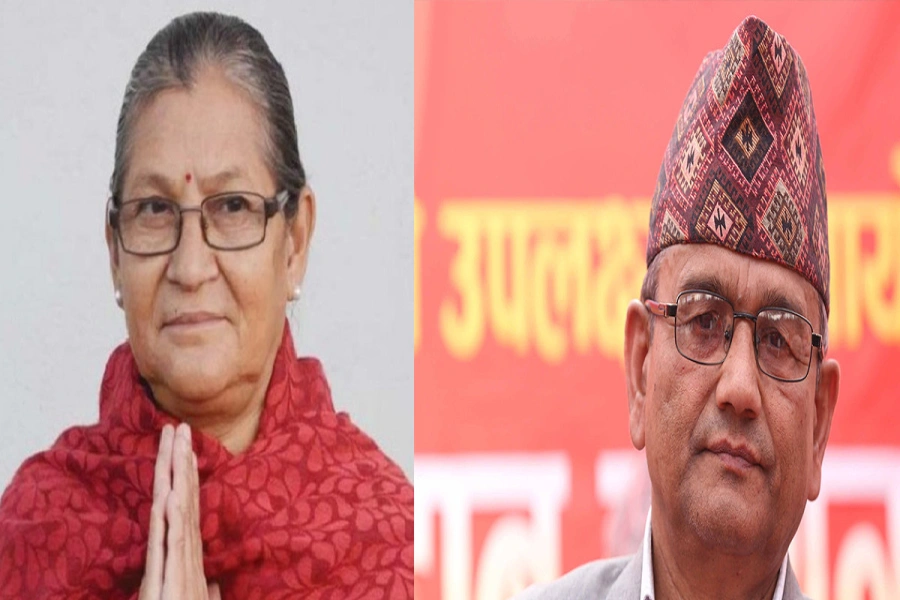
Anusha Yadav Salima Hashmi
Photo Courtesy: Nayantara Gurung Kakshapati
Let’s take a step back, to the archive itself. Traditionally – and in metropolitan Nepal – the archive has been associated with written material: books, perhaps newspapers, other periodicals, copies of laws and state decisions, land documents, written accounts of events as they took place or soon after, records pertaining to the rulers and ruling families of the day, and correspondence.
The most traditional archive can be, most simply and at first glimpse, a record of who has held power, perhaps by virtue of their access to the written word.
But even our notion of the ‘traditional’ archive should expand. Records from churches and temples, and those from Machhendranath, for example, can provide rich accounts of the past, far beyond these religious institutions. The Machhendranath records provide information on earthquakes, deaths, families and their organization.
Archives are not static repositories of documents – they cannot, and must not, be. Salima Hashmi, artist, peace activist, and Dean of the School of Visual Arts at Beaconhouse National University in Lahore, explains how she is “an accidental archivist.”
She was pulled into the world of recording and historical exegesis after coming across the letters written from jail by her father, Faiz Ahmed Faiz, to her mother. One particularly ironic letter describes a day that Faiz found especially beautiful.
He writes about the movement of air, birdsong heard from his jail cell, and his sense of those around him: “Perhaps I may even become a poet!” he ends. Professor Hashmi’s recognition of the value of these letters – and the willingness of the family to share Faiz with the many across Southasia who have loved and learnt from his poetry – opens up space for greater public engagement with this celebrated poet.
While Faiz’s letters provide insight into the world of one widely celebrated individual, archives – even of individuals – can take many forms other than paper documents.
Sadanand Menon is a writer, arts editor, photographer and curator based in Chennai. A member of the faculty at the Asian College of Journalism, he is active in issues connected to the creation of a contemporary Indian dance. Sadanand also speaks passionately about the importance of archiving in the world of performing arts.
As he speaks, I begin imagining an archive of Nepali dances and theatre, a dynamic way of paying tributes to centuries of performers and performances, and of better understanding of the origins of dances. While warning against “morgues of information,” Sadanand also proposes a new way of looking where we learn what we learn. “
[We should] see dancers and performers as universities,” he says. Let’s think about that, then – what would it mean to see a person as an archive? How could this reshape our sense of the past, and challenge state-centric writings of history, expanding it to include the worlds enacted on stages and circles around our country?
What not to show
Time and time again, among archivists and historians today, we hear debates about digitization. One very real concern about digitization is its role in preservation. Formats and media are changing at a rapid rate – remember the floppy? Digitization does not ensure preservation. It also does not ensure access, an important point to note for many of us in this so-called digital age.
But in other ways, the arguments about digitization follow on the tracks of an older debate about information access: who should be granted access to what forms of knowledge? Why? On one side sit those who believe that all information should be freely – or at least publically – accessible.
On the other are those who believe that digitizing and fully opening democratic access decreases the ‘value’ of a set of works, or even of knowledge itself. Even as he highlights the importance of public archives, historian and author Ramachandra Guha challenges the “politically correct” idea of the day that insists on electronic access for everyone. “Why would you put the crown jewels up?” he asks.
Asking for the curious to do a little more prep work, however, does not preclude greater openness. Anusha Yadav, a graphic designer and photographer based in Bangalore, and founder of the Indian Memory Project, disputes the demonization of the internet, or of access, more broadly.
“If you can’t let everyone see the crown jewels,” she says, “at least put up a picture!” Her work, The Indian Memory Project, is an online archive of family pictures that has captured the hearts of thousands across India and Pakistan. Growing up in a conservative town, Anusha wanted to know more about the diversity present in ‘her’ country.
As she explains: “It started as a Facebook page depicting diverse ceremonies and wedding traditions. [Going to weddings], I was realizing that the NRIs [Non-Resident Indians] who came knew the songs and dance traditions while the resident Indians did not. [NRIs] were the ones holding on to values and traditions. I thought we needed more of this. [As we put up photos], all kinds of stories came up that baffled the notion we had of India as a homogenous, restrictive place.”
So why not combine access with engagement? Even if a resource is more easily e-available than physically so, a curator still exists.
Make it difficult to copy images, put in text or audio that provides better background, link your user to other resources both on- and off-line: the archivist and librarian are still important, they just have a different presence. To this writer, the debate does not seem to be a new one. What we are arguing about seems to be form.
Let us return to Nepal, to our traditions of history, and future directions for the discipline. According to some, the history department at Tribhuvan University (TU) was recently in danger of being shut down.
Increasingly fewer students are registering. At the same time, we are asking more and more questions about our past. Where are we looking for answers?
On the other end of the issue sits the Nepal collections at the National Archives and the Nehru Memorial Museum and Library in Delhi. These house the work of British Residents in Kathmandu, but have not been accessed by any Nepali scholars since 2000.
The Madan Puraskar Pustakalya (MPP) is located in Patan, a publicly accessible archival collection of Nepali literature (including first and rare editions of many works), periodicals, signs, and “anything that has been published in Nepali, as was the original mandate,” says Amar Gurung, the head of the archive.
MPP’s resources are used primarily by students in the Nepali language and literature department at TU, and foreign scholars. But the collection – the biggest private one – could be better used. Like many archives in South Asia, it is in danger of being closed because of a lack of financial resources.
Textual archives are by no means the only – or even the best – sites to achieve a more comprehensive understanding of the processes and relations that have shaped our past and present.
They are one resource. As Professor Indira Chowdhury, Director of the Centre for Public History (CPH) at Srishti School of Art, Design and Technology in Bangalore, emphasizes, we must include oral history within the purview of ‘history’.
Oral history – which is about more than just oral traditions and recordings of speech – must involve frameworks, appropriate locally derived theory, and an understanding of the past around an individual’s story, to better appreciate how it intersects with other historical trajectories.
An archive is a curious place. It has the power to humanize, and the ability to erase illusions of innocence. As we look at images of our families and the grandparents of almost strangers, we acquire a new sense of their individual personalities. We look at how they stood, and what they wore; who they posed with, and the ways in which they wanted to be remembered.
To other records: a single palm leaf manuscript from a Syrian Christian church in Kerala, preserved by archivist Father Ignatius Payyappilly. The leaf contains – at first glance – a simple property deed.
Translated, it is seen to be a man transferring wealth to his son-in-law on the occasion of his daughter’s marriage – so we know that the Syrian Christian community engaged in dowry practices, and that multiple witnesses were made to sign such agreements. A slightly closer reading and we see that the “property” in question is in fact a family of three.
We have learnt that into the 1842 C.E. (1370 Malayalam Era), slavery was active in Kerala among Syrian Christians, that a slave market existed in Parur near Kochin, and that families could easily be split up as they were traded.
And then there is this: in our quest to re-determine relations of power within our country, through reference to the past, and in the frequent public frustration expressed towards our southern neighbor, we seem to have willingly overlooked our involvement in at least one struggle for independence from colonial rule, whatever the reasons may have been.
During the Sepoy Rebellion of 1857, Nepali troops were commissioned to break the strikes. This was preceded by earlier relationships with the British Raj, such as in 1767, when Jaya Prakash Malla requested British Company assistance in stopping Prithvi Narayan Shah’s campaign. We – rightfully – celebrate our status as an uncolonized state.
But what was the cost of our ‘independence’ from colonial rule? Perhaps we could use government records and correspondence to better understand relations between Nepal and the different regions of South Asia and, on another important level, the modes and forms of exchange within localities and between communities in Nepal.
Going back to sources – to newspapers, to archives, to photographs and individuals who can give us a sense of what happened (more than five years ago) – seems like a vital first step. After all, how do you contest a version of the past unless you can prove that it is just that – one possible, and possibly wrong, interpretation among many.
An archive also suggests that we believe in our ability to continue, as a community, as a nation, as a species. We preserve information because we believe that elements of the past are important – but also because we have faith in the value of our present. Our grandchildren, after all, will want to know how they came to be.
This past weekend, the Hri Institute for Southasian Research and Exchange held a conference of South Asian archivists in Bangalore, perhaps the first of its kind. Part of Hri’s ongoing effort to connect archives across South Asia, the meeting provided an opportunity to come together and share both motivations and concerns. Video, notes, and clips will be shared in the coming weeks at hrisouthasian.org for dissemination, among other intents.
The writer is associated with Hri Institute for Southasian Research and Exchange.
Related story
Understanding Could Safeguard Kids On Social Media