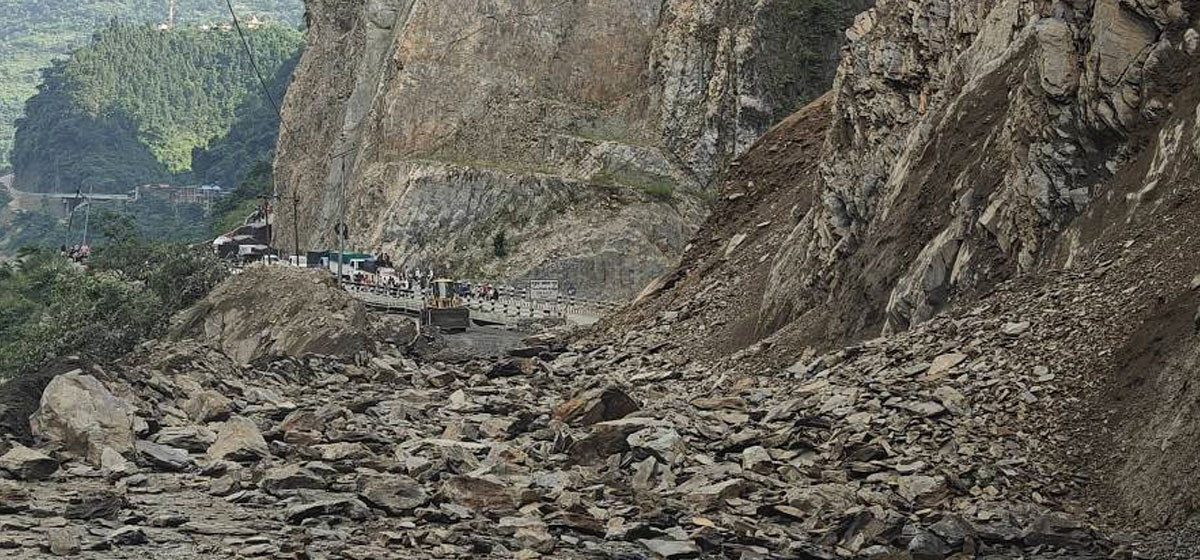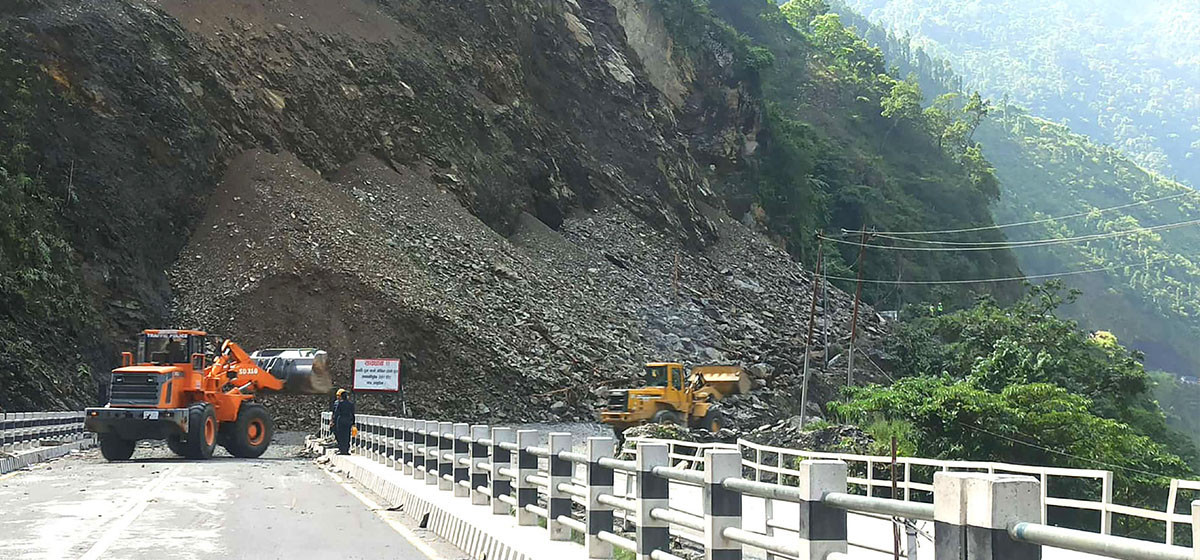
The rising Himalayas are composed of highly fractured and weathered rock masses—schist, phyllite, and quartzite—that lose their natural equilibrium when cut for roads or hydropower projects. During the monsoon, heavy rainfall infiltrates this fractured terrain, increasing pore-water pressure and drastically reducing shear strength, triggering chains of landslides, debris flows, and road closures that claim lives and disrupt the economy. The repeated slope failures at Tuin Khola along the Narayanghat–Mugling highway are not isolated incidents; they reflect chronic geotechnical vulnerability, with tens of thousands of cubic metres of debris reported in September 2025 alone and re-failures occurring during clearance work. Human activity exacerbates this instability: unplanned slope cutting often exceeds natural angles of repose, blocked or inadequate drainage saturates cut slopes, quarrying and riverbed mining undermine fragile foundations, and deforestation removes root networks that once reinforced the soil. Landslides in Nepal are therefore not merely “natural disasters” but predictable failures resulting from a dangerous combination of fragile geology, intense rainfall, and unscientific human interventions.
Scientific Diagnosis: Understanding the Mechanisms
Landslides along Nepal’s highways are a recurring threat, arising from a complex interplay of geology, hydrology, human activity, and climate. Understanding the underlying causes is essential to designing effective interventions.
Geological Weaknesses
Many road alignments in Nepal’s mid-hills traverse steep, fractured slopes of weak, highly-jointed rock and weathered colluvium. These naturally unstable soils and rocks are easily disturbed by construction or erosion. Earthquakes further reactivate old slides and create new fractures. Along the Narayanghat–Mugling road, rotational and translational slides are common, particularly in weathered schist and phyllite, and cut slopes exceeding the natural angle of repose are highly vulnerable.
Hydrological Drivers
Most slope failures are rainfall-induced, as monsoon or prolonged rain increases pore-water pressure, reducing effective stress and shear strength. Many landslides are reactivations of older slides or shallow, rain-triggered failures. Steep slopes combined with high pore pressures create conditions for sudden, catastrophic collapse, as frequently observed along the Mugling–Narayanghat corridor.
Human-Induced Instability
Improper slope cutting and disrupted drainage amplify natural weaknesses. Road construction often leaves steep, unsupported cuts, while absent or poorly maintained drainage allows water accumulation. Bridge construction or hill-cutting near roads can trigger progressive failures, and reports indicate that many landslides in the Mugling area are linked to such human activities.
11 bridges built, 2 under-construction on Pokhara-Muglin road

Vegetation Loss and Land-Use Change
Vegetation roots naturally stabilize slopes, increasing cohesion and resilience. Deforestation, upstream quarrying, and uncontrolled development remove this reinforcement, raising vulnerability. Unchecked land-use changes in Nepal have intensified landslide frequency and severity, highlighting the need for integrated slope management.
The absence of systematic monitoring compounds the problem. Warning signs such as cracks, seepage, and bulging toes often go unnoticed until catastrophic failure occurs. A scientific approach based on geotechnical investigation, rainfall thresholds, and continuous instrumentation is critical for accurate diagnosis. Without such tools, Nepal remains reactive rather than preventive in its approach to slope management.
Short-Term Fixes: Containing the Damage
Emergency interventions often focus on reopening blocked highways quickly rather than stabilizing slopes permanently. In the Narayanghat–Mugling section, this has meant repeated clearance of debris and ad-hoc retaining walls that fail within one or two seasons. Short-term measures such as gabion toe walls, tarpaulin covers during heavy rainfall, and temporary diversion of surface runoff are crucial to prevent immediate disasters. Regular slope inspections during monsoon months can help in identifying weak zones before full-scale collapse. However, these reactive strategies, though necessary, only buy time; they do not address the fundamental instability of Nepal’s mountain slopes.
However, these are reactive strategies that prevent immediate disasters but do not resolve the underlying instability. Nepal must transition from patchwork solutions toward proactive slope risk management.
Medium- and Long-Term Engineering Solutions
Every slope is unique, and effective long-term stabilization requires a site-specific approach informed by detailed geotechnical investigations. Engineers must consider the geological structure, hydrology, slope geometry, land use, and climatic conditions before selecting appropriate interventions. Often, the most effective strategy combines multiple methods to address both immediate stability and long-term resilience. Key interventions include:
Reprofiling and Benching – Reshape slopes to reduce steepness and create stepped benches, redistributing load, slowing runoff, and reducing erosion. Benches also provide access for maintenance and emergencies. Properly benched slopes in Nepal show a lower risk of shallow landslides.
Subsurface Drainage and Relief Wells – Horizontal drains, trenches, and relief wells lower groundwater and pore pressure, restoring soil strength. Combined with surface drainage, they are critical for stabilizing cut-and-fill slopes, especially under road embankments.
Soil Reinforcement Techniques – Soil nails, geogrids, and ground anchors enhance cohesion and shear resistance in residual soils and shallow rock, stabilizing steep cuts without extensive excavation. Evidence shows that combining reinforcement with drainage improves long-term performance.
Rock Anchoring and Bolting – Anchors and bolts restrain unstable blocks in blocky, jointed rock slopes, preventing planar, wedge, or toppling failures. They are vital along high-traffic corridors and must be guided by structural mapping and stress analysis.
Retaining Structures – Gravity walls, anchored walls, and MSE structures support slope toes and critical sections, resisting sliding and overturning while carrying road surcharge. Integrating these with drainage and vegetation is cost-effective in mountainous terrain.
Bioengineering and Nature-Based Solutions – Vegetation like brush-mattresses, vetiver, and deep-rooted natives stabilizes shallow failures and controls erosion. Combined with engineered structures, these solutions are sustainable, enhance biodiversity, and reduce sediment transport.
Rockfall Sheds and Galleries – Reinforced concrete galleries or sheds protect roads from falling debris, allowing uninterrupted traffic. Design must consider rock size, fall energy, and slope angle, particularly in narrow corridors where detours are impossible.
Policy & Governance Reform: Systemic Solutions
Engineering solutions alone cannot address Nepal’s landslide crisis. Weak governance, fragmented institutional mandates, and a lack of accountability amplify the risks. Current practices allow roads to be constructed with minimal geotechnical oversight, often prioritizing speed over safety. Maintenance budgets are underutilized, with drainage and slope protection works receiving little priority compared to road surface repairs.
Nepal needs systemic reforms that put slope safety at the heart of infrastructure planning, combining regulation, investment, and community engagement to address the country’s persistent slope crisis. Detailed geotechnical investigations and strict enforcement must guide all road projects to prevent unsafe cuts, while national landslide inventories and real-time monitoring can support early warning and traffic management. Proactive funding through a dedicated slope resilience budget, regulation of upstream land use, and capacity building for engineers, contractors, and local governments are essential. Equally important is community involvement, with residents maintaining drains, planting vegetation, and serving as first responders in early warning systems.
Without these reforms, engineering fixes will remain temporary band-aids on a deeper systemic failure.
Specific Recommendations for the Narayanghat–Mugling Section
The Narayanghat–Mugling highway remains one of the most landslide-prone corridors in Nepal, yet it is a lifeline connecting Kathmandu to the southern border. A corridor-specific landslide management plan should be urgently implemented. First, high-risk cut slopes should be reprofiled and protected with a combination of soil nailing and shotcrete to improve stability. Second, drainage systems along the alignment must be redesigned to prevent slope saturation; subsurface drains and lined channels are critical here. Third, real-time monitoring using rainfall gauges, inclinometers, and remote sensing can provide early warnings to travelers and authorities. Finally, systematic bioengineering using deep-rooted vegetation along benches can reduce shallow failures and promote slope healing.
Conclusion
Landslides in Nepal are not random acts of nature; they are the predictable outcome of fragile Himalayan geology interacting with unscientific human practices. The Twin Kholadisaster is a wakeup call that patchwork solutions are no longer sufficient. A scientific, integrated approach combining slope protection, drainage, governance reform, and community engagement is the only path forward. If Nepal invests in proactive, evidence-based interventions today, it can safeguard lives, protect infrastructure, and ensure that vital road networks remain open even under the harshest monsoon conditions. Landslides will always be part of the Himalayas. But whether they remain an annual disaster or become a manageable risk depends on the choices we make today.
The author is a Civil and Environmental Engineer specializing in nature-based solutions, slope stability, and landslide management. Currently, he works as an Engineer at the US-based consulting firm DT Global International Development USA Ltd, focusing on sustainable infrastructure and resilient engineering practices.