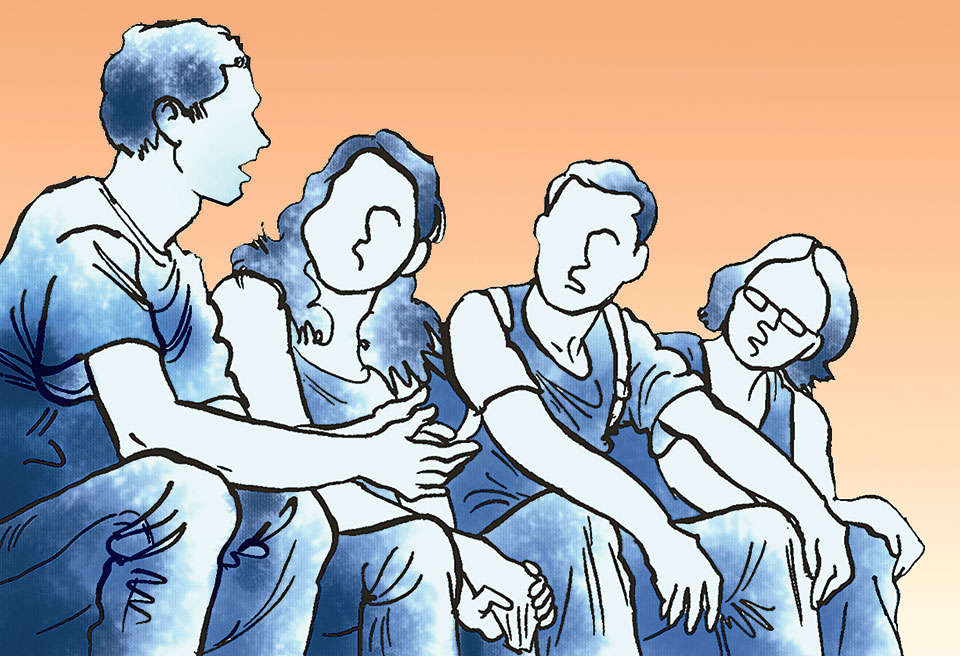
I don't know why this bothers me so much, because this isn't really a "personal" problem. I don't know if this can even be called a problem. Well, a very good friend of mine recently got married to the person she had earlier introduced to me as her 'uncle.' Yes. And he's quite old, at least 12 years her senior. Age wouldn't have mattered were he not married with a five-year-old son. My friend told me her side of the story, which, however convincing it sounds, hasn't earned my sympathy. I feel it's so wrong, especially given the fact that the wife of that uncle was really close to my friend. I've met her couple of times and she's really sweet. I want to look my friend in the eye and tell her what bothers me, but I'm afraid of hurting her. The strange thing is, their families (minus the auntie of course) are very accepting of the relationship. What should I do? I don't want to lose my friend and still pretend to be okay with everything.
--SumiI think there are times when good friendship has to take the truth test. If you pass the test, you get promoted to the status of True Friendship. If you fail, like you said, it might end your relationship but you still get promoted to True Friendship status for truly trying with the welfare of your friend in mind. If you hang around with her knowing what you know but not sharing what you know, then you might as well question if you are even good friends to begin with.
When people are in love, their minds are so high in dopamine that they create their own reality around them and they don't see the other side of reality. Your friend right now doesn't exist in the same realm of reality that you and I exist in. In her romanticized version of reality, there exists true love that is without any morality, rules or regulations. In her world, the man she is in love with perhaps appears as a true savior. His image is probably so etched in every cell of her existence that she struggles to believe that there could be life without him. She is so focused on the prospects of happiness in a future together that she is perhaps blinded to the reality that his unresolved past and her actions might continue to complicate their lives. In the excitement of what she is hoping to get from this relationship, she is probably not seeing everything that she would lose; how all other pursuits worth her time and energy might just trickle away.
As a friend, our job is not to judge her on the basis of the social norms of morality. It is not about asking if she is doing the right thing or a wrong thing. It is not about choosing to believe or not believe her side of the story. True friendship is about showing her what you see and telling her what you know. At the end of the day, your friend will do what she can. She, and only she, can make the final call. As a friend, your job is not to steer her towards one direction instead of the other. The interplay between her choices and her destiny will take her where she needs to go. But the test of true friendship is whether or not you lit a lamp in dark corners of her mind - showed her what she needed to see, and said what she needed to hear.
------
Dear Swastika,
I'm married to someone who I feel is holding me back from achieving a lot of things in life. He is very insecure and wildly suspicious though he has no reason to be. I feel very suffocated and angry. I tried to talk to him but he just doesn't listen to anything. I have had to give up many opportunities to learn and experience new things just because he isn't okay with it. He behaves as if it's his right to dictate to me. We've had huge fights about this but I'm always the one who gives up first. I'm at the end of my tether and have started contemplating about walking out. But then I think about his family who is so wonderful to me. I also feel like maybe I should compromise this side of him but I don't know why. I know I have every right to live my life as I want to but it's so hard to practice what I know.
--Gyanu
"Going after a dream has a price. It may mean abandoning our habits, it may make us go through hardships, or it may lead us to disappointment. But however costly it may be, it is never as high as the price paid by people who didn't live."
– Paulo Coelho
There are some things in life you can live with. There are some things in life you can't live with. There are some things in life that you can live without. There are some things in life that you cannot live without. Then there are things that you should not live with or live without. However, there isn't a list of can and cannot or should and should not that applies to all the people all the time. This is something that you are going to have to map it out for yourself.
Ask yourself – can you or can you not live with a husband who is constricting your freedom to learn, experience and grow as a human being? Can you or can you not live with a husband who is constantly doubting your integrity and denying your rights to make choices? Can you or can you not live in the hope that he will change one day; that he will come to realize your desires and consent to your choices? Can you or can you not sacrifice your dreams for the sake of the goodness that your in-laws show? Maybe you should also ask yourself if you love him enough and if that love is worth putting aside your own hopes and dreams.
But maybe I am oversimplifying marriage. It might not be as simple as the question of can and should. Maybe life isn't as simple as – you stay if you can live with him and you leave if you can't live with him. Marriage after all is a complex web of social norms, emotional entanglements, financial complexities, question of safety and security, etc. At this time, what you might want to do is talk to people – your in-laws, your parents, siblings, and friends. Tell them how things are and ask if they see something that you are not being able to see. Ask them what they would do in a situation like this. Ask them if they see a way around that you have not been able to see. Maybe there is a way you can kill the snake without breaking your cane.
But nevertheless, while talking to people can help you see what you haven't been able to see, at the end of the day, we come back to the same question: What can you live with or without and what can't you live with or live without?
Swastika Shrestha is the co-founder and head of training and support at Teach for Nepal. She has several years of experience training and mentoring youth leaders. She can be reached at swastika@teachfornepal.org.
Related story
Digitized era of friendship