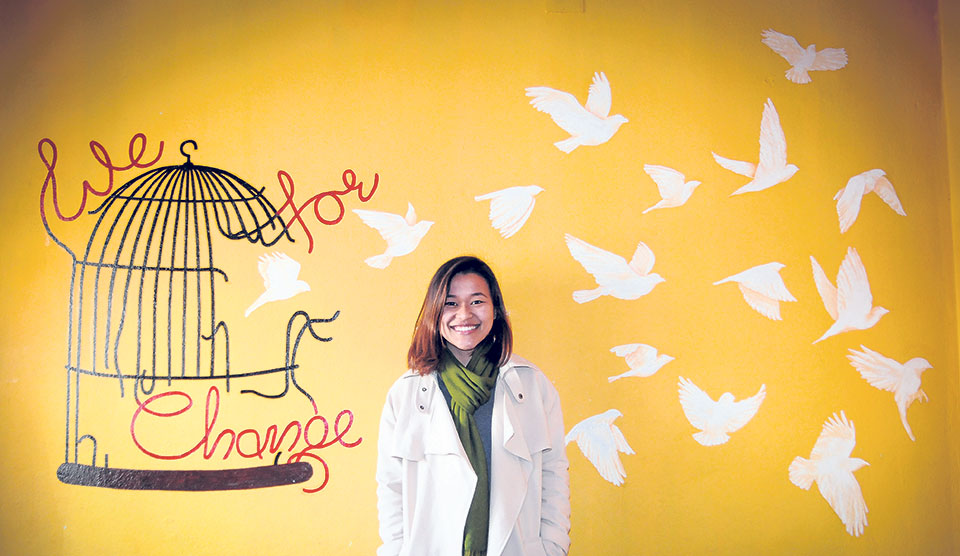
Bhawani Rana is the Chairperson of Sneha Group. The group operates freight business, travels and tours, resorts and hotels, agribusiness. Rana is also the Chairperson of Agro Enterprise Center, an agricultural wing of the Federation of Nepalese Chambers of Commerce and Industries (FNCCI). On the occasion of International Women's Day, Kriti Bhuju talked to Rana on what it takes to become a successful entrepreneur and what message she wants to give to Nepali women. Excerpts:

Change of Guard and OBOR

At present, what are you involved in?
Currently, I'm working to expand my business in the tourism sector. I'm also the Managing Director of Kathmandu Urban Cable Car that has planned to develop an urban cable car system in the capital and Director of Nepal Life Insurance Company. Besides these responsibilities, I'm also the chairperson of Agro Enterprise Center, an agro wing of FNCCI and through it I'm working to enhance the involvement and capacity of women in agriculture.
You're an exemplary woman in the Nepali society. How did you achieve this position?
I still feel that I have a lot to do besides being involved in many organizations. I started my work at an early age of 21 when I invested in my relatives' garment factory named Award Garment. I keep myself busy with lots of involvements and that, I believe, has made me popular among Nepalis. I was Vice President of FNCCI for three years. I was also the first elected woman to FNCCI. I was the member of the Nepal Investment Board. It's all because of my family's support, and my hard work and self-confidence that I have been able to devote so much time to my work and do well.
As a woman, how difficult is it to manage your household activities and business?
Our culture and society do not want women to be more open. There are challenges in our society for women to work and establish a business on their own. In my case, I was lucky enough to get support from my families. I think women are the best managers as they can manage to keep their family happy and work under pressure outside home simultaneously. There's nothing a woman can't achieve, given the right moral support.
What do you think Nepali women should do to establish their image in the society?
First of all, we as women shouldn't think that we should only be doing household chores. Women need to have aims in life and work towards fulfilling them. Positive thinking is very much important and women should expose themselves to bring out their hidden talents.
To make women stand out, I've been working in different women-related organizations for almost two decades. I've been helping women utilize their talents by providing them trainings, helping them bring their products in the market and get access to credit for expanding their business.
On the occasion of International Women's Day, what message do you want to give to Nepali women?
We women are capable, we're strong and we can do anything. And I mean it. As the theme of this year is 'Make It Happen', we women should make change happen in the society; we should turn our dreams into reality. Lastly, I want to say that now is the time to come forward and it's the time to start. Let's not blame anyone for our situation but let's take charge of our destinies.
Babita Basnet on Nepali women over the years
Babita Basnet is currently President of Media Advocacy Group and Editor of Ghatana Ra Bichar, a weekly tabloid. She's been in journalism for more than 20 years and has been writing on all kinds of political and social issues. Shreejana Shrestha talked to Basnet regarding the status of Nepali women as she has seen over the years. Excerpts:
How's the status of Nepali women now as compared to, say, 20 years ago?
The condition of women now is completely different than it was 20 years ago. I'm an example myself. I had just crossed my teenage 20 years ago. At that time, taking about menstruation with any of the family members was a taboo while women these days can openly talk and discuss about reproductive health and their physical rights. Women have now started campaigning that they hold full rights to their bodies.
Only last week, I attended a program 'Young Women for Change' and I was extremely elated to see the level of understanding of the young participants. There has been massive change in the perception of health, education, communication, technology, economy, politics and other social aspects also. Also, violence and other forms of humiliation are no longer private affairs as they used to be before.
What are some of the most significant changes Nepal has undergone in relation to women's issues?
In the last 20 years, many laws have been formulated regarding domestic violence, sexual harassment, and marital rape. The most significant progress we've made is in the sector of women's education and awareness.
The perception towards women has also changed and women are living dignified lives. There's been a remarkable rise in the number of women
working in various professional sectors. Having said that, however, we still have miles to go.
How can media play a role to make the society gender-friendly?
Media plays an effective role in changing the social perception towards women. Media has played a big role in raising awareness about various women's issues.
The development of media after 1990 has successively advocated the issue of gender equality. Local radios, FM stations and other national media incessantly raised the issue of women during the civil war. Mainly, media can play its role on issues like equal participation, rights and duties when it comes to gender equality.
Women are often addressed as half the sky, goddesses, Laxmi, Saraswati and many more but I say 'equal opportunities, equal challenges.' Women should also rise from their status and not only talk about opportunities and rights. They should prepare themselves to face the challenges.
What's your take on the recent acid attack in Kathmandu?
The forms of violence have also changed with time, and acid attack is a recent example. I believe if impunity remains in acid attacks and other forms of violence, culprits will be encouraged. It's very important to end impunity on violence against women at any cost. The cases of minor rapes are settled in the villages and the issue of domestic violence is always related to the concerned family's prestige.
What I feel is that the right time has come to adopt legal procedure to rise above these cases. Justice is the only remedy for victims, and having a strong legal system in place in the country will discourage perpetrators. I'm disappointed by the slack implementation of the existing laws which I think is one of the major loopholes of our society.
Chhaya Sharma on changes regarding VAW
Chhaya Sharma is Chairperson of the Federation of Women Entrepreneurs' Association of Nepal (FWEAN). She is also a CA Member who is actively campaigning women's issues.
Sachi Mulmi spoke to Sharma to know about her opinions on the escalating issue of violence against women (VAW). Excerpts:
Do you think that we've improved or done any better than last year regarding the issue of VAW? What new measures have been adopted?
There have definitely been some improvements. There has been a slight interest from the political side to make things better for women.
Just a few weeks ago, we managed to pass a Bill regarding sexual assaults at workplace. We conduct regular table discussions regarding how we can make VAW a thing of the past. We are definitely looking to take positive steps in the issue.
But there have been increase in reports regarding VAW, the acid attack a few weeks ago, for example. What are your thoughts regarding this?
It's sad that no matter how many laws we erect to fence off these attacks, it's still in increment. It's true that the Administration hasn't been able to take care of the matter.
They might have tried reaching the depth of the issue, but pressure from various fronts could be responsible for not dishing out proper punishment to the perpetrators. Sometimes, there are no resources, and at other times, the mentality of people involved becomes the obstacle.
Is there nothing to look forward to, then?
We can't say that. Yes, there have been more reports about violence against women in papers and media, but the way women have come forward to raise their voice against it is something to look forward to.
It's invigorating to see all the women – from schoolgirls to adults – take it to demonstrations and rallies to demand their rights.
This is something different that I've found from last year. Aside from that, there are various groups lobbying to pass laws for the safety of women. So there are many things to do and expect.
In this situation, what do you think women should do? What are your suggestions?
Women can't wait for things to happen, because like most things in Nepal, they have a tendency of making people wait.
So personally, I look to implement things in however way I can, and ask others, too, to do so.
For example, regarding workplace behaviors, women have to be aware about the policies and also inform about it to their colleagues regarding it. All the big things changes will happen, but you need to initiate them.