Since transactions close early on the day before weekend break, the rush at District Administration Office was less. In the District Development Committee building however, a few senior citizens were worryingly enquiring from their village secretaries whether they would be able collect the meager amount of old age pension before Bibaha Panchami festivals. Discussions in other government offices of the district capital revolved around the impending budget—their main concern being the possibility of a pay raise. It seems budget has lost its earlier relevance in the economy of the open market.
The languid pace of life in a town at the margins of national turmoil was even more unhurried at the Bus Stand Chowk. A few idlers were speculating whether the police were complicit in the crimes of all armed groups or they had their favorites and rivals among cross-border entrepreneurs of ransom and abduction industry. Policemen on duty at the temporary sentry post appeared relaxed. Bilat Singh (55), a resident of nearby Khaira in Jaleshwar municipality was leisurely cycling back to his village. A retired Assistant Sub-Inspector of Police, Singh probably considered this stretch of road, with security posts on both ends, safest in the area to cycle. He had failed to factor the human error and possible inhumanity of some vehicle drivers. Everything changed within minutes as public rage replaced slackness when a reckless bus ran over Singh right in front of idlers, bystanders and the police.
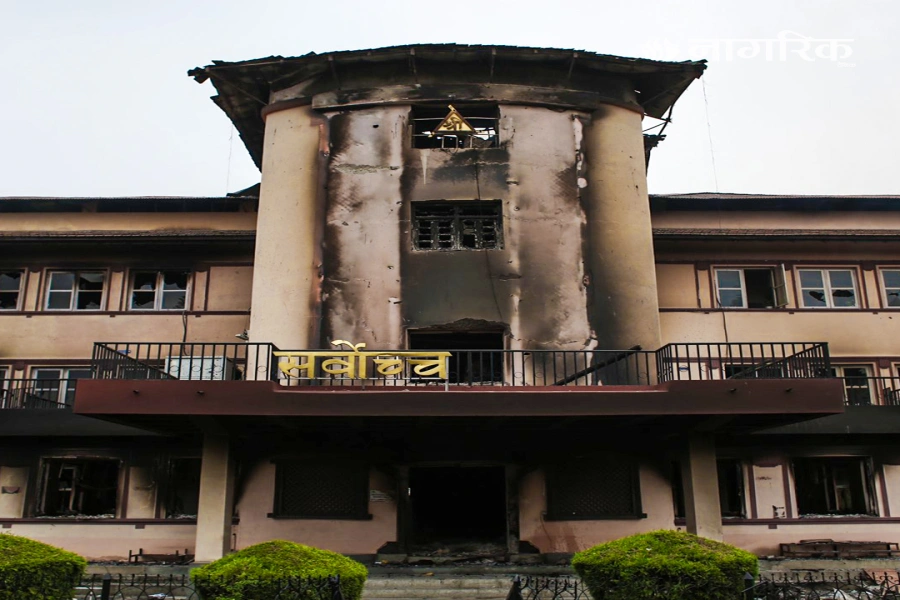
According to eyewitnesses, the incident was similar to what happens anywhere in Nepal when a motor vehicle hits a pedestrian or a cyclist. The bus first ignored the victim and swiftly raced ahead. The driver then realized that the wounded cyclist lying on the road was still alive. He put his vehicle in the reverse gear, crushed his victim to make sure that he was fatally injured, and then speeded away ignoring the warning whistles of the police and concerned cries of the public. The former policeman was rushed to Janakpur Hospital where he was declared dead. Meanwhile, impotent rage of the people had exhausted itself: Temporary police posts at Khaira and Bus Stand Chowk were burnt down within minutes of the crime.
When reprimanded for unnecessary arson by a concerned citizen immediately after the incident, the whinge of an innocent onlooker was telling: He complained that the police could have shot at the tyre of the offending bus and stopped it in its tracks. It did not seem to occur to him that such a response could have invited a bigger catastrophe with the bus out of control hitting a house, other pedestrians or speeding vehicles on the road. The police responded in a coordinated manner instead and communicated to their colleagues. The runaway driver was apprehended. Temporary police posts were put in place once again within few days. Locals, however, are still suspicious if the justice will be done. The transportation company that owns the bus is reputed to have friends in high places in the ruling UML party hierarchy. It is widely believed that the transportation cartel and its labor unions are so strong that together they can easily subvert the will of the state or the course of the law.
THE MORAL VACUITY
Unlike the modern method of timekeeping where the date changes in the middle of the night, traditional systems in Nepal consider the extent between one sunrise and another to be part of the same day. Therefore, it was the Friday night, rather than the early hours of Saturday, that President Rambaran Yadav prorogued the legislative-parliament upon the recommendations of the caretaker premier.
Apparently, the only law that works in Nepal is the law that people—from the president, the premier and parliamentarians to the pedestrian in the street—take into their own hands. Such an abyss has not yet been reached, but the polity and society is dangerously veering towards lawlessness.
The decision of the executive smacked of Orwellian doublespeak of an authoritarian regime—the budget session being prorogued to announce a full-fledged budget through a presidential decree is politically even more indefensible than the scuffle that took place earlier in the legislative parliament. The discontinuation of the legislature has given a long rope to the government to tie itself up in knots or hang democratic norms, processes and procedures. The caretaker premier has many political flaws, but an inability to protect his personal, familial and party interests is not one of them. There is no reason for the embattled premier to hurry political consultations and call the house into session before May 14 next year or a division in the Maoist ranks whichever occurs earlier.
Meanwhile, ministers of the officiating government are free to indulge in all excesses at public expense. The caretaker premier loves globetrotting. His deputies are addicted to politics of patronage. It is business as usual at Singh Durbar once again; the legitimization of the budget through the backdoor has provided the government with full freedom to be free of all legislative control in the foreseeable future.
The implication of shenanigan of high and mighty at the center upon governance structure at the grassroots is a different matter altogether. What happened at Constituent Assembly Building, Singh Durbar and Shital Niwas in the hectic Friday night probably justified what has taken place earlier in the day at Jaleshwar: Apparently, the only law that works in Nepal is the law that people—from the president, the premier and parliamentarians to the pedestrian in the street—take into their own hands. The word ‘anarchy’ has its root in two Greek terms, ‘an’ meaning without and ‘arkhe’ for rules. Such an abyss has not yet been reached, but the polity and society is dangerously veering towards lawlessness.
POLITICAL EMPTINESS
In the hills and mountains, dominance of the Maoists remains unchallenged. The Nepali Congress and UML do have their pockets of influence intact, but their voters and supporters have to perforce maintain a low profile. With a ragtag band of political opportunist and un-elected timeservers running the government in Singh Durbar, no activist at the grassroots would be foolish enough to stand in defence of ruling party bigwigs. In Tarai-Madhes however, Maoists are not perceived to be any different from other ‘national’ parties that seek to perpetuate Pahadi supremacy in the country.
Winners of the region in the last elections were regional parties like Madeshi Janadhikar Forum (MJF) and Tarai-Madhes Loktantrik Dal (TMLD) that evolved out of Madhes Uprising. In addition to these formations, there were (some still retain their political pretensions) various armed groups claiming to fight for the rights of Madhesis. Over last two years, the ground beneath their feet has slipped. Madhes-based parties are no longer perceived to be dependable on their home turf.
It was clear from the beginning that the rift in MJF ranks was caused by greed for loaves of office. The Bijaya Gachhadar group is in government while Upendra Yadav is cooling his heels in the wilderness of oppositional politics. The Gachhadar faction will probably prosper in whatever highbred politics evolves in the coming days, but the eclipse of Lalu Yadav brand in Bihar may cast a shadow over caste politics of Yadav.
The TMLD has increasingly begun to resemble the Tarai Congress of yesteryears when Bedananda Jha gathered the aspirations of Madhesis only to submit it in a bundle at the feet of the establishment in Kathmandu and its sponsors in New Delhi. Few doubt the integrity of Mahant Thakur or Brikhesh Chandra Lal, but in the perception of even their own supporters, the party is being run by the ilk of Hridayesh Tripathi and Sharvendra Nath Shukla. Whatever else the duo is at present, they have not been cultured in the politics of democratic socialism.
Various armed groups are just that—mere armed groups with little sympathy or support among the masses. The Tarai-Madhes, at least in the central and eastern regions, appear to be almost barren. Since there is neither authority nor its legitimate challengers, the field is wide open. Without a political settlement at the center, it would be impossible to check the slide of the periphery from despondency to desperateness.
cklal@hotmail.com
Related story
Thom Browne goes for spectacle at Paris Fashion Week