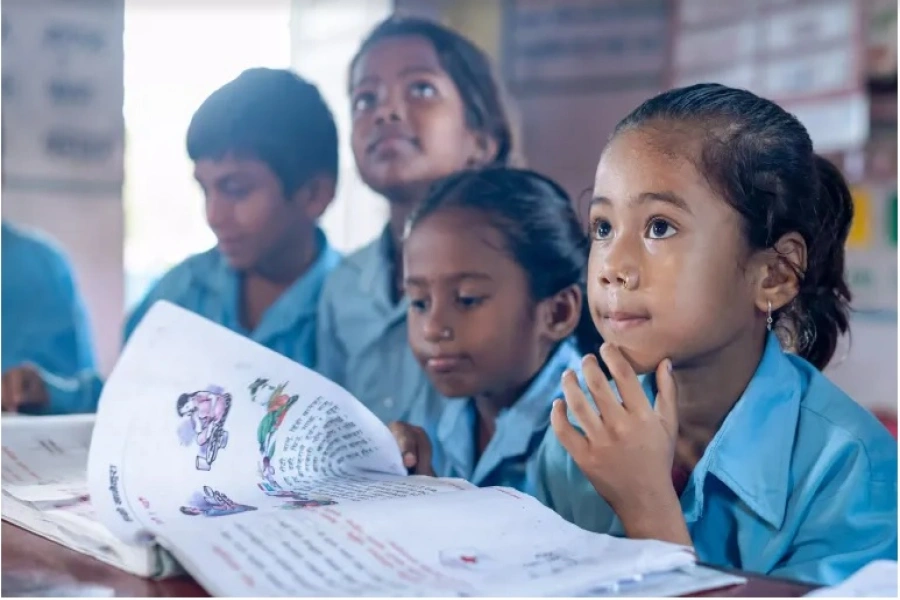
Those villages have do not have access to electricity and use oil lamps to lighten their homes at night. But the houses of regular school going children are now lit with solar lamps at night.Dungwang Primary School of Sarling and another primary school of Shyamrang have handed over solar lamps to parents of their students. Those lamps have to be charged on a daily basis. The charging panels of those lamps are kept at the premises of the schools and children can charge their solar lamps while they spend their days studying. Hence, only those students visiting the schools would be able to charge the panels regularly.
"Although parents admit their children in schools, they gradually stop attending classes. After thinking deeply on how to change their habits, we came up with this idea," said Nani Babu Chepang, principal of Sarling Primary School.
Principal of Shamrang Schhol, Attibal Chepang, said they had collaborated with an organization last January to purchase and distribute solar lamps to the parents of those students who come to schools regularly.
All the students of Sarling and Shyamrang schools are of backward Chepang community. Compared to members of other communities, Chepangs are comparatively very backward.
Shamrang School runs classes from grades one to five and is attended by 166 students of 86 families. On the other hand, Sarling has classes from grade one to three where 64 students from 55 households are enrolled.
As those settlements are in remote hills, locals are still unsure when the electricity will reach the villages. Only very few can afford kerosene to light up traditional lamps, let alone purchase solar lamps.
"Many houses in the villages remain dark at night. We had no choice but to eat dinner and go to bed early," said Ram Mani Chepang of Shamrang.
His daughter, Mira, studies in grade second while his sons, Rabilal and Raghunath are students of grade one. Ram Mani has received two solar lamps. "Now my children are able to study even during night. It has also made our household work easier," he said. Parents had paid Rs 1,000 to the schools to receive the solar lamps.
"Chepang children have to get involved in household chores including collecting fodders from the forest and are busy till the evening," said the Principal Atti Bal. "They cannot study at night in lack of lights. Hence, they gradually leave schools," he added.
Related story
Tapping into the sun