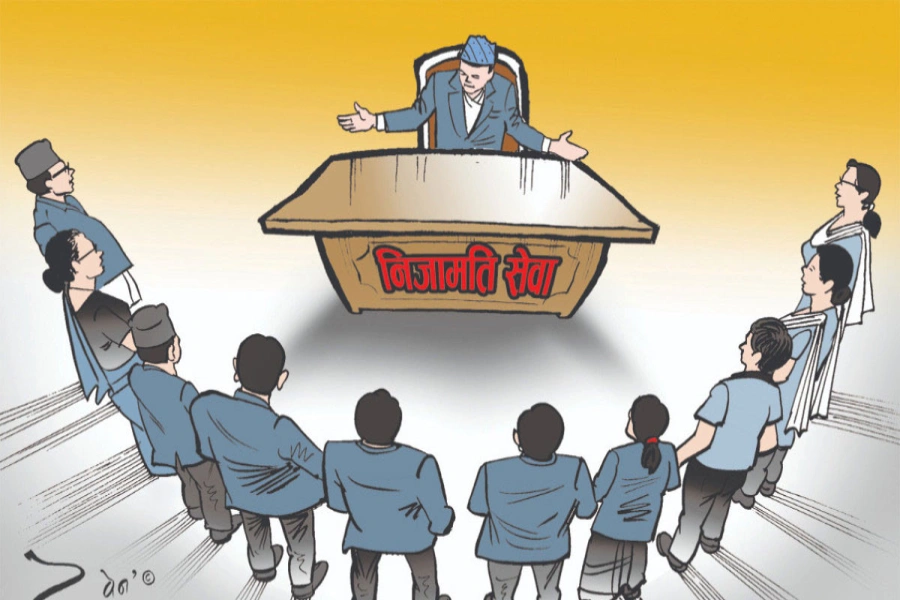
If indigenous nationalities´ caste-wise participation in MBBS scholarships provided by the government is any indication, the reservation policy has helped boost up socio-economic status of only those ethnic groups which are relatively advanced. [break]
Newars, who are from arguably the most advanced ethnic caste, top the list of beneficiary groups of MBBS scholarships meant for indigenous nationalities. Interestingly, even within the Newar community, more privileged sub-castes like Shreshtha and Shakya are ahead in terms of obtaining the scholarships.
According to the scholarships department at MoE, almost 95 per cent of the beneficiary indigenous nationalities are Newars. Thakali, Gurung, Magar, Tamang and Rai constitute the rest five per cent. Let alone endangered groups like Chepangs or Kusundas, not even relatively advanced castes like Sherpas and Limbus have got scholarships in the past three years.
In 2007, the government had allotted 15 seats for indigenous nationalities in MBBS scholarship program. Out of 15, Newar students obtained 11 seats. The remaining four seats were distributed among Thakali, Tamang and Magar students.
Likewise, of the total 34 seats meant for students belonging to indigenous nationalities in 2008, Newar students obtained 29 scholarships, leaving only five seats for students belonging to other ethnic castes. In 2009, Seven Newar students got MBBS scholarships out of 13 seats allocated for indigenous groups.
“It is just an example,” says Jitpal Kirati, vice chairman of National Foundation of Development of Indigenous Nationalities (NFDIN). “In fact, advanced ethnic castes have been ahead in attaining government facilities everywhere.” The reservation policy of the government, Kirati says, has been a ladder of progress only for those ethnic groups who need it the least.
Narayan Krishna Shreshtha, the under-secretary at the scholarships department of MoE, admits that the least advanced and most needy ethnic castes have been deprived of their rights. “It is mainly due to the reservation policy that places all indigenous and nationality groups under the same category,” Shrestha explains. “It does not prioritize different ethnic groups on the basis of their varied socio-economic conditions.”
Consequently, only the advanced ethnic groups manage to grab the opportunity most. “You cannot expect a Raute or Kusunda student to obtain MBBS scholarship under the current policy,” opines Shreshtha. “They do not meet minimum required criteria.”
Does this mean that there is no probability of making the current reservation policy more inclusive? “No,” asserts noted indigenous expert Krishna Bhattachan, who has done a number of researches on different modalities of reservation policy, Bhattachan says that the government should adopt a remedial affirmative action to make the reservation policy more inclusive.
According to Bhattachan, there are two kinds of reservation policies practiced all over the world -- preferential and remedial. As per preferential policy, the government equally treats all ethnic groups, thereby making them compete with one another. In remedial policy, the government tries to uplift the least advanced ethnic caste by resorting to the remedial affirmative action.
“The government should give first priority to the most endangered ethnic group,” Bhattachan says. “If no one is able to grab the opportunity from this group, then only should the government look for relatively advanced ethnic groups.” Bhattachan flays the government for not adopting remedial policy of reservation. “As per the existing policy, students belonging to marginalized ethnic groups will never become doctors or engineers,” he argues.
Bhattachan says that the government should simultaneously focus on helping least-advanced ethnic groups meet required criteria. “At present, no Kusunda student meets the minimum criteria of holding ISC certificate for MBBS study,” he says. “The government should help them get ISC certificate first. After some years, they will of course become able for MBBS study.”
Related story
Railways shortens advance reservation period from 120 days to 6...


-1778309205.webp)