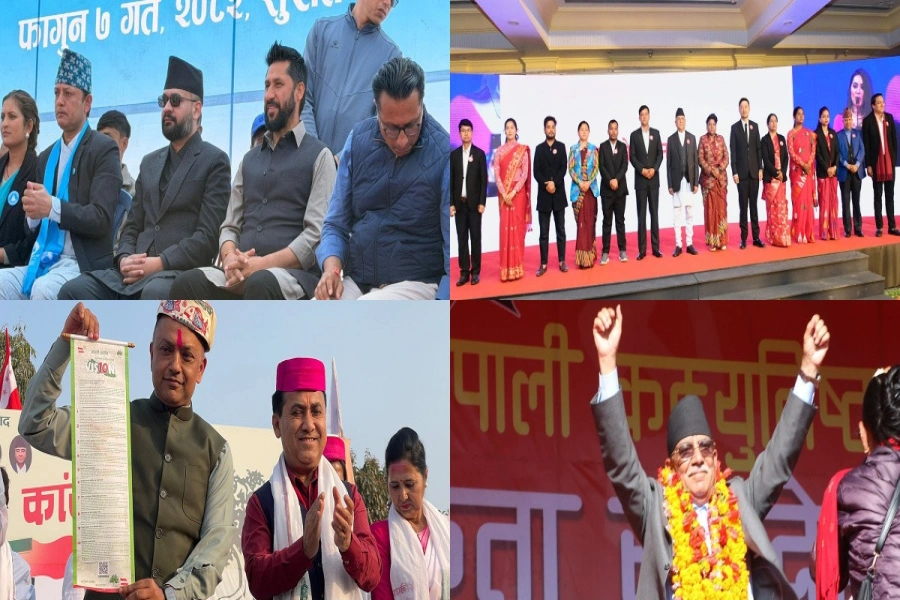
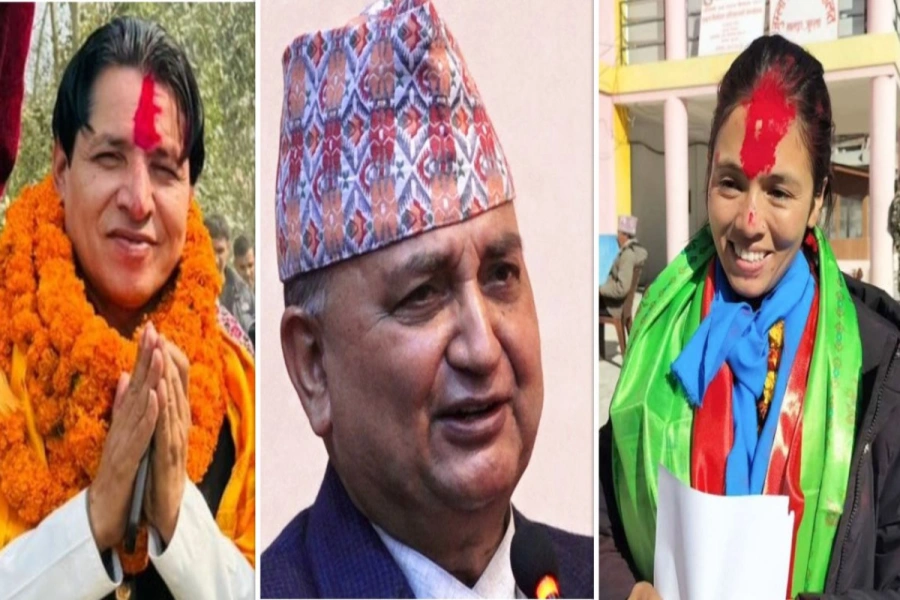
While Nepali Congress (NC) parliamentarians and central committee members have opined that the number should not exceed 240 members, nearly four dozen lawmakers of CPN-UML on Thursday asked their party leadership to revise the proposal, arguing that the number should be around 151 as proposed by the Constituent Assembly´s Committee on State Restructuring and Distribution of State Powers. [break]
But the top leaders of all major parties including NC and UML have yet to ´seriously´ take up the issue of parliament size and how to reduce it. "I don´t think serious discussions on the size of the federal parliament will begin until there is an agreement among parties on the number of federal states and the size of the provincial assembly," said NC Central Working Committee (CWC) and Parliamentary Party member Pushpa Bhusal.
According to established international practices, a country with 30 million population like Nepal can have a maximum 245 members in the national parliament including upper and the lower house. "In an exceptional case, we can make an intelligent compromise as we did in the case of the Constituent Assembly. But the proposed number of 385 is not feasible as we plan to move towards ensuring sustainable peace and stable government after the successful conclusion of the peace process," said Acting Chief Election Commissioner Neel Kantha Uprety.
Uprety argued that it would be appropriate to have no more than 245 seats in the federal parliament keeping in view the population and topography. "The basic idea of federalism is decentralization. The center should be small, lean and efficient," he added.
Top leaders involved in negotiations have justified the proposal arguing that 385-member federal parliament is necessary in view of the recent understanding to ensure at least one electoral constituency in one district and take into account the size of population in the tarai and other densely populated districts. "The leaders appear reluctant to find compromise on the size of federal parliament as they want to secure their political space. How would it be possible to ensure political space to all leaders if there is only one constituency in one district?" argued an NC leader.
NC leader Gagan Thapa said an overwhelming majority of the party leaders during recent meetings have suggested to the party leadership to limit the size of federal parliament to around 200 members. "There is unanimity among the party´s [NC] CWC and PP members that utmost flexibility should be shown during negotiations but the number should not exceed 240 under any circumstance," he said.
Although the UML Standing Committee was quick to react that 385-member federal parliament was not viable, there has not been any serious discussions on the issue so far.
UML lawmaker Yam Lal Kandel, who led the signature campaign for a small federal parliament and minimum number of federal states, said the size of the federal parliament should be determined in line with the proposal made by CA Committee on State Restructuring and Distribution of State Powers.
The CA committee has proposed 76 members elected under the first-past-the-post system and 75 under proportional representation system. "We feel that the proposal of the CA Committee is appropriate. Further discussions on the issue should begin in line with the same proposal," said Kandel while not ruling out the possibility of flexibility.
Maoist Chief Whip Dev Gurung, who belongs to the hard line faction led by Mohan Baidya, alleged that they were not consulted by Chairman Dahal before agreeing on 385-member federal parliament. "There was a proposal of 151 members in the CA´s thematic committee. This is more than double of what has been proposed. No one had ever imagined that the number would be this big," he said.
Gurung said that their reservations is not just over the size, but also over the modality of electing members of the parliament. "This has reduced the number of proportional seats from existing 58 percent to 45 percent. This is simply unacceptable," he further said.
Related story
Desperate search for missing girls as nearly 80 dead in Texas f...