K sandesh boki aayeu ae badal, aakash chhopi
Kumar Sanu is a maestro of Indian sub-continental music, having recorded songs across a range of continental languages, defining an entire era of romantic melodies in Bollywood. The Indian singer’s ariose voice has dealt justice to the succulent Nepali lyrics in this particular song which has transformed into a gem of Nepali music history, but the words of the lyrics itself has roots in ancient sub-continental poetry, dating at least back to Kalidasa, the Shakespeare of India.
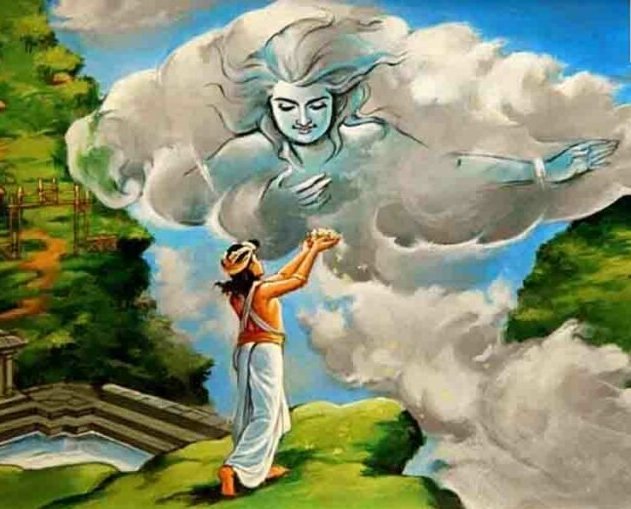
In his masterpiece lyrical poem Meghaduta (Cloud Messenger) written 4th-5th century CE, the Sanskrit poet narrates a story of a nature spirit, exiled by his master Kuber to a lonely hill for a year, who attempts to send his love to his beloved through a cloud as a messenger. One of the greatest poems written in Sanskrit, Meghaduta is divided into two parts: the journey of the cloud and the message that it carries.
Memory of Rose

From the Jasmine that spirit offers to the elephantine cloud, to the repeated mentions of peacocks that rejoice with the onset of the rain-giver, Kalidasa’s romanticism embedded in an appreciation of nature triggered a genre of poetry of Sandesh Kavya (messenger poem) in the Indian subcontinent whereby poets portrayed a stranded lover attempting to send message to their beloved via a messenger.
The element of novelty in Meghaduta is not just the personification of an inanimate object that is the cloud, but the conversation between the spirit and a personified cloud. Written more than a millenia later, 'The Daffodils' by English romantic poet William Wordsworth does slightly personify a cloud by comparing himself to a cloud. I wondered lonely as a cloud… one of the groundbreakers of romantic movement in English poetry reminisced, but he never identified the cloud as a person, rather simply reduces it to a metaphor.
In one aspect, the romantic movement of Sanskrit is in itself at least 1500 years older than its English counterpart, explaining the difference in creative capacity in romanticizing nature by pumping life into the inanimate. The best attempt to personify a cloud by an early English poet comes via romantic poet Percy Bysshe Shelley’s 'The Cloud' (1820) where the narrator is a cloud.
Shelley’s poem still falls short of Kalidasa’s masterpiece in terms of bringing life to nature as it is a mere conscientious attempt to feel into a cloud, or as modern philosophers would call it, empathize with a cloud. By empathizing with a cloud, Shelley seems to recognize that the cloud feels but without a hint of connection to rational beings like the spirit, the poem lags behind in humanizing a cloud. In Meghaduta, however, Kalidasa through the conversation between the nature spirit and the cloud uplifts the inanimate rain-giver to personhood by assigning it the role of a messenger. And it is important to note that the messenger is not similar to a pigeon that carries a message without comprehending its contents.
If the English poets were not influenced by Kalidasa’s portrayal of a cloud, it could be reasoned that writers, independent of its origin, have a literary fixation with clouds. Romanticists, as eccentric as they are in attempting the unthought (you need not look beyond PB Shelley’s wife Mary Shelley’s 'Frankenstein'), are the most susceptible to attempting to bring clouds to life. But nobody does it better than Kalidasa.
@@@