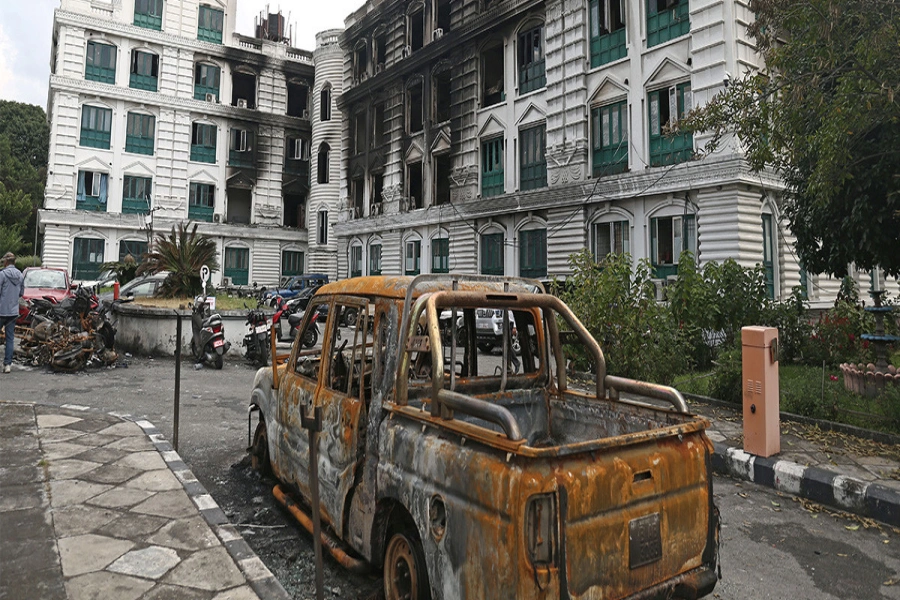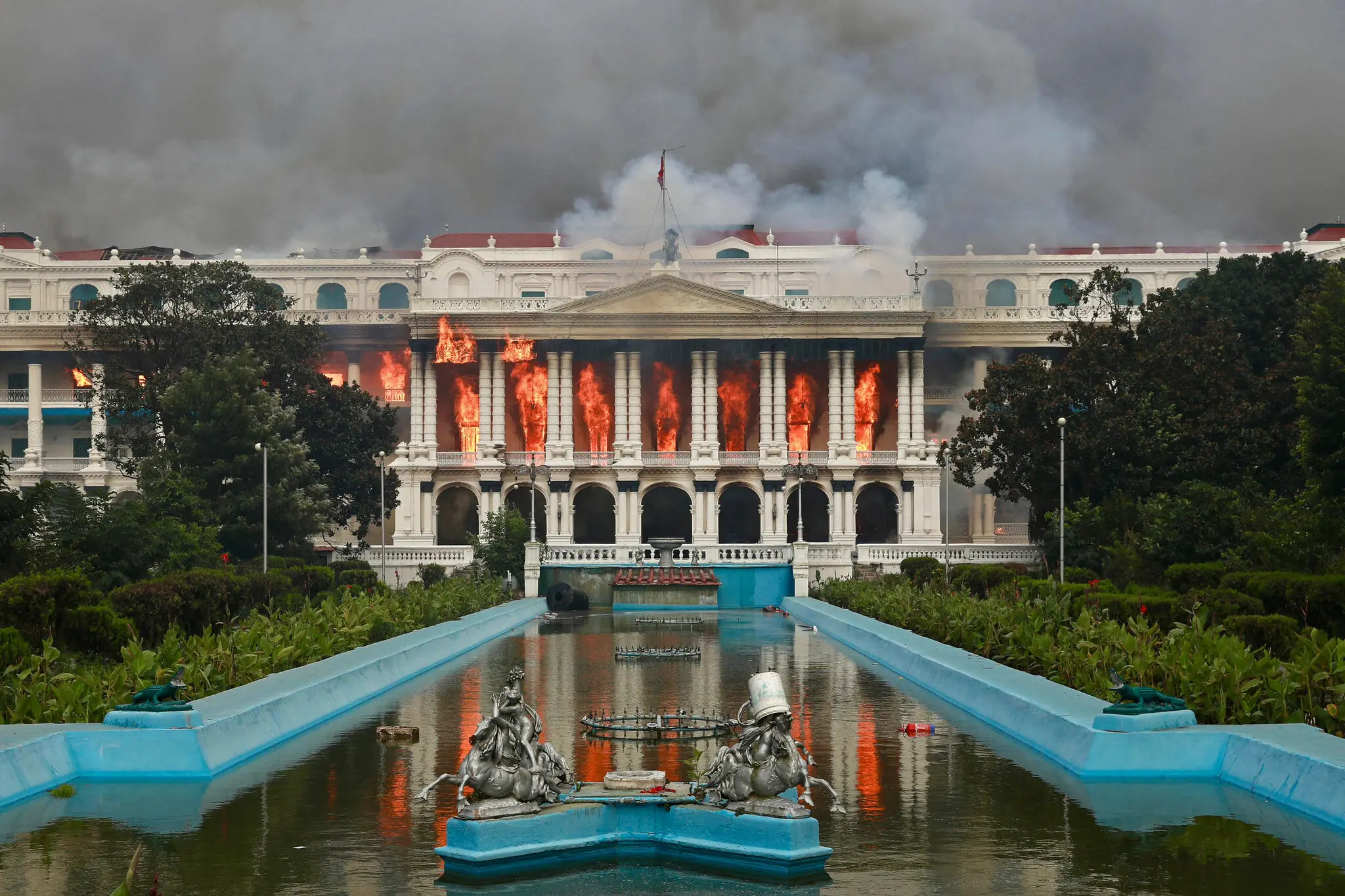
KATHMANDU, Oct 13: What initially appeared to be a day of spontaneous rage in Nepal is now emerging as a carefully planned campaign of destruction, according to a New York Times investigation into the September 9 arson attacks that left dozens of government and private buildings across the country burnt down.
The investigation — based on dozens of interviews, forensic assessments and field visits — found evidence suggesting that the nationwide fires, which erupted a day after 19 protesters were killed by security forces, were “too organized and too widespread” to have been a spontaneous reaction.
On September 9, fires consumed Nepal’s key state institutions — including ministries inside Singha Durbar, the Supreme Court, and ward offices — along with private homes of politicians and businesses linked to politicians. More than 110 police stations in and around Kathmandu were torched, causing losses estimated at nearly one-third of the country’s GDP, according to a cabinet minister quoted by The New York Times.
“You don’t get so many buildings on fire in a short time frame without a good deal of organizational prowess,” said Richard Hagger, a senior fire investigator cited in the report. “Something like that takes weeks, if not months, of planning.”
You don’t need to put climate change in the headlines to tell g...

The report revealed that “ready-to-use lists” containing personal details of prominent figures accused of corruption surfaced online just hours after the Sept 8 shootings. By the following afternoon, many of the individuals named on those lists had seen their homes or offices set ablaze.
Fire experts told the NYT that the speed and scale of the conflagrations indicated the use of specialized accelerants. “Looking at photographs, I suspect that sodium or magnesium or other chemicals were used because of the size of the conflagrations,” said Pawan Dhungana, section chief of Nepal Police’s central forensic science lab. However, he confirmed that his team has not been asked to conduct any tests since the incident.
“Seeing all these conflagrations, not just in Kathmandu but all around the country, one can suspect it was preplanned,” Dhungana said. “Of course, we don’t have any evidence of anything.”
Witnesses told the NYT that attackers arrived with fuel containers and petrol bombs, and that some bragged they would be paid after the job was done. In several cities, buildings were set ablaze on alternating floors — a method used to link fires and intensify damage.
Despite the scale of the disaster, Nepal’s security forces reportedly remained passive. Four people with direct knowledge of the situation told the NYT that troops were ordered not to intervene. Only Parliament’s perimeter saw active police defense, even as fires spread across Kathmandu.
The interim government of Prime Minister Sushila Karki has announced a commission to investigate both the arson and the excessive use of force by security personnel. However, a forensic police officer told The Times that judicial delays could mean “up to seven years” before any conclusive report is produced.
Even the anti-corruption court and Supreme Court archives suffered heavy losses, with an estimated 60,000 case files destroyed. “We all want to know who did this,” Dhungana said. “But it’s almost like we cannot find out.”