KATHMANDU, May 29: After Donald Trump was elected as the President of the United States, the US government halted the Millennium Challenge Corporation (MCC) grant assistance project. In response, the Nepal government has requested that the MCC project be continued.
Following Trump’s election, the Department of Government Efficiency (DOGE), led by Elon Musk, unilaterally announced the suspension of the MCC, despite it being ratified by the parliaments of both countries.
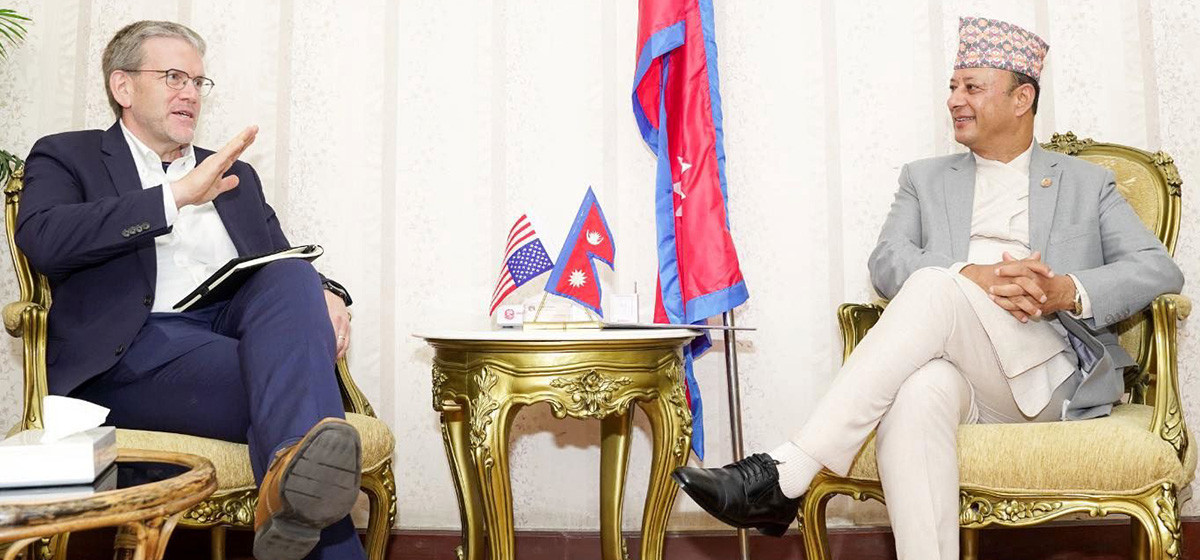
Nepal’s Minister for Energy, Water Resources, and Irrigation, Deepak Khadka, urged US Ambassador Dean R. Thompson to take the initiative in ensuring the continuation of the MCC. During their meeting, they discussed various aspects of energy cooperation between the two countries and the implementation of the MCC project.
Energy Minister Khadka stated that work on projects initiated through the MCC is underway, but the recent hold on the project has created some uncertainty. “We believe that the MCC project will continue and that there will be further American support in the energy sector,” the Energy Minister told the US Ambassador.
Although it has been said that the MCC will continue in some countries, no further decision has been made regarding Nepal.
PM Dahal joins MCC CEO Albright to celebrate the launch of the...

During the meeting with Minister Khadka, US Ambassador Thompson assured that the US will continue its support and cooperation in Nepal’s energy sector. Quoting the ambassador, the Ministry of Energy stated that every possible effort is being made to advance the MCC project. The meeting was attended by MCC and MCa representatives as well as senior officials from the ministry.
The MCC is a grant project worth about 550 million dollars (approximately Rs 75 billion). Although the project was initially halted shortly after Trump’s election, there were indications in March that it would continue, but it was halted again.
While the US was reviewing its foreign aid policies, MCC Nepal had reported that permission was granted in the second week of Chaitra (mid-March) to move forward with some activities under the MCC Nepal Compact, but the project was later stopped again.
The MCC agreement initially included a grant of 500 million dollars from the US, but later an additional 50 million dollars was added, making the total grant 550 million dollars. Including Nepal’s investment, the total investment in the MCC is 746.7 million dollars. The Nepal government had agreed to invest 196.7 million dollars.
Under the joint investment of MCC and the Nepal government, the agreement includes constructing a 315-kilometer-long, 400 kV capacity transmission line, three 400 kV substations, and an upgrade project for 77 kilometers of road from Bhaluwang in Dang to Shivakhola in Banke.
The MCC project faced significant controversy when it was launched in Nepal. The MCC Nepal Compact was approved along with a 12-point explanatory note. After the MCC was halted, the government also faced difficulties in budget management.
For the upcoming Fiscal Year (FY), the National Planning Commission (NPC) has recommended increasing the budget ceiling to Rs 190 billion, with foreign grants rising by 22 percent and foreign loans by 30 percent. As the budget increasingly relies on foreign grants, the US suspension of approximately 550 million dollars in aid has added challenges to Nepal’s budget management. The Ministry of Finance has stated that the suspension of US assistance will affect programs (budget).
In 2022, the United States Agency for International Development (USAID) and Nepal signed a five-year development objective agreement worth 659 million dollars. Although some funds have been spent over the past two years since 2022, the remaining amount has been halted.
Approximately three dozen programs operating through Nepal’s budgetary system under agreements with the US’ main foreign aid agency, the USAID, have been affected.
Programs worth 71.7 million dollars through the budgetary system and 587.3 million dollars implemented in collaboration with US development partners were underway. Following the executive order, programs related to education, health, agriculture, and statistics, which were being run through the Nepal government’s budget system, have been halted.