KATHMANDU, July 25: Amid discussions confirming Prime Minister KP Sharma Oli’s visit to India, the two countries have agreed to finalize the text for the review of the "Extradition Treaty and the Mutual Legal Assistance Agreement."
This agreement was reached during the Home Secretary-level meeting between the two countries, which took place on Tuesday and Wednesday in New Delhi, India. The meeting was held after a gap of nine years.
Discussions are ongoing about Prime Minister Oli visiting India on August 16. Amid this, the Home Secretary-level meeting decided to review the extradition-treaty. A team led by Home Secretary Gokarna Mani Duwadi had left for Delhi on Monday for this purpose. The meeting finalized the draft of the Mutual Legal Assistance Agreement between Nepal and India. After both governments agreed to the draft, the high-level agreement was signed.
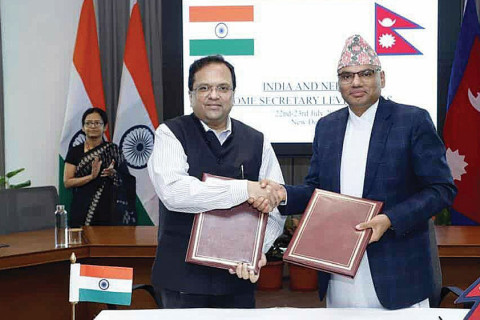
Following the agreement, Home Secretary Duwadi on behalf of Nepal and Home Secretary Govind Mohan on behalf of India exchanged the agreement documents. It is believed that this agreement will help in controlling transnational crime.
Home Joint Secretary Ram Chandra Tiwari, spokesperson for the Ministry of Home Affairs (MoHA), who participated in the meeting, said that the draft had already been agreed upon at the technical level.
Experts discuss historic Nepal-Britain 1923 Treaty

He also said that the meeting reached an agreement on amending the existing Supurdagi-Sandhi “There has been an agreement on amending the Extradition Treaty,” said a source at the MoHA.
India is the only country with which Nepal has a extradition treaty. The treaty was signed in 1953, and now the way has been paved to initiate a review process.
According to the treaty, if a person accused or convicted of a crime in one country is found in the territory of the other, the individual may be extradited by the treaty's terms and conditions. India’s then-Home Minister Rajnath Singh raised the issue of reviewing the treaty during the state visit of then-President Bidya Devi Bhandari. The topic had also come up during the Home Secretary-level meeting in 2016. Nepal had consistently rejected India’s proposals to include provisions allowing Indian police to enter Nepal in uniform and to extradite third-country nationals declared “most wanted” by India.
During the Home Secretary-level meeting held in New Delhi in September 2016, the Indian side had agreed to remove those provisions. However, consensus was not reached at the time as the Nepali side argued those provisions contradicted its legal system. Currently, it is still unclear which points have been agreed upon.
The original Extradition Treaty was signed on October 2, 1953, between then PM Matrika Prasad Koirala and Indian Ambassador Balachandra Krishna (BK) Gokhale. India has been pressuring for a new treaty in line with the present context, arguing the old treaty is now outdated. Since a new treaty has not been signed, the security agencies of both countries have been informally exchanging most-wanted individuals residing in each other’s territory.
The treaty gained significant attention when Yasin Bhatkal (Mohammed Ahmed Siddibappa), the founding leader of the terrorist group Indian Mujahideen, was secretly handed over by Nepal Police to Indian authorities. He had been arrested in Pokhara in August 2013. Before that, in May 2013, Nepal Police had arrested Bablu Dubey, who was on India’s most-wanted list, from Sitapaila, Kathmandu, and handed him over to India.
Given the open border between Nepal and India and the legal provision that allows citizens to travel between the two countries without a visa or permit, India had strongly pushed for timely review of the Extradition Treaty. Although attempts to review the treaty have been ongoing since 2008, the process had stalled due to Nepal's lack of consent.
“It was not possible to amend the treaty due to the risky conditions proposed by India. It still remains to be seen which points have been agreed upon this time. The process will now move forward,” a source at the MoHA said. One of the most contentious issues was India’s insistence that Nepal should agree to extradite not only those who committed crimes in India, but also individuals sought by Indian authorities for investigation—even if they were not Indian citizens.
According to the provisions of the Nepal–India Extradition Treaty, a person involved in any of the 17 listed criminal offenses and who flees to the other country may be extradited. The treaty includes offenses such as murder and serious crimes leading to death, fatal assault or battery, rape, gang robbery, highway robbery, violent robbery, burglary or theft, arson, desertion from the military, smuggling of prohibited items, and bribery by government officials.
It also includes violent theft, theft of goods worth over 500 rupees, cattle theft, abduction or enforced disappearance, forgery or counterfeiting of documents or currency, holding property obtained through the aforementioned crimes, and prison escape while serving a sentence for any of these crimes.
The recent Home Secretary-level meeting also indicated India’s positive stance on border management. During the discussions, both parties agreed to review all aspects of bilateral security cooperation and border management and to further strengthen them.
According to sources from the Ministry of Home Affairs, the two sides agreed to cooperate in the repair and maintenance of border pillars, address cross-border criminal activities, strengthen the work of border district coordination committees, improve border infrastructure—particularly Integrated Check Posts (ICPs), roads and railway networks—enhance the capacity and empowerment of security institutions, and collaborate on disaster risk reduction and management.