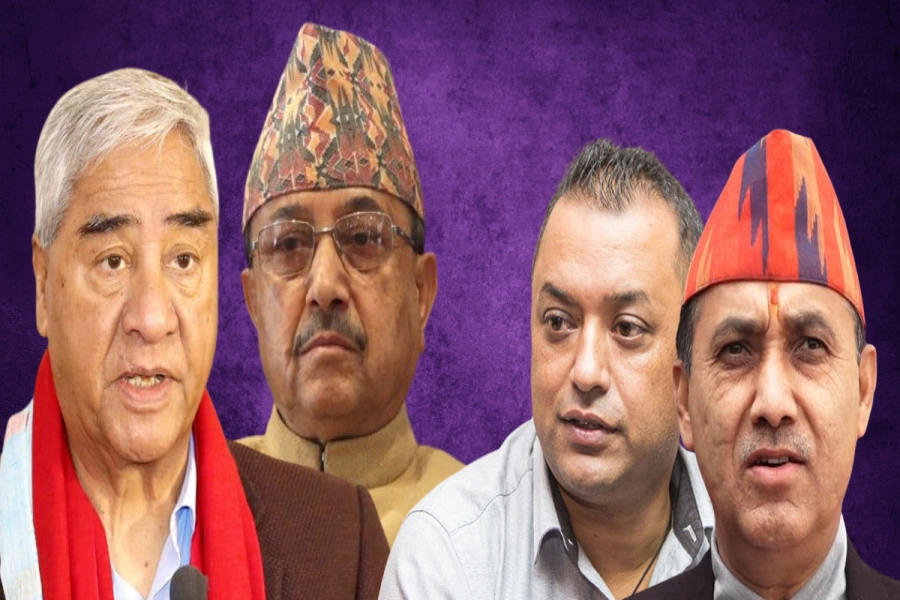
KATHMANDU, Dec 22: Nepal’s oldest political party, the Nepali Congress (NC), is currently preparing for its 15th General Convention. While its main rival, the CPN-UML, has already elected new leadership through its general convention following the violence of September 8 and vandalism on September 9, the NC has remained entangled in internal disputes.
As the party debated whether to hold its general convention before or after the House of Representatives (HoR) elections scheduled for March 5, the NC extended its Central Working Committee (CWC) meeting for 48 days. Eventually, it decided—after prolonged hesitation—to hold the convention in Kathmandu starting January 10. However, the controversy surrounding active membership, which forms the backbone of the convention, remains unresolved.
Although the party had decided to distribute new membership forms down to the ward level by December 11, it claims to have delivered membership forms only up to the district level by Friday night. Declaring a large-scale membership expansion drive, the NC says it has dispatched 600,000 new membership forms through districts and constituencies to the grassroots level.
Founded in 1946 by BP Koirala and other young leaders, the NC has steadily increased its active membership after every general convention. Despite leading Nepal’s political, economic, and social transformations for decades, the party’s growing membership base has not translated into electoral gains. Instead, the NC has continued to lose votes in recent general elections.
Party leaders themselves have begun to complain that, as the NC becomes increasingly disconnected from the younger generation, active membership is being distributed less to win elections or energize party organization and more to strengthen factional influence. At a time when the party is struggling to win over urban voters and is losing credibility among people in remote areas, the obsession of leaders with securing personal political futures by capturing party structures has further complicated the membership dispute.
NC’s 14th General Convention: Over 852,000 verified as active m...

As a result, it has become almost certain that the general convention scheduled for January 10 will be postponed.
The NC had formed a committee under General Secretary Gagan Kumar Thapa around 18 months ago to oversee the distribution and management of active membership. However, even the renewal of existing memberships has not been completed so far. Committee member Prakash Rasaili claimed that the renewal process has reached its final stage, except in a few districts such as Dhanusha, Bara, and Pyuthan.
Ahead of the 14th General Convention, the NC renewed about 72 percent of its active membership. Rasaili said the renewal rate would be higher this time.
During the 14th General Convention, the party increased its active membership by nearly 100 percent, pushing the number beyond 852,000. However, this did not lead to an increase in votes in the November 2022 general elections. Instead, the NC received over 700,000 fewer votes than in the previous election.
This decline came despite General Secretary Thapa’s pledge to add 1.5 million new voters to the party ahead of the 2022 elections. The party had doubled its active membership during the 14th convention, claiming it would attract young voters. Yet in the 2022 election, the NC lost 754,000 votes, securing only 2,715,225 votes, or 25.71 percent of the total.
A party leader pointed out that in several constituencies, the number of active members exceeds the proportional representation votes received by the party. “Earlier, even if there was just one active member in a neighborhood, most residents voted for the Nepali Congress. Now, there are active members in almost every household, but votes for the party continue to decline in general elections,” the leader said.
According to him, the practice of distributing membership to protect personal influence and dominance at every party level has increased numbers on paper but weakened the party in reality.
In 2008, following the unification of the NC and NC (Democratic), the party had around 500,000 active members and secured 21.14 percent of the vote in the first Constituent Assembly election. With about 450,000 members maintained after the 12th General Convention, the party received 25.55 percent of the vote in the 2013 Constituent Assembly election. The membership figure remained similar during the 13th General Convention in 2016, and in the 2017 general elections, the NC won 32.77 percent of the vote.
Currently, the party is renewing around 800,000 memberships and has distributed 600,000 new membership forms. Yet party leaders themselves admit that, rather than increasing votes in the next election, the NC is more likely to see a further decline under the current circumstances.
Nevertheless, speaking at a public program on June 24, 2024, General Secretary Thapa declared that the NC would once again secure over 40 percent of the vote under the existing electoral system—similar to the 1991 election—and emerge not only as the largest party but one capable of forming a single-party government for five years on the strength of its own mandate.
While NC leaders and cadres may take confidence from such declarations, winning back public trust and votes appears far more difficult than in the past, as factions and individuals increasingly overshadow the institution itself.