
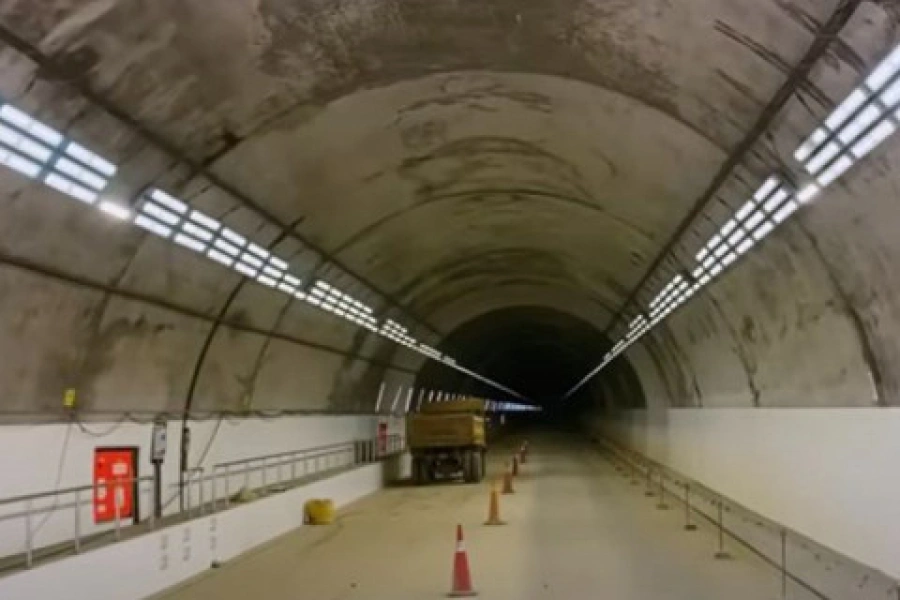
KATHMANDU, July 27: The Nagdhunga-Sisnekhola Tunnel will be formally inaugurated on Monday, nearly a year after construction was completed. Initially, only emergency vehicles, including ambulances, fire engines and security vehicles, will be allowed to use the tunnel.
According to Nagdhunga Tunnel Deputy Project Director Sanjay Panthi, the tunnel will remain under a three-month trial operation.
"After that, it will come into full operation. Even then, motorcycles and vehicles carrying fuel will not be allowed to use the tunnel," he said.
Minister for Infrastructure Development Sunil Lamsal will inaugurate the tunnel on Monday. The ceremony will also be attended by the head of the Japan International Cooperation Agency, JICA.
Foundation stone destroyed in fire
A senior official at the Department of Roads claimed that the foundation stone unveiled by then Prime Minister KP Sharma Oli for the Nagdhunga Sisnekhola Tunnel was destroyed in a fire during the Gen Z movement on September 8 and 9.
Although the tunnel will be officially inaugurated on Monday, the original foundation stone will not be displayed.
Deputy Project Director Panthi said the plaque had to be removed when tunnel excavation began because the tunnel alignment passed beneath its original location.
Nagdhunga tunnel set for trial operation from July 27
"We relocated the foundation stone to the Foreign Cooperation Branch of the Department of Roads in Babarmahal. During the Gen Z protests, the office building caught fire and the plaque was destroyed. We have been searching for it, but have not found it," he said.
Asked whether the plaque would be replaced, Panthi said no decision had been made.
Former Prime Minister Oli laid the foundation stone for the project on October 21, 2019.
Sources said the secretariat of Infrastructure Development Minister Sunil Lamsal has also taken interest in the missing plaque. However, they said the minister's office had never instructed officials to remove it.
An official at the ministry described the disappearance of the plaque as "gross negligence" if it had indeed been lost.
Project cost
Construction of the tunnel began in 2019 and its completion deadline was extended several times.
The project was built by Japanese contractor Hazama Ando Joint Venture. It received a concessional loan of Rs 16 billion from JICA, while the Government of Nepal spent an additional Rs 9 billion on land acquisition and other costs.
According to project officials, about Rs 18.5 billion was spent on construction and nearly Rs 6 billion on compensation.
Chinese Nepali joint venture to operate tunnel
The Ministry of Infrastructure Development has awarded the operation and management contract to Yusin ART Joint Venture, a partnership between Nepal's Yusin and China's ART, selected through a competitive bidding process.
The company is currently training 150 employees to operate the tunnel. Seven of them are foreign technical experts with prior tunnel operation experience, while it will be the first such experience for the Nepali staff.
The government has already published the tunnel toll rates in the Nepal Gazette. Fees will range from Rs 60 to Rs 600, with different rates for vehicles entering and leaving Kathmandu.
Under the agreement, ART Yusin JV has committed to paying Rs 1.1 billion in revenue to the government over the next five years from toll collection.
Why did operations begin late?
Project officials said the tunnel's opening was delayed because selecting an operator took several months.
The government had initially planned to begin operations on January 1, 2026, but repeatedly postponed the date.
Preparation of the operational guidelines also caused delays. The government approved the Tunnel Operation and Management Procedure only last October, setting out rules for tunnel operation, maintenance and service providers.
Officials at the Department of Roads said the tunnel will significantly ease traffic congestion at Thankot and Nagdhunga, where vehicles travelling into and out of Kathmandu often face long traffic jams.
The current distance between Balambu and Sisnekhola is 7.5 kilometres. With the tunnel in operation, the route will be shortened by about 2.5 kilometres to approximately 5 kilometres, reducing travel time by around 30 minutes.
According to the project, ART Yusin JV will also be responsible for operating safety systems inside the tunnel, including oxygen supply, firefighting equipment, communication systems, security infrastructure and toll collection. The company will also manage the tunnel's electricity supply.
A ministry official said Nepal had no previous experience in operating road tunnels, so drafting laws, procedures and operational arrangements took longer than expected.
"We have learned valuable lessons from this project. Future tunnel projects will be much easier to implement," the official said.