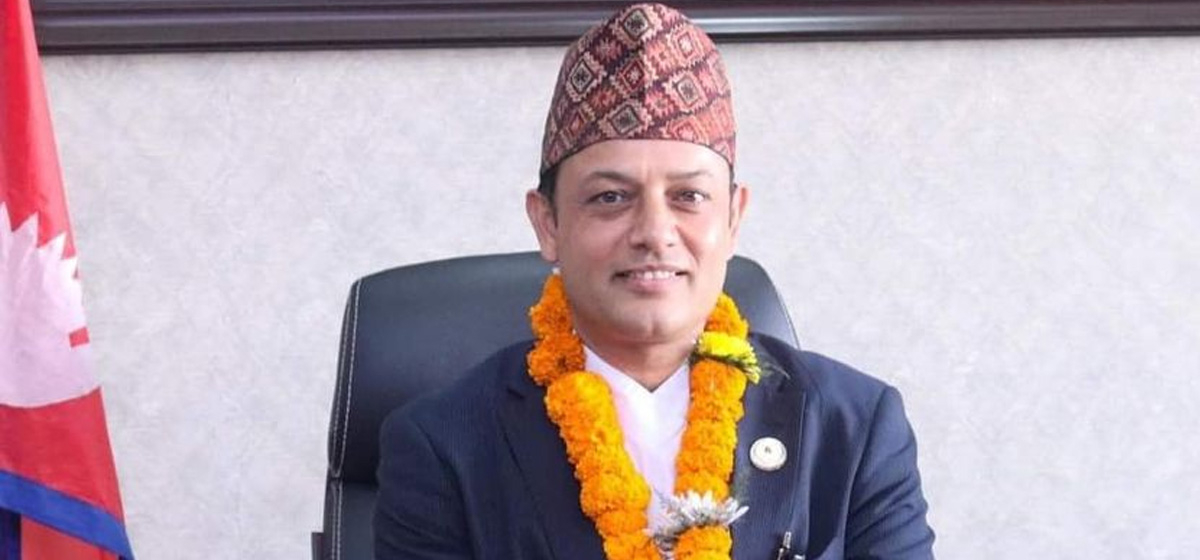
KATHMANDU, Nov 1: Nepali Congress (NC) President Gagan Kumar Thapa has said that a strong government requires strong state institutions, rules and laws, rather than simply a powerful prime minister.
Thapa made the remarks at a press conference on Sunday, a few days after the newly elected central working committee took office following the party’s 15th General Convention.
He said the government must act against corruption and investigate irregularities, but it must do so by following established legal procedures and respecting the institutions responsible for enforcing the law.
Thapa objected to reports that police had taken the director general of the Department of Irrigation and the chief of the Sunkoshi Marin Diversion Project into custody from their workplaces and questioned them at the Prime Minister’s Office.
He said the government has the authority to assign responsibilities to civil servants, take disciplinary action against those who violate rules and prosecute officials involved in corruption. However, it must not bypass established institutions and legal procedures to do so.
RSP Acting Chair Aryal calls for probe into GenZ movement viole...
Thapa also recalled an earlier incident in which officials, including the chief of the Commission for the Investigation of Abuse of Authority (CIAA), and staff from the Ministry of Foreign Affairs were reportedly kept at the Prime Minister’s Office for eight to nine hours in connection with a passport printing controversy. He also cited incidents in which a construction contractor and a government secretary were taken into police custody from their homes.
“There is a difference between the rule of law and ruling by using the law as a weapon. The rule of law does not mean only citizens must obey the law; the government must obey it too. The law applies to the prime minister, ministers and police alike,” Thapa said.
He acknowledged that the prime minister holds executive powers but stressed that those powers have limits. Problems arise when those limits are exceeded, he said.
“A strong government does not mean a powerful prime minister. It means strong institutions, rules and laws. Once all these are strong, the prime minister becomes strong automatically,” he said.
Thapa said the younger generation’s demand to end corruption was legitimate and that the Nepali Congress supported the campaign. However, he cautioned against disregarding legal procedures and due process in the name of fighting corruption.
“If we say that procedures do not matter, we will ultimately create conditions for even more corruption and protection of the corrupt. We have already seen that power corrupts,” he said.
He stressed that the government must take corruption control seriously but should not exercise power arbitrarily over state institutions and civil servants.
Speaking about the recent arrests and subsequent release of several journalists, Thapa said the issue should be addressed through parliamentary channels.
“Let the parliamentary party issue instructions. The prime minister should take those instructions, the government should act, an investigation should be conducted and results should follow. That is what we want,” he said.