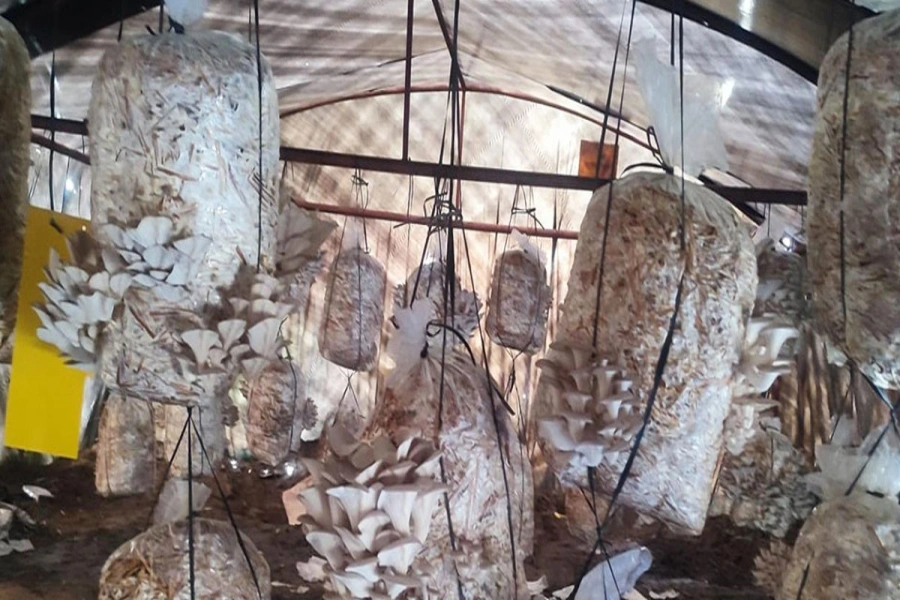
KATHMANDU, Dec 31: Nepal’s mushroom sector has made a strong commercial breakthrough, generating an annual turnover of Rs 20 billion as domestic production expands rapidly.
According to the Mushroom Producers’ Association of Nepal (MPA-N), approximately 35,000 farmers nationwide produce nearly 50,000 metric tons of mushrooms annually.
Despite achieving self-sufficiency in mushroom production, farmers claim that the industry continues to struggle with transportation issues for raw materials and policy ambiguities.
Nearly 90 percent of straw—the primary raw material for mushroom cultivation—is transported from Madhesh Province to the Kathmandu Valley and other hill districts. Farmers complain that administrative authorities frequently harass them during transportation, often under the pretext of inspections.
Cooperation for trade

“When transporting straw, which is essential for farming, traffic police and administrative officials create unnecessary obstacles in the name of checks,” said Binod Paudel, operator of Jaleshwor Agriculture Mushroom and Livestock Farm Pvt Ltd in Thake Rural Municipality–10, Dhading. “This has increased production costs.”
MPA-N Chair Santosh Karki said Nepal has now become fully self-reliant in mushroom production, marking a sharp shift from the past when nearly 80 percent of mushrooms were imported from India.
“There is no longer a need to import mushrooms,” Karki said. “Instead, mushrooms produced in Nepal have already begun to be exported as samples to Gulf countries such as Dubai and Kuwait.”
Currently, oyster, button, shiitake, and king oyster mushrooms are being commercially produced in Nepal. Data from the MPA-N show that daily consumption in the Kathmandu Valley alone stands at 10,000 kg of button mushrooms, 1,000 kg of king oyster, 500 kg of shiitake, and 50 kg of oyster mushrooms.
Alongside transportation hurdles, a shortage of skilled labor has emerged as another major challenge.
Paudel, who has been cultivating mushrooms in 50 tunnels for the past six years and earns between Rs 1.5 million and Rs 1.7 million annually, said labor shortages are increasingly severe. “Where five or six workers are needed, it is difficult to find even one. Even when workers are hired, many leave within three to four months due to the growing trend of overseas migration,” he said.
Farmers also say they are compelled to import mushroom seeds (culture) through informal channels due to the absence of a legal framework. They complain that the state has not invested adequately in mushroom seed production and research.
Mushroom producers have been demanding production-based subsidies, customs exemptions, facilitation in seed supply, export certification, and broader policy support from the government.
According to the MPA-N, with proper policy-level facilitation, mushroom farming could make a significant contribution to Nepal’s economic growth.