–Albert Einstein
I’m forgetful about facts like dates. I can never remember them. They always slip through my mind. Unfortunately, the education system in our part of the world is more into rote learning and mugging up than generating ideas and finding ways to conduct research. I think it’s the idea that’s more significant than the particular date when a specific event took place. And it’s totally unfair to penalize someone and put a question mark on his or her caliber simply because they have not learnt the dates by heart. For example, I’ve taught Virginia Woolf’s “Orlando” in the Masters level but I don’t know the exact date it was published. I do know that it was in the 1920s though. And I believe it’s sufficient. People should not be judged on the basis of their power to memorize. Memories are not our possessions. Ideas are. So we must be able to possess or come up with more of those. [break]
Einstein also said that he was born intelligent but education ruined him. That’s also a case that I’ve witnessed quite a few times. Our education system is still rigid and traditional with little space for openness and creativity. When you try to put everyone in the same league and status, problems definitely arise. For example, if a child cannot memorize something but can read something and write about it in his or her own words, that’s the best thing that could happen to the instructor as well as the learner. As a teacher, we should make our students capable of producing their own ideas rather than merely reproducing what we teach them. And this must happen from the school level itself.
Bhaswor Ojha
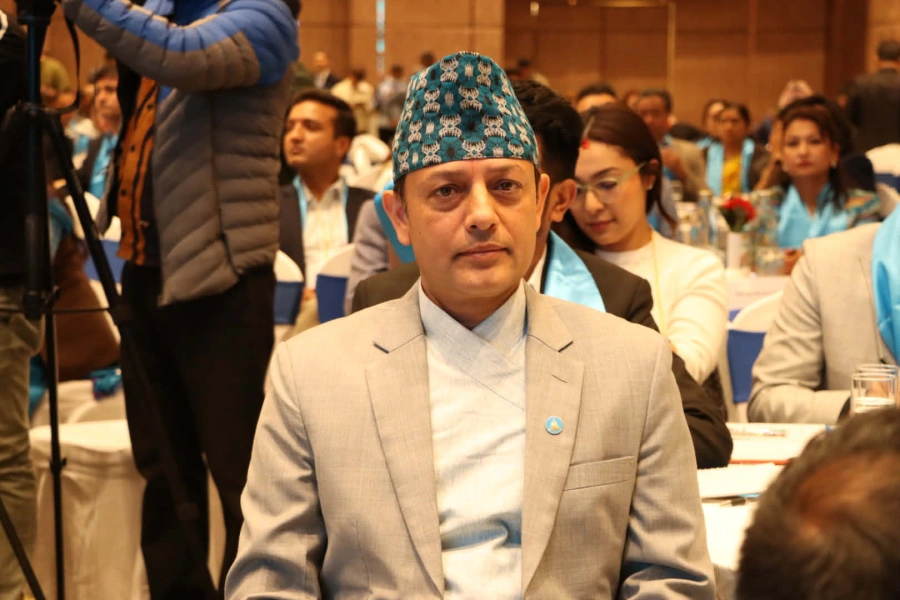
About Paudyal
Paudyal’s childhood was spent in India. He started out as a science student but soon realized that he was not cut out for science. Literature, he realized, was his forte since he had strong literary tendencies. As a college student, he was involved in student politics. He was associated with All Manipur Gorkha Student’s Union. His father was very supportive of his political activities because he too, was an activist.
He used to read a lot of novels during his bus ride to school and back. After he came to Kathmandu in 2003, he started teaching in a school. That’s where he got a chance to study the kids. As a hostel in charge, he would be with them all the time. He read a lot of books like Gulliver’s Travels, Lord of the Rings, Alice in Wonderland and Harry Potter.
He used to write stories, poems and plays since early schooldays. He has written school textbooks and twelve other books for children that include novels, short stories and drama. He has also written a book of short stories and criticism for adults. He has also translated more than twenty books so far.
He’s really concerned about the fact that Nepali literature has not gained much global and international recognition. “One main reason is that our writings don’t have original ideas and we aren’t rooted in purely local epistemology,” he says.
“I have written articles about it and held discussions on how to export Nepal to the foreign soil in all its uniqueness and novelty.”
Paudyal’s five picks
Bhagwad Gita Ved Vyas
On contrary to the popular belief, Gita is not abstract but very practical. It answers every philosophical question about life. My favorite part of Gita is Vibhuti Yog. It’s the tenth chapter. It talks about the presence of divinity in almost everything. This is the best approach towards non violence because the moment we see everything as a divine essence, we stop violence.
Muna Madan Laxmi Prasad Devkota
It’s a Nepali classic because it’s a story of most of the Nepalis people. It’s by far the best production from Nepal. It’s rooted in Nepali folk tradition and culture. Its metrical pattern is that of “jhyaaure chhanda” which is so intimately Nepali that it’s a classic for all generations, regions and communities. The pathos is so powerful that it breaks the reader into tears.
The Adventures of Tom Sawyer Mark Twain
This is the most realistic portrayal of childhood. Before this, books were usually infused with doses of fantasies and supernatural powers. So, children probably couldn’t find themselves portrayed realistically. With Tom Sawyer, came the amalgamation of vices and virtues in a child which is exactly how kids are in reality.
Hungry Stones and Other Stories Rabindranath Tagore
This is Tagore’s work for a common reader. The language is as mesmerizing as always but it’s simpler. These are timeless stories that are close to humanity and carry a universal human appeal. Most stories have children as characters. Some of my favorites are Postmaster, Homecoming and Kabuliwala. They evoke sympathy and compassion in the readers.
Of Mice and Men John Steinbeck
The writer is a Nobel Prize winner in literature. This is the best book on friendship between two poor and homeless men. Poor men’s dreams are like that of mice. They’re deemed worthless and are hardly, if ever, fulfilled. The two friends George and Lennie dream of a rabbit, a house with a lawn and some land. But the dreams never come true. In the end, George shoots Lennie in order to save him from being ruthlessly killed by other people. This is a dismal example of mercy killing.
As told to Nitya Pandey
Related story
Literature and int’l drama festival to be held in Janakpur