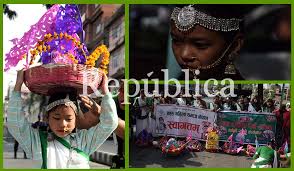

KATHMANDU, Aug 16: The traditional Jhulanotsav, or Swing Festival, began in the Mithila region on Saturday with the start of Shukla Tritiya in the month of Shrawan. Devotional songs dedicated to Lord Vishnu and Goddess Lakshmi have begun echoing across Mahottari and other parts of the Mithila region.
The festival is dedicated to Vishnu and Lakshmi, with idols of Ram and Sita, and Radha and Krishna, regarded as their incarnations, placed on elaborately decorated swings. Devotees rock the swings while singing devotional songs. The festival concludes on the full moon day of Saun and remains one of Mithila’s distinctive cultural celebrations.
With the festival underway, temples and monasteries across Mithila have taken on a festive atmosphere. In Mahottari, devotees and saints have gathered at Ram Janaki, Lakshminarayan and Radhakrishna temples, as well as Vaishnav monasteries, to participate in the celebrations.
Dr Rabindradas Vaishnav, successor Mahant of the Lakshminarayan Monastery in Matihani, said the festival holds a special place in Maithil Hindu tradition as an occasion for devotion, cultural expression and entertainment.
“This is a festival in which the child forms of gods and goddesses are placed on swings. It symbolically recalls how Kaushalya, mother of Lord Ram, and Yashoda, mother of Lord Krishna, rocked them in cradles,” he said.
Promoting Mithila Art

Unlike many household festivals, Jhulanotsav is celebrated collectively at monasteries and temples. Idols of Ram and Sita, and Radha and Krishna, are placed on specially decorated swings, which devotees rock while singing. Holding the ropes and singing Jhula songs, devotees express their devotion through music, dance and prayer.
The festival formally began in Matihani on Saturday evening, when idols of Lakshminarayan were carried in a palanquin from the Lakshminarayan Temple to the swing house in a procession accompanied by traditional music.
Throughout the festival, people gather at monasteries and temples near their settlements, singing devotional songs and dancing while rocking swings carrying idols of Sita Ram and Radha Krishna.
Jhula, Malhar and Kajari songs based on traditional Maithili folk melodies are commonly performed during the festival. Although Jhulanotsav is celebrated across the ancient Mithila region, the celebrations at the Lakshminarayan Monastery and Temple in Matihani and the Janaki Temple in Janakpur are particularly well known.
The festival is also celebrated at the Ram Janaki Kuti in Jaleshwar 1 and Bardibas 14 of Mahottari.
The festival is believed to have entered Mithila under the influence of traditions from Ayodhya, regarded as the birthplace of Lord Ram, and Vrindavan, associated with Lord Krishna’s childhood. Since Janakpur was Sita’s maternal home, local tradition holds that the festival was introduced around 1787 BS by saint Surkishor Das as part of the Maithil tradition of pleasing the son in law.
According to local tradition, King Janak presented a vast quantity of diamonds, gems and precious stones as dowry during the marriage of Ram and Sita. The heap is said to have grown into a hill, now known as Manipurvat, located about five kilometres northwest of the Janaki Temple in Janakpur. Mithila tradition calls for the hill to be worshipped on Shukla Tritiya of Saun to mark the beginning of the Swing Festival.
Matihani has a dedicated swing house where idols of Vishnu and Lakshmi are brought from the Lakshminarayan Monastery and Temple in palanquins and placed on swings. This year, idols from dozens of monasteries and temples in Mahottari and across the border in India have been brought to Matihani for the festival. Saints and ascetics gather at the site throughout the celebrations.
The festival traditionally concludes on the full moon day of Saun, when the rope of the swing carrying the idols of Vishnu and Lakshmi is cut.
According to Manoj Jha Mukti, associate professor of Maithili language and literature at Yajnavalkya Lakshminarayan Vidyapeeth in Matihani, both the Vidyapati and Mithila calendars used in the region begin the year with the lunar month of Saun. Festivals such as Madhushravani, Jhula, Nag Panchami and Raksha Bandhan, all celebrated during Saun, therefore mark the beginning of the annual cycle of festivals in Mithila.