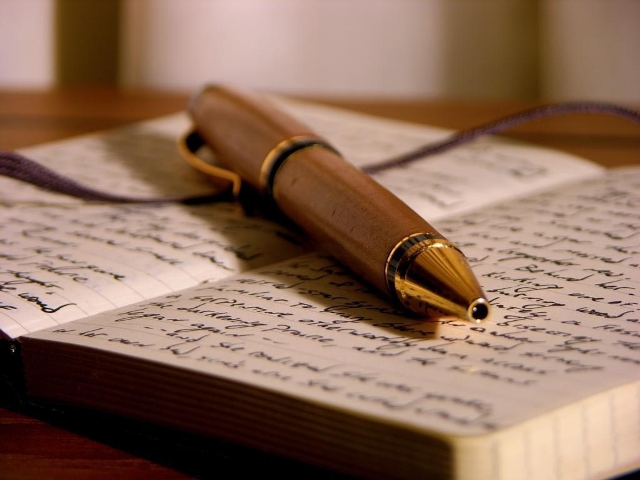
This ‘blank screen-empty mind’ syndrome has been bothering me a lot of late. Are my creative juices drying up for good? Are the write neural connections inside my brain perpetually misfiring? As you can imagine, for someone who makes his living writing, this is no trivial matter. [break]
You sit in front of the flickering monitor, waiting, without the faintest idea of what you might eventually write. You scratch your head, constantly shift positions, pace the room. Nothing helps. Somehow you seem to have convinced yourself that no matter what you write, and however hard you try, the final outcome is going to be worthless.
elliebloo.com
As depressing as the whole experience can be, I also find it fascinating that I should have nothing to write about when I can literally choose from among a million different things. As I lie on my back propped up against a pillow in my bed, a photo collage smiles down upon me from the study table to the right. These are the photos of my niece, not yet a year old when they were taken. Cute, cuddly, and mischievous, her big khol-rimmed eyes shining through her rotund face, Anaya looks simply out of the world. If I put my mind to it, I could easily write a few thousand words on her. But I don’t.
By the side of the framed photo montage is a book that is supposed to give me ‘writing tips’ whenever my mind goes kaput for ideas, as it often does these days. But nine times out of ten, it would not even occur to me to open the book for the much-needed inspiration. It’s far easier to give in to the temptation of not writing anything because, well, writing is hard and not everyone’s cup of tea. (Is it mine? I wonder).
Sometimes, even if you feel like writing something, you don’t see the point. Like Lawrence ‘Tubby’ Passmore, the writer protagonist of David Lodge’s Therapy, you reach a point in your life when doings things simply because you are supposed to stops making sense. There has to be an overarching purpose, an overall theme to connect all the loose ends in your life. In Lodge’s fictional universe, every character faces an ‘existentialist crisis’ at some point. At that point, they start searching for tailor-made ‘therapies’ to get a semblance of order back into their lives. This might entail taking a long pilgrimage, visiting a counselor, repenting for an old sin or, in Tubby Passmore’s case, simply reading Kierkegaard.
For many people like Passmore, the very act of writing can be therapeutic. When your head’s a mess, it can help put things into perspective. Those who keep a diary supposedly enjoy better psychological health. The people who can clearly put into writing their future goals have been found to be more successful than those who only have fuzzy (unwritten) ideas about what they want to do with their lives. But again, it’s much-much easier to write for a one-man readership (yourself) than for a wider audience.
One of the reasons people want to get published is to connect with other likeminded people, the potential readers. Writing is a powerful means of communication. But how can you hope to engage the busy readers who have far better things to do than go through no-good, self-congratulatory trope they are so used to seeing in the mass media?
The secret is to muddle through, in the hope that you will eventually come up with something worth a read. The surprising thing is that more often than not, you actually do. Human beings are programmed to create patterns. There is a method even to Kafkaesque madness. For a writer, once you have something (anything) on the screen it’s a question of working with what you got. A.E. Hotchner, in his biography of Ernest Hemingway, quotes the celebrated American author as saying that after he wrote something he spent most of his time “honing [the stuff] and honing it until it gets an edge like the bullfighter’s estoque, the killing sword.”
Writing is hard work. Sadly, most of the stuff we get to read in newspapers are works of lazy, self-obsessed writers who just want to get a byline even for a piece of absolute hokum.
At least, they write. There are many who can’t bring themselves to write anything but never tire of complaining what a poor lot of writers we have!
The writer is the op-ed editor at Republica.
biswas.baral@gmail.co
Related story
ICC T20 World Cup: England set Nepal a challenging 185-run targ...