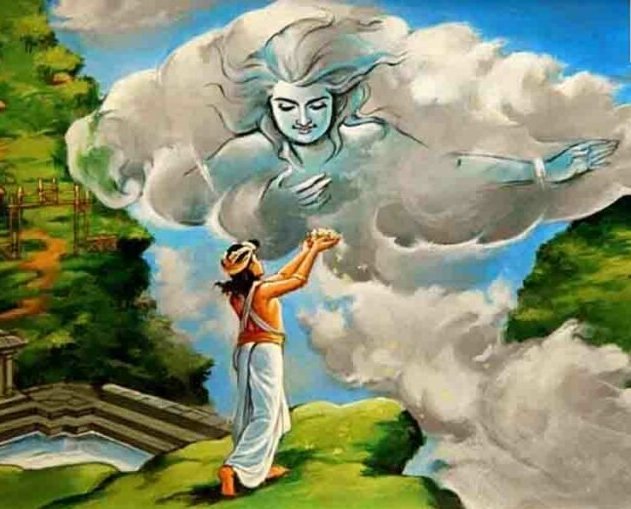
There, the man discovers that the beast isn’t such a beast, after all. Rumors of its taste for human flesh prove false when the man sees the din’s young captives playing in a garden in the shade of pomegranate trees, surrounded by water fountains, sculpted hedges and marble terraces. His young son is among them, but he leaves him there in paradise, declining the din’s offer to take the boy home to a village where children are prone to die of the cold.
In the novel, the tale becomes an allegory of sorts. Its teller is Saboor, a newly remarried widower who regales his children Pari and Abdullah. The siblings are unusually close. “Each night they sleep together in their cot, their heads touching, their limbs tangled.” After the death of their mother in childbirth, it was Abdullah, who cared for Pari as an infant, changing her diapers, and soothing her when he cried. What the children don’t know, as they listen with rapt attention to their father’s story, is that they are about to be separated. Pari has been sold to a wealthy couple in Kabul, the Wahdatis, and as part of the deal, she is allowed no contact with blood relatives. Eventually, she will leave Afghanistan with her adoptive mother and settle in France.
Abdoullah, meanwhile, will migrate to America, via a Pakistani refugee camp. Will the siblings ever meet again? Hosseini, a master of suspense, hinges his plotline on that very question. Sweeping more than half a century, the narrative is bisected into eight self-contained and disparate stories told by as many narrators.
Navi, the children’s step-uncle, is caught in a love triangle with his employers. Markos, a plastic surgeon living in the Wadhati’s old house in Kabul, finds refuge in US-occupied Afghanistan from his domineering Greek mother. Adel comes of age in what remains of Saboor’s village, facing some uncomfortable truths about his father that explain the presence of the goon with the Kalashnikov at his front door. With each meta story, we are dished out new tidbits on the siblings’ merging trajectories. But by the end of it, we’re sated. Hosseini is not the kind of writer to taunt his readers with loose ends.
The fairytale at the beginning of the novel is both an allegory and a scene setter. Hosseini is a teller of morality tales and a conjurer of witches. Pari’s adoptive mother, Nila Wadhati, is a piece of work. Once in Paris, she neglects her child while cultivating a true passion for poetry, booze and seduction. A French journalist who interviews her about her poetry career notes, “She has intelligent, flirtatious eyes and a penetrating gaze under which one feels simultaneously appraised, tested, charmed and toyed with. They remain, I suspect, a redoubtable seduction tool.”
It sounds as though he is describing Lauren Bacall in “The Big Sleep.” Perhaps if Nila had been given a voice, she would have come across less as a film noir cutout. But for all the character’s flaws, Nila serves an important purpose. Hosseini is interested in Afghanistan’s jostles with modernity and it is through Nila that they are played out. In 1950s Kabul, she listens to Jazz, takes unsuitable lovers and writes erotic poetry. When she first meets Pari before the adoption, she wears a sleeveless peach mini-dress, leaving her heels at the entrance of the family’s hut.
Privileged and educated as Nila is, she bucks against traditions with relative impunity. Wealth gives her license for self-expression and enables her to cast off her family and its cultural burden, leaving nothing behind for Pari.
Abdullah, meanwhile, foists tradition on his daughter, Pari’s namesake and mirror image. Pari Junior’s weekends are taken up with Farsi classes and Koran reading. Joining the school swim squad is out of the question, lest men see her in her bathing suit.
Hosseini takes the book’s title from William Blake’s “Nurse’s Song,” a delightful poem about childhood. “The little ones leaped and shouted and laughed and all the hills echoed,” Blake writes in the final verse, bringing to mind a young Pari and Abdullah before their separation.
But equally, too, the title suggests menace. In Afghanistan, allegiances are written on the landscapes, and in recent history, the Taliban has held fast in the mountains, especially in the country’s northwestern region. There, the beasts are real and they are not stashing their victims in stepped gardens to frolic under pomegranate trees.
Title: And the Mountains Echoed
Author: Khaled Hosseini
Genre: Novel, in English
Publisher: Riverhead
Pages: 416, hardcover
Published: May 21, 2013
alanarosenbaum@me.com
Related story
Masterpiece leaves storage as Antwerp museum nears reopening