BP Koirala resides in memories of his opponents and supporters alike for stoically suffering the indignity of adopting ‘neither surrender, nor struggle’ political stand in the larger national interest. Premiers of the Panchayat-era do not count. They were merely puppets. The emblem of the first royal-democratic regime of post-1990 order, however, has to be the earthen water-pitcher of Krishna Prasad Bhattarai. The hypocrisy of austerity continues to have a powerful appeal in the Nepali society which wants its leaders to conduct themselves like princes but live like paupers.
After the Constituent Assembly (CA) elections, Girija Prasad Koirala managed to keep remnants of royal-democratic order on artificial respirator until it gained back its strength. If a motif has to be chosen for the reign of the first head of state and the government of Federal Democratic Republic of Nepal, it has to be an oxygen cylinder. Koirala finally died trying to reconcile the irreconcilable: New Laws and Old Order. The challenge for President Rambaran Yadav is still the same.
Pushpa Kamal Dahal was a premier in a hurry. He showed no patience in dealing with the high priests of Pashupatinath, learned preceptors of Shital Niwas or the pompous prefect of the praetorian guards. In trying to do too many things all at once, he fell off his perch. The memorial of his term should be stamped with the sketch of a broken three-legged stool.
Madhav Kumar Nepal was merely a guest who overstayed at Baluwatar. He owed his seat in the CA to Dahal and would never have been able to realize his life’s ambition of becoming a Prime Minister without the blessings of Koirala. The best that he could do during his tenure was to do nothing. He did that with such aplomb that his shenanigans had to be captured in full color and published at public expense. The marker of Nepal’s term in office has to be an automatic camera or an iPad with all its functions except photography deactivated.
Jhalanath Khanal knew that his prime responsibility was to keep the seat warm for the rightful claimant to premier’s chair at Singh Durbar. He performed his duty with care and conscientiousness. The insignia of Khanal’s tenure has to be a Chinese-made comfortable recliner. Those also serve who wait and relax until the time comes to stand up and bow out.
By every logic and reasoning, Dahal should have been the automatic successor of his outgoing nominee at Baluwatar. He had played all his cards right. Anti-India posturing had increased his stock in the ‘nationalist’ market, but he had toned it down just in time to allay fears of the domineering neighbor. He believed that the Nepali Congress would consider him a lesser evil compared to a certain Maoist claimant to the throne considered to have been too close to Indians for the comfort of the Americans, the Chinese or even the Europeans.
Dahal had relied upon the Brahmanic Marxism rampant at Balkhu Palace to take care of the UML and his federalism rhetoric to appease Madheshis. Ultimately, nothing worked and he had to accept a role that no communist ever imagines for himself: Responsibility without power. He is completely unprepared for the task that destiny has thrust upon him, which is to help formulate ground rules for consensual politics.
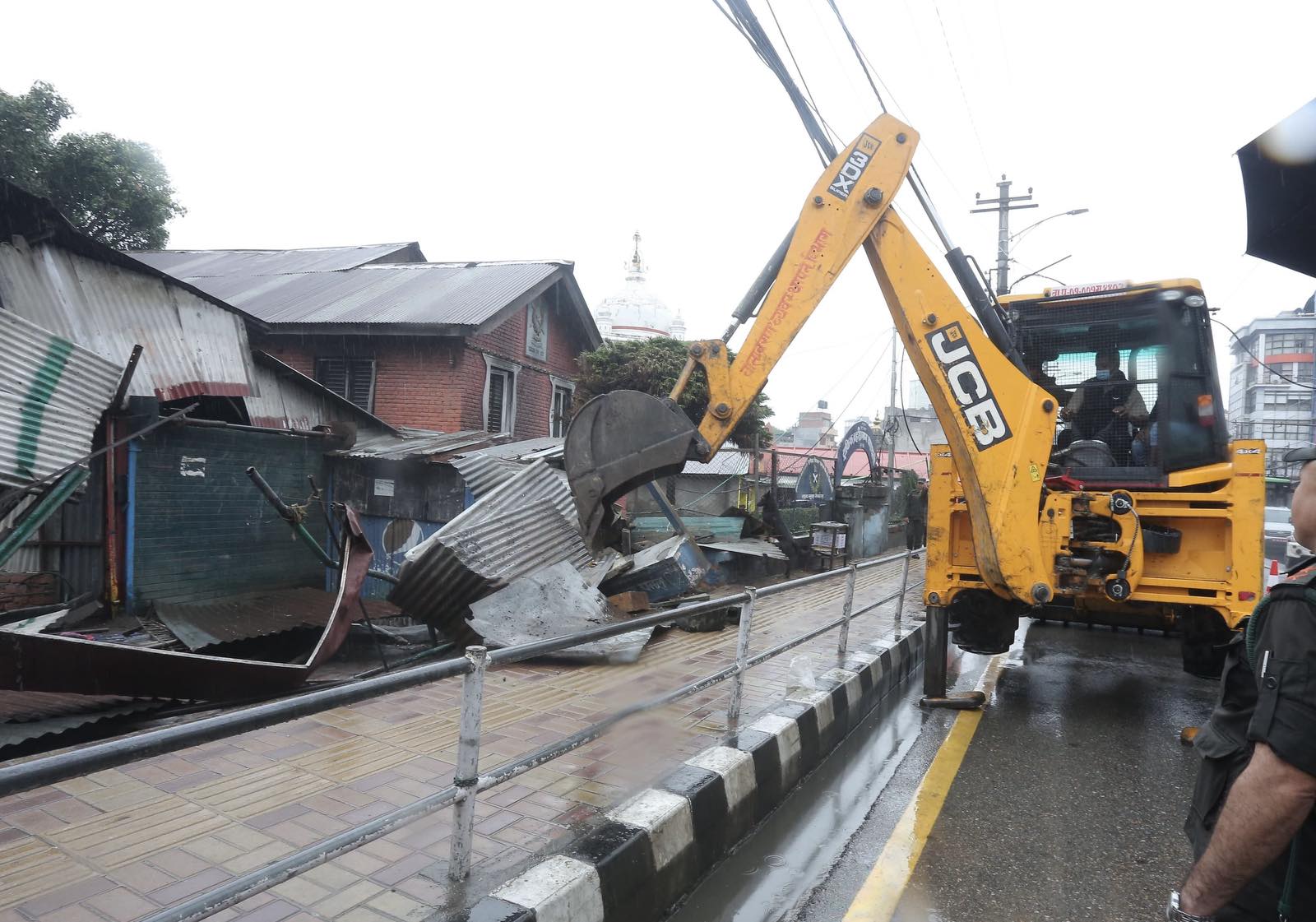
Baburam Bhattarai knows that he can never hope to match Dahal’s political acumen. He has instead chosen a different tack to leave his mark. Riding a bulldozer—the homemade Mustang off-roader is a merely a ruse—Bhattarai is playing a game where he enjoys a competitive advantage. It is called the politics of development.
DEVELOPMENTAL POLITICS
Back from one of his routine rounds of South Asian beat, Kanak Dixit recently quipped among his friends that the spectacle of demolished houses on main thoroughfares is what connects Kathmandu with Bengaluru and Colombo.
The street scene is not much different in the engineer-led Indian states of Bihar and Uttar Pradesh. Back in the days of Karl Marx, religion was supposed to have been the opium of the masses. The new narcotic of the post-ideological age is development. The intoxicating high that tall buildings and wide avenues give to the people that have only seen them in the pictures are beyond description.
Developmental politics aims to create a critical mass of consumers. Urbanization is sine qua non of building a unified market with predictable buyer’s behavior and establishment of an efficient supply system. Industrialization needs bulk transport and mass transit; but highways are enough to fulfill requirements of commercial enterprises. More beholden to the business lobby than to the masses, conservative governments in Bengaluru, Colombo, Lucknow, and Patna cannot help but widen roads at all costs. Bhattarai has appropriated the natural developmental agenda of NC and left his opponents in quandary: They can neither support a campaign so invasive nor oppose a program so popular with the business lobby and the international development-set.

Riding a bulldozer, Bhattarai is playing a game where he enjoys competitive advantage. It is called the politics of development.
The problem, however, would begin when increased supply would create its own demand and more vehicles would compete for space. Fuel import bill would balloon without widened roads adding much value in the national economy. The saucer shaped valley would once again gasp for clean air. Bhattarai would then be remembered as the quintessential demolition man that destroyed the livability of the Kathmandu valley.
MISPLACED PRIORITIES
Urbanization has now become almost an unstoppable process. Other than some cataclysmic occurrence—acute energy crisis, calamitous climate change or unsettling urban chaos—nothing would be able to stop people from migrating to cities in ever larger numbers. They would need safe shelter, clean water, adequate sanitation, basic education and health services, and affordable public transport. Wider roads for SUVs can wait.
In an urban setting, a child on his tricycle, a father pushing a perambulator, a mother lugging tools of her trade in a bulging backpack, and a grandfather clutching a stick would have to feel safe to walk on the footpath or while crossing a street. Walkways would have to be comfortable enough for a man with a kharapan, a woman with a doko or a teenager with an open umbrella. In urban settlements of countries like Nepal, where a tiny minority drives around in private cars and that too mostly for pleasure, the focus of design has to be the safety and comfort of the pedestrian.
It is still not too late for Bhattarai to check his ruinous legacy. All he has to do is walk along new footpaths being built to check whether they are fit enough for the young, the aged and the differently-abled. There comes a time when a leader has to gather courage to tell his people that what they really need is different from what they want.
cklal@hotmail.com
Related story
'Spider-Man: No Way Home' Gets Special Hardcover Making-Of Book