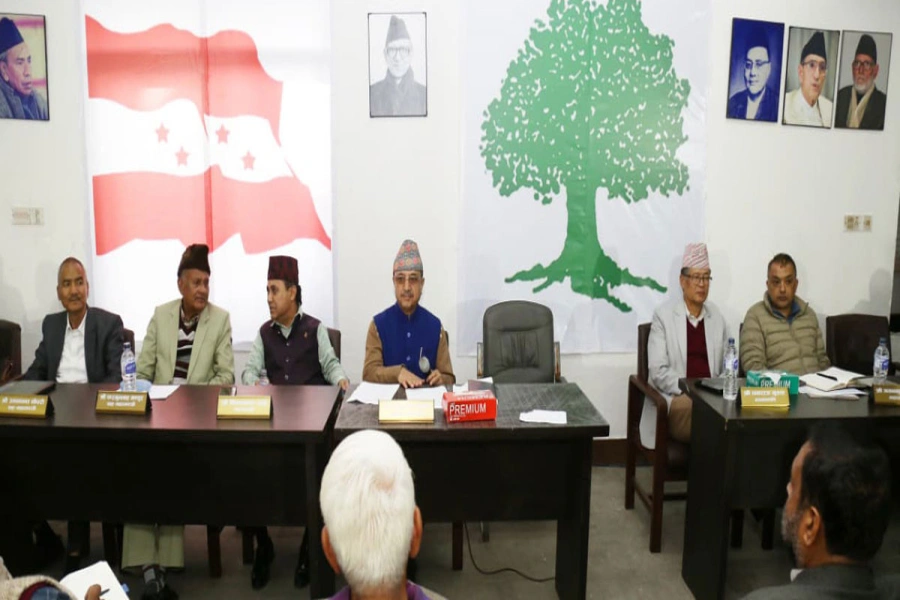
KATHMANDU, January 1: The Nepali Congress’ (NC) much-anticipated 15th General Convention has slipped into uncertainty after the party failed to conduct ward-level conventions as scheduled, raising questions over the feasibility of the entire convention calendar.
Following a 49-day-long Central Working Committee (CWC) meeting, the party had announced plans to hold its 15th General Convention in Kathmandu from January 10 to 12. However, the ward conventions slated for Wednesday could not take place as disputes over active membership—a mandatory prerequisite for the convention—remain unresolved.
The failure to initiate ward conventions on the pre-announced date is likely to have a cascading impact on the entire convention schedule. Despite the growing uncertainty, the NC CWC has yet to issue any formal notice revising the timetable or postponing the convention, deepening confusion among party leaders and rank-and-file members alike.
Amid the uncertainty, General Secretary Gagan Kumar Thapa took to social media on Wednesday, stating that the party statute requires a Special General Convention to be held by mid-January. He made it clear that with a regular convention no longer viable, a special convention has become the only remaining option.
Brexit negotiators trade barbs, eying deadlines

“Holding a Special General Convention by mid-January has become not only a statutory obligation but also essential for safeguarding party unity and confidence,” Thapa wrote. Stressing the collective responsibility of party workers, he added, “To build a Nepali Congress capable of fulfilling its national duties, we have moved forward on the path of convening a Special General Convention within January.”
According to the party statute, a Special General Convention may be convened either by the CWC or upon the request of 40 percent of the General Convention representatives. Acting on this provision, leaders in favour of a special convention submitted a written application to the party’s central office on October 29, backed by the signatures of 2,488 General Convention representatives.
Citing this mandate, General Secretaries Thapa and Bishwa Prakash Sharma have repeatedly argued that the party must proceed with a Special General Convention if the regular one cannot be held on schedule.
Compounding the crisis, a CWC decision on December 1 revealed serious lapses in the membership process. Of the 600,000 new active membership forms dispatched from the central office to districts and lower units, 400,000 were found to be without serial numbers. Once the discrepancy came to light, those forms were annulled and replaced with new ones issued from the centre—a delay that derailed the previously fixed membership distribution timeline.
The CWC had earlier resolved to send new membership forms to lower units by December 6 and ensure their delivery to ward levels by December 10. It had also decided that membership distribution would be completed by December 23, with the finalised list submitted to the party president or acting president by December 29.
Additionally, the party had planned to form district-level preliminary screening committees to oversee the membership process. These committees were tasked with completing their review and reporting to the centre by December 27, while appeals related to disputes were to be resolved by December 29.
According to the official schedule, conventions of overseas NC chapters were to be completed by December 30. Ward conventions were slated for December 31, followed by rural municipality and municipal conventions on January 1, and provincial assembly constituency conventions on January 3.
Likewise, district and constituency conventions in districts with a single House of Representatives constituency were scheduled for January 5, while those with multiple constituencies were set for January 6. Provincial conventions were planned for January 7 and 8, culminating in the 15th General Convention in Kathmandu from January 10 to 12.