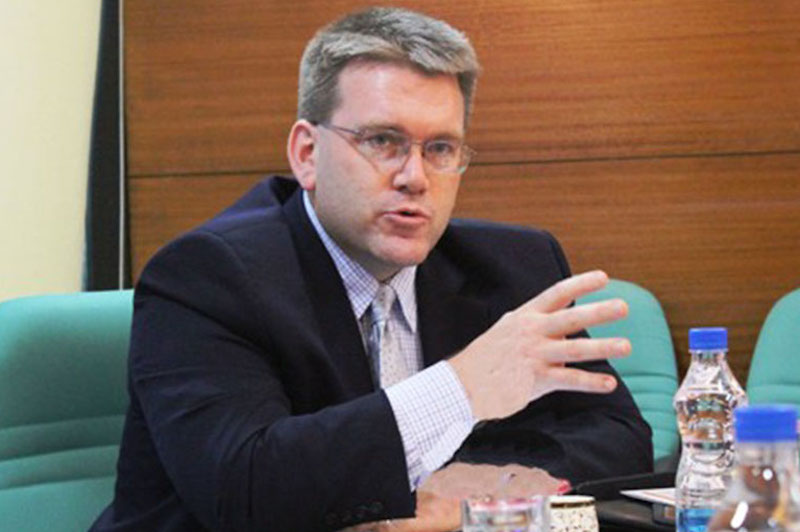
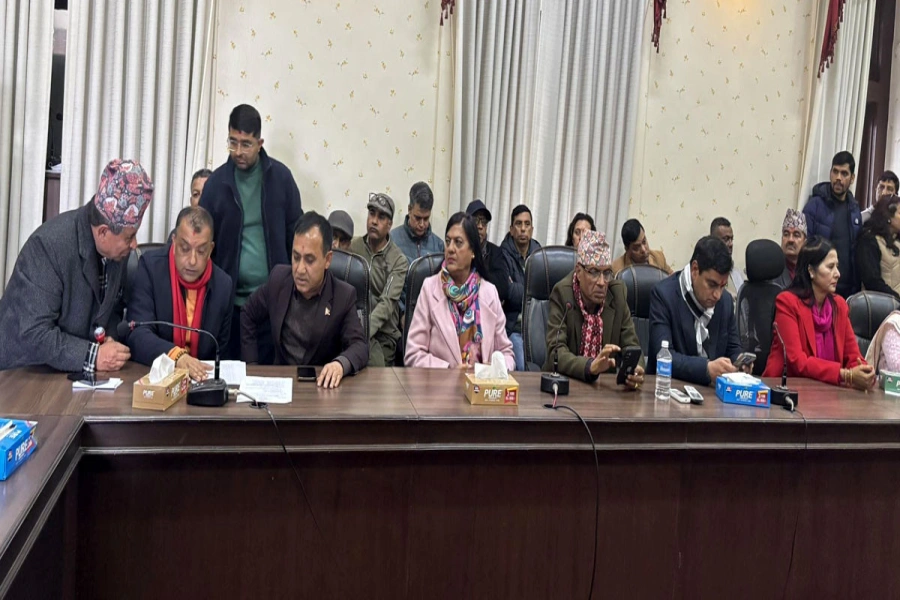
Speaking at a conference titled 'Spark, The next stage Growth' organized by Nepal Republic Media in Kuala Lumpur, Malaysia, on February 19, the who's who of Nepal's advertising sector also concluded that unity amongst them would help the industry grow qualitatively as well.
"Spark, the next stage growth, is an event which is open to all stakeholders of our organization," Nepal Republic Media's Sambridhi Gyawali said she said opening the conference. "It is a platform where we discuss and talk about industry-related ideas and problems, and find solutions to flourish."
The welcome note was followed by an industry overview by Pinaki Roy from Nepal Republic Media that set the tone for the conference. He talked about the size of the Nepali advertising industry in the last two fiscal years and the top spending sectors in terms of volume and value. He also pressed issues faced by the advertising fraternity.

After setting the stage for the conference, the first session dealt on 'Advertising Industry -- Then and Now'.
Keynote speaker Nirmal Raj Poudel from Welcome Advertising -- a former president of the Advertising Association of Nepal and also a former executive committee member of Federation of Nepalese Chambers of Commerce -- presented a paper pertaining to issues related to the advertising industry. "The industry that started with 100-rupee notices as advertisement, has grown to around Rs 5 billion a year," he said, adding that the definition and market for advertisement had seen a sea change since then. "In the last decade alone, turnover has grown by 15 to 20 percent annually."
Despite the massive destruction by the earthquake and blockade by India, the growth of industry is satisfactory, he added. Poudel was of the view that a National Advertising Policy -- that is the need of the hour -- can solve most of the problems faced by the industry. "It will help better manage, categorize and standardize the industry," he said, suggesting that localization of multinational companies' ads will also help expand the market. "Political and policy-level instability and a lack of industry status and policy are the major road blocks for the growth of the industry."
In the last decade, the number of agencies, advertisers, and consumer brands -- both local and international -- has grown substantially. However, there is still immense scope for growth. He also highlighted the need for promoting Research and Development (R&D), skills exchange programs and technology transfer. Poudel also suggested a road map that envisages an Advertising Development Board and an Advertising Authority for structured growth of the market. He also argued that adoption of a clean feed will help market expansion.
In the session moderated by the coordinator of the Business and Economy Bureau of vernacular national daily Nagarik and English-language daily Republica, Kuvera Chalise, the industry players actively brainstormed on challenges to growth of the industry. They also urged for increased coordination and active involvement of all stakeholders in the advertising cycle for the growth of the industry.
Spark Adventure 2023 sets sail with over 200 participants to di...


Taking part in the discussion, Harshawardan Sahani from V-Chitra opined that the agencies face a challenge in retaining their creative people. He also suggested to his colleagues that they not under-scale or under-quote to help the industry grow. Calling for unity among industry players, he said survival of the industry was more important than the survival of the strongest.
The participants, on the occasion, also discussed factors like advertising agencies' doling out more discounts to clients, media outlets slashing advertising rates in an attempt to fight for a smaller pie and advertisers' reluctance to spend adequately on brand building exercises which were slowing the industry's total value from growing.
The next session 'Banking & Financial Sector's advertisement contribution to the Industry' -- the sector that making up a larger chunk in the past few years -- dealt on contribution of the sector that has flourished in the last decade due to a liberal economic policy.
Bijay Ghimire from Kites Media was the keynote speaker of the session also moderated by Kuvera Chalise. Ghimire put forward a detailed view of the advertising trends from the banking and financial sector and their contribution to the industry, some due to regulatory compliance factors and others for branding and product promotion. "Increasing financial literacy and awareness will help the industry grow," according to him. "An investment of a certain percentage on branding and product promotion will not only help the industry but also serve a social purpose," he suggested, highlighting some of the challenges of the bank and financial institutions in investing more on advertisements.
Taking active part in the deliberations, Shambhu Adhikari from Cosmos Advertising, said the government's instable policy had hurt the growth of the advertising industry. Citing the example of the government putting a spending cap on advertising by educational institutions and insurance agencies, he also asked for better lobbying to make the concerned authorities understand the necessity of advertisement and for harmonization of inter- and intra-governmental agencies' policy. "This increase in the size of the cake will definitely help the industry increase."
Likewise, Santosh Silwal Giri from AD Factor suggested sensitizing clients to make them better understand the value of advertisement. Barshatu Regmi from Time Media, asked for fair competition in the market whereas Durga Humagain from Safal Media of Pokhara suggested creating awareness outside the Kathmandu Valley to expand the market. Kiran Gaire of Media Basket seconded him.
The participants discussed ways in which they could further encourage the sector for growth.
Similarly, Mohammed Akhtar from Ad Media moderated the third session on 'Successful Brands created in Nepal'. Arun Sthapit from Eco Advertising and Sudeep Thapa from ANS Creation were the keynote speakers of the session, where they shared their experience with some successful brands. They shared how they developed creative campaigns and established brands.
The participants also shared their experience with challenges they faced during branding. Long-term planning, creating of a life cycle for brands, consistency, and changing focus in branding were also discussed. They raised concerns about lack of knowledge amongst customers and clients in terms of product cycles.
The fourth session 'Creating Growth for Print Media', also moderated by Chalise, was one of the most interesting sessions, where most of the participants suggested how the print media was still the largest favorite platform for advertisers. Despite ever-growing competition from other forms of media, print media is still the leading media vehicle not only in Nepal but also in neighboring India, Ranjit Acharya from Prisma Advertising, said presenting his keynote speech. "Trust and cultural aspects have given print media an upper hand," he said talking more on content-integration, syndicated articles, and changing some policies that could increase revenue in print media.
While number and size advertisements related to BFIs have increased in the print media in recent years, there is much that can be done, he said, suggesting that their notices -- now primarily published in black and white -- switch to color. This will increase the size of such advertisements as well as result in increased revenue, he said.
The print media gets the largest chunk of advertisement, according to a research in India and Nepal.
In India, print media occupies around 43 percent of the total advertisement, whereas the Nepali print media too has an almost equal share of 42 percent -- out of total advertisement -- as print media is the most effective medium. "It must ensure a competitive edge in the future as well, the participants voiced, "And increase believability."
The participants, on the occasion, also highlighted the need for research and development, increasing reach and improving content for more readers.
Likewise, they also noted that the advertising fraternity needs to stand united and set industry norms so that advertisers value the work that agencies do. Currently, pitching to clients is done solely on the basis of low rates and discounts that agencies can offer, according to them.
Free press-releases are also doing the industry no good, they added. The advertisers are increasingly looking at limiting their advertising budgets by seeking free publicity. They also talked on monetizing press releases and media coverage.
Likewise, the advertisement fraternity also discussed clients' trading mindset as they were looking at advertising as expense instead of investment. The day advertisers feel that they don't need to advertise to sell their products, its curtains for us, they said.
The industry currently attracts no talent, they said. They said that agencies were currently turning into one man shows with no second or third lines of succession that's would take the industry forward.
Media outlets must look at exploring retail-level advertising too. Citing some examples, they said that boutiques and restaurants should start advertising especially in print media, with tailor-made campaigns as per clients' needs.
(VIDEO)
With digital media gaining momentum, the print media too must seek a collaborative approach to reap benefits. "Media habits are changing drastically," Acharya said, adding: "While digital media breaks news, it also ignites the desire for its audience to seek related views the next morning in the newspapersAs a keynote speaker, Ujaya Shakya from Outreach Nepal, said that there was no culture of brand guidelines in Nepal. "In fact, clients expect agency teams to deliver brand guideline for them, he said, asking: "Are we their brand custodians, creative partner, media partner or simply vendors."
The advertisers believe 'advertisement IS brand building', Shakya continued, sharing his experience of clients, who would like to stop their ad release as soon as they get smallest of reasons. "Are we a structure to deliver brand strategy even though traditionally we have been doing it," he questioned. "The agencies have failed to monetize it, if they have been helping clients in brand strategy."
He also threw some light on brand content and visibility. The industry players, with their rich experience of brand promotion, shared that quality creative concepts increase expenses. "Advertising industry has widely been supporting the birth of the brand in Nepal," they said, adding that advertisement was an investment, not an expense.
The participants also dwelt on how to create synergy to create brands. The advertisers have not been patient with regard to understanding the product cycle. As soon as a product starts doing well after its launch, the advertiser takes the lasting power of the initial success for granted, and stops advertising, they echoed, adding that respective agencies that manage these brands must educate their advertisers.
The last session -- 'Digital Media's Integration with Print' -- moderated by Ujaya Shakya from Outreach Nepal discussed penetration of digital media in recent times. Deependra Tandon from Business Advantage as a keynote speaker explained the advantage of digital media and asked the industry to explore ways to find the best way to integrate digital media with that of print.

After a whole day of the session, the industry players thanked Nepal Republic Media for providing a platform to discuss their overall issues. These Spark sessions are expected to ignite industry growth, they shared. "It should be the beginning of discussions for the growth of our industry," said Bishal Purush Dhakal from Avani Advertising, echoing other players.
Sohan Shrestha from Nepal Republic Media, who ended the conference with a vote of thanks, said this was just the beginning. He said he expected the conference would spark future growth in Nepal's advertising market. Shrestha also shared that as a leading media house, Nepal Republic Media was committed to better service and improve the quality of growth of the industry.