"Apples are well grown in dry lands with cool air. They are better if land is sloppy. But they need irrigation at times and farmers are fulfilling this need by the use of snow-fed irrigation ponds," said agriculture officer at the DAO, Dhan Bahadur Kathayat adding the technology was introduced in the district two years ago by his office.
"While introducing this technology in the district two years back, we had selected orchids of two farmers for test. As the results were very effective, we extended the technology to other farmers across the district. Now this is very popular among farmers here," he informed. Jumla is the first district in entire Karnali zone to practice this technology.
Raju Malla, a local farmer, stated that Hansha Mahat and Narbir Kami were the ones whose land was selected for the pilot project by the DAO. "The experiment was successful. And after we adopted this technology, our apple production increased in the past two years in comparison to previous years," he said.
"I was also with them when we dug the pond for the collection of snow. We had dug three meter deep and three meter wide pond," he said adding that the pond's design was provided by the technical officer from the DAO. "The snow collected in each of these ponds melts and the water remains there for a long time. Each of these ponds holds water that is sufficient to irrigate around 150 apple trees"
After adopting the technology, Malla has seen substantial growth in the production of apples from his orchid. "This year, we had two snowfalls in the winter. We have collected snow in the pond that will be sufficient for irrigating our orchids till July."
Deep Bahadur Malla, another orchid farmer said that the ponds have been a boon for them. Adding to the benefits they get from irrigation, Malla said that the ponds have been a good source of water for their cattle too.
Despite its multiple benefits, selecting land for making the pond requires knowledge of the soil geology, DAO officials informed. The capacity of the pond to accumulate snow and keep the water intact is determined by its location and soil geology. "For a better pond, it should be dug just below dry, unused and sloppy land," said Bishnu Bahadur Mahat, chief at the DAO.
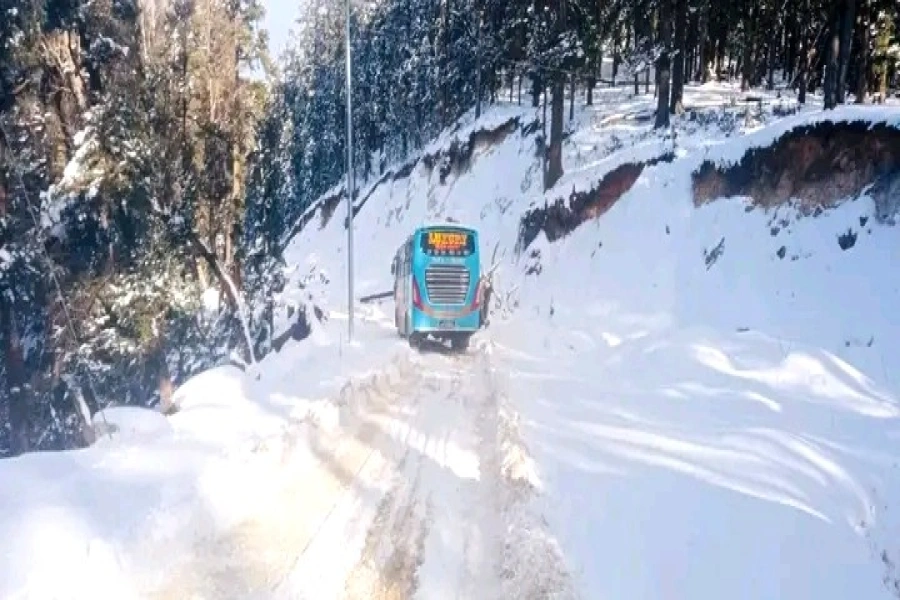
"Such land makes it easier to roll the snowballs to the pond and lot of snow could be easily collected in a while. We have trained the farmers accordingly," he informed. "Farmers have to be proactive during snowfall and ensure that their ponds are ready with plastics in formation in their ponds. The district usually has snowfalls during November/December and farmers should be proactive in filling these ponds with snow after the fall," he said.
"Due to very low rain and dry air in this range, the technology of snow collection has indeed worked as boon for farmers. Now the farmers need a few more skills to improvise traditional farming skills," Mahat stated.
Apart from promoting technologies to increase production of traditional agricultural produce, Mahat said that his office has been imparting trainings for producing other feasible crops, producing fertilizers and farm management. "Farmers should be trained for preparing fertilizers and their usages in various crops that can be grown here. Along with imparting management skills for managing their farms are important aspect to work on," he said informing production of various crash crops is yet to be tested across the district.
He informed that apple farming is done in 28 hector of land across the district. That covers 1500 orchids. Agriculture expert Krishna Poudel also stressed on further improvising the snow-fed pond technology. "The ponds have quite excited the farmers. The technology should be improvised further and made available to every household across the district," he said.
Director at the Agriculture Training Center, Balaram Koirala opined that the technology should be expanded to Manang, Mustang, Bhajhang and Bajura districts.
Related story
Damage to irrigation amounts to Rs 2.42 billion