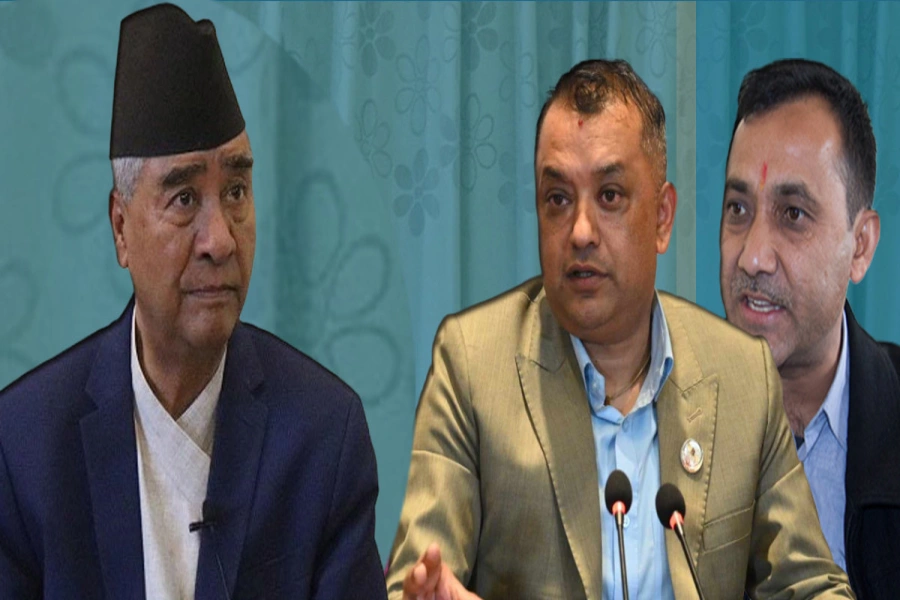
With the customary visits of India and China out of the way, the priority of Prime Minister KP Sharma Oli should be one, to expedite the long-delayed reconstruction and two, to begin meaningful negotiations with the Madheshi parties that are again itching for a fight. Eleven months after the first big earthquake hit the country on April 25th, 2015, the National Reconstruction Authority (NRA) is apparently still busy 'collecting data' on destroyed homes and infrastructure. This is baffling. We wouldn't need the authority if reconstruction works were to be so delayed. The hope was that the NRA, after the appointment of its office-bearers last December, would waste no time in mobilizing the enormous resources committed at both national and international levels; that these resources would help with timely rehabilitation of displaced families. But most of the 600,000 affected families in the 14 worst-hit districts continue to live without any help, in flimsy tents, bravely battling the elements. The NRA and particularly its chief, Sushil Gyewali, must be held to account for this unjustifiable tardiness.Thus Prime Minister Oli should waste no time in expediting reconstruction works, which should now be much easier after the lifting of the Indian blockade. The other focus should be on resolving the Madhesh crisis. The 'discriminatory' provisions of the new constitution against Madheshis were the pretext that allowed India to impose a crippling economic embargo on Nepal. In our view, there are plenty of good aspects of the new constitution, which has been made stronger and more inclusive after the twin amendments at the end of January. But if the Madhesh-based parties are still dissatisfied with it, they deserve a hearing. Broadening the political support for the constitution will only add to its legitimacy. There is no reason the constitution can't be amended again to address the concerns of the Madheshi parties. Yet the Madheshi parties also need to behave responsibly. They are now threatening with yet another Madhesh-centric agitation, when more disruption in their daily lives is the last thing people in Madhesh want. So meaningful talks is a two-way street. But as the head of the government, the onus to make the first move is with PM Oli.
Prime Minister's Oli's five months in office have certainly been eventful, interspersed with the blockade, the Madhesh-based agitation, and his visits to India and China. He deserves credit for his recent efforts at balancing Nepal's relations with its two giant neighbors. The recent opening to China is expected to reduce Nepal's near complete dependence on India. But problems with India also allowed the prime minister to deflect attention from his failures, most notably to control black-marketing, which, anecdotal evidence suggests, is being fanned by members of his own government. He must do more to take on these black-marketers. Getting timely help to earthquake victims, gaining the trust of Madheshi parties and taking on vested interests—all the while trying to swat rumors of the imminent collapse of his government—the prime minister has his task cut out in the next few weeks.
Related story
FATF’s Grey List: A Wake-Up Call for Nepal