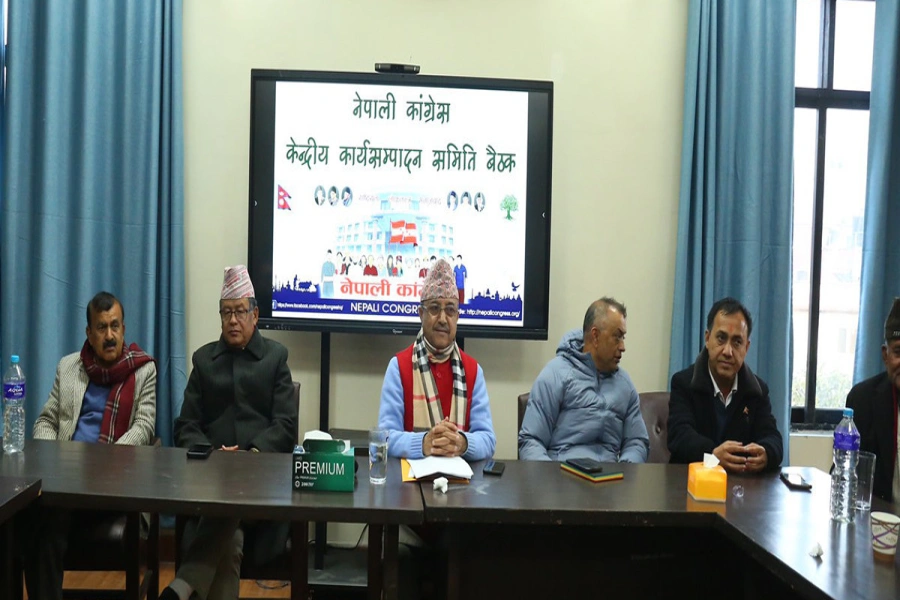
KATHMANDU, Dec 3: In what appears to be the “toughest time” for the Nepali Congress (NC), the issue of holding a special general convention has pushed the party closer to a split.
In a dramatic turn of events, the NC’s Central Work Performance Committee (CWPC), despite calls from 54 percent of party cadres (general convention members) to hold a special general convention, proposed holding the 15th General Convention from May 11 to 14 after the upcoming House of Representatives election.
Leaders of the establishment faction, led by acting party president Purna Bahadur Khadka, who tabled the proposal, said time constraints had forced them to cancel the previously announced general convention, which was scheduled to be held in January.
The new proposal was tabled by invoking Article 43 of the party statute, formally pushing the convention date beyond the upcoming election. A Central Working Committee (CWC) meeting, however, still needs to ratify the date.
Will Major General Pandey step down amid age dispute?

On the other hand, leaders of the establishment faction did not address the call of the majority of the general convention members who submitted signatures demanding a special general convention following the September 8 and 9 protests. The NC statute mandates that if at least 40 percent of representatives seek a special convention, it must be convened within three months of submission.
The rift inside the party is largely due to this signature campaign demanding a special general convention.
NC General Secretary Gagan Thapa, who now appears to be the pivot of the rival faction, told the press after the CWPC meeting that the party leadership has shown it does not want any changes following the September 8 and 9 protests. “They still think we live in the same Nepal as before September 8 and 9, but we do not. It is in this spirit that our cadres demanded a special general convention, and we must adhere to their legal demands,” Thapa said.
He noted that four to five leaders, including himself, registered dissent during the meeting.
Citing Article 17(2) of the party statute, Thapa said a special general convention must be convened within three months of a formal request by at least 40 percent of convention representatives, with January 11 and 12 marking the statutory deadline. He referred to a Central Committee decision taken on December 1 last year, which states that such a demand can only be deferred if a regular convention is feasible; otherwise, the party is obliged to address it.
He also said that the work procedures of the special general convention will be determined by the Central Working Committee (CWC) if it endorses them; otherwise, the signatories demanding the special general convention will formulate their own procedures.
Guru Raj Ghimire, one of the initiators of the special general convention, said the leadership’s proposal to hold the general convention from May 11 to 14 is merely another tactic to extend the tenure of the current CWC. Multiple leaders of the rival faction said party president Sher Bahadur Deuba is seeking to extend his tenure by more than two years before retirement or handing over leadership.
“There are loopholes in the party statute that allow the party president to extend his tenure. President Deuba is playing the same game, and the newly announced dates are just another gimmick,” Ghimire said.
The NC party statute allows the president to extend his tenure by one year without holding a general convention and further delay it by another six months by paying a specified fine to the party.
Another leader and former lawmaker of the dissolved House of Representatives (HoR), Ajay Babu Siwakoti, echoed similar views. “No matter what tactics are used to extend their tenure, we have floated the special convention with a majority of votes, and it cannot be denied at any cost,” Siwakoti said.
As the largest party of the dissolved HoR prepares for both national elections and its internal convention, the Nepali Congress now faces the daunting challenge of maintaining unity while responding to growing demands for change from within.