Perhaps, I was being over optimistic by hoping that things would get better this time around. Sadly, Nepal Academy of Fine Arts (NAFA) has hardly brought about significant changes and improvements at the second National Exhibition which opened on June 11.[break]
Bazaar atmosphere
Although it’s a huge sigh of relief not to see artworks hanging right at the entrance of the NAFA’s building in Naxal, the exhibition on the whole, still looks and feels like a curio shop. Paintings, which dominate the exhibition, hang on partitions in outdoor corridors and oddly placed panels.
Installations which deserve bigger spaces are limited to corners of the same room. Subesh KC’s work “Conceptual,” supposed to be placed on a long wall, was lying flat on the floor instead.
In the handicraft section, hand-painted mirrors and a bucket hang from beams and doors. On a positive note, smaller sculptures have been placed on pedestals and aren’t scattered on the floor. Presentation-wise, the exhibition is only a less cluttered and cramped version of 2011.

Leaking galleries
Dirty brown stains on the ceilings, floors and panels are still there and I assume will be there next year as well. NAFA seems to pay no attention to converting its spaces into respectable galleries.
It’s “Arts” and not “Atrs”
It’s very embarrassing that the word ‘Arts’ itself has been spelt wrong at the exhibition, that too on the award winners’ labels. No excuses for that. Period.
Quantity over quality
None of the aforementioned points matter so much when it comes to the biggest issue of the National Exhibition of Fine Arts. The quantity of artworks by far exceeds the quality thereof that a national exhibition should maintain.
As I browsed through the paintings, I came across one titled “Chara ra Simsar” by Jeev Nath Pokharel. It’s a typical landscape with two trees framing the center of the painting while oversized birds of different kinds sit on the branches. Some real moss has been stuck on the surface of the canvas, and therefore, the painting is described as “mixed.”
Bluntly speaking, to me the work appeared as an amateur painting, which a school student would probably make for an environmental project. In that case, it would’ve been great but as a submission for display at the National Exhibition, the work is intolerable. It makes it worse for the fact that the artist is an Assembly Member of NAFA.
A total of 593 artists submitted 784 individual artworks to the 2nd National Exhibition. Participants have the option of entering their artworks for either competitive or non-competitive categories. Pokharel is one of 45 artists in the “Non Competited Artists” or NFC.
Out of all the submissions, NAFA’s Selection Sub-Committee selected 611 artworks by 565 artists for the final show. The Judging Sub-Committee reviewed artworks under “Competited Artists” and chose National Fine Arts Award winners in eight categories – Contemporary painting, Traditional painting, Contemporary sculpture, Traditional sculpture, Folk art, Handicraft, Architecture and Other Creative Art (i.e., Photography, Installations, Videos). For some reason, Print Making has been shoved under Contemporary Painting when it is a whole separate medium on its own.
This year, too, I stick to my conviction that awards can be on hold, if necessary, at the National Exhibition. The Architecture category winner is a simple straw and cardboard Nepali house. When there aren’t enough entries that meet the standard of a ‘national’ award, why give awards for the sake of it?
At the first round of ARTalk (jointly organized by KUart and Quixote’s Cove) held on June 21 in Kathmandu, artist and Academic Program Coordinator of KUart, Sujan Chitrakar, raised the question of the standard of works by Nepali artists. Is Nepali art is strong enough for the global arena? Have Nepali artists put in enough efforts?
“Not enough yet,” answered Ashmina Ranjit who has been involved in arts since 1987 without a pause. Coming from an experienced contemporary artist such as her, it’s a serious concern. “We have to start at many levels and we have to inculcate critical thinking,” also shared Director of Siddhartha Art Gallery, Sangeeta Thapa.
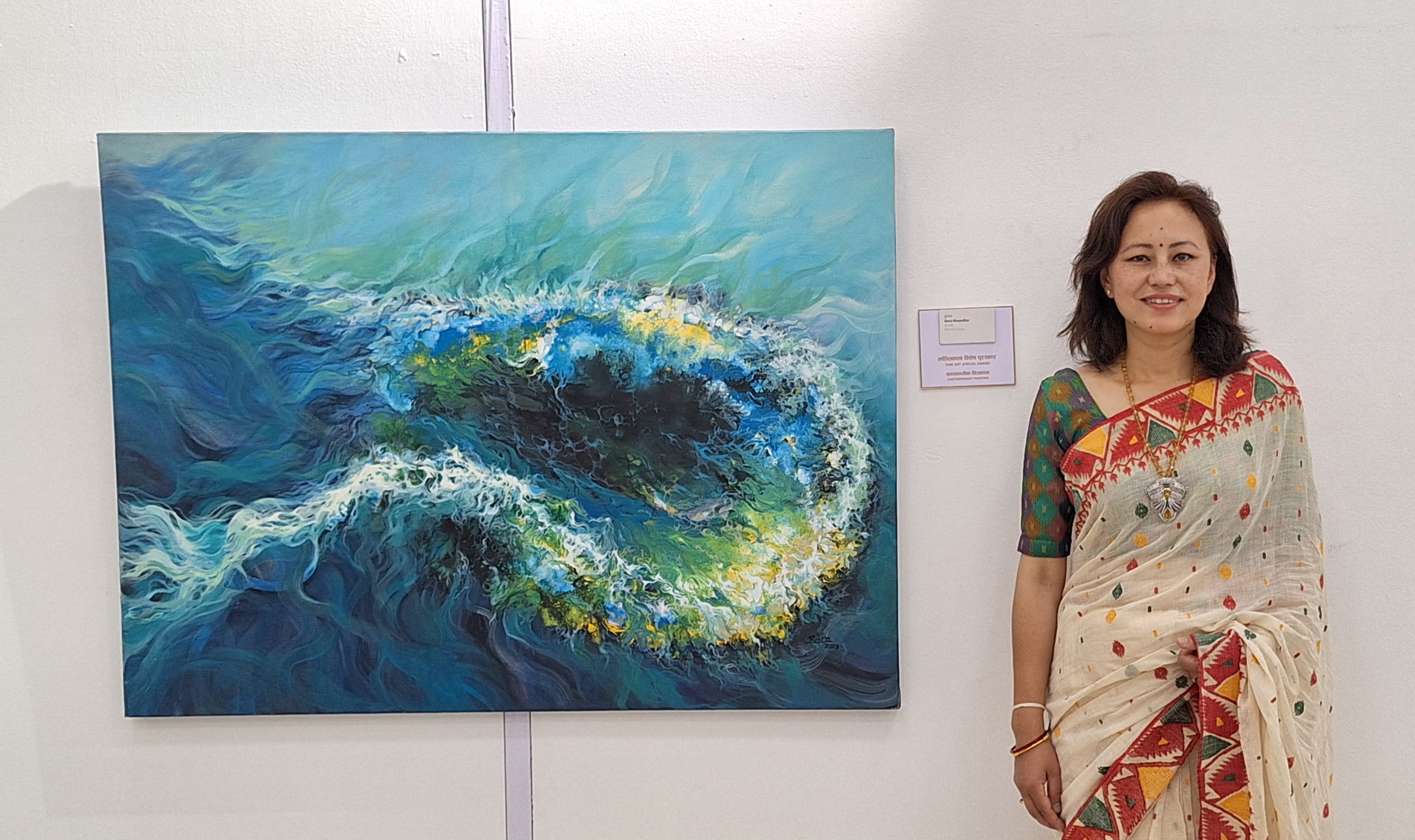
The audience of some 120 people burst into peals of laughter when Chitrakar joked that he had finished viewing the National Exhibition in five minutes. Arjun Khaling, who received a Special Award for his painting this year, later asked Chitrakar for a clarification of his statement.
“I meant it as a metaphor and not because the exhibition space was small,” Chitrakar put in. He was rather referring to the lack of captivating works present at the show, which is very true.
It isn’t that the National Exhibition doesn’t carry a single interesting or appealing work of art. Khaling’s painting is one of them. Saurganga Darshandhari’s print “Kin,” Nabin Nalbo’s acrylic painting “Haatka Mudraharu,” Madhu Krishna Chitrakar’s “Shri Yantra,” and Shashi Kala Tiwari’s oil painting “Peacock” were some works that made me stop and look.
However, many of the works in the Contemporary Painting section (the biggest section) were predictable and typical like last year – landscapes, portraits, and so-called “abstract” works that carry little or no critical content. The Contemporary Sculpture section has several works made from junk material but they appear odd and forcefully put together. The poorest entries are in the Photography section.
A couple of submissions were artworks I had seen at previous exhibitions, especially those by KUart graduates and students. Sushma Rajbhandari’s work is pretty much the same as last year, i.e., a painting of Lord Ganesh. Bishnu Prasad Shrestha’s sculpture also looks like the one he exhibited last year.
Gyanu Gurung, whose work I admire, too has an entry similar to the previous year. Yes, artists do have consistent styles and content, but then the National Exhibition should be a platform to show something new, too.
So what is NAFA doing with its annual budget of Rs 250 million (2.5 Crores)?
“We’re currently planning an open sculpture museum in Pokhara,” said Om Khattri, the Head of Sculpture Department at NAFA, at the ARTalk event. “It’s difficult to execute plans with an unstable government where ministers and secretaries are always changing,” he lamented. Bindu – a group of artists recently cleaned up a studio in NAFA at their own initiative and is now running a print workshop. A sculpture workspace has also been built in the premises of the Academy.
NAFA still has its bigger plans. In the National Exhibition of Fine Arts 2012 catalogue, Chancellor Kiran Manandhar states that NAFA aims to establish galleries and exhibition halls; initiate various art events; and build a guesthouse for local and foreign artists who come to NAFA for exhibitions and workshops.
For those, we’ll just have to wait and see in the years to come. But for the following year, I merely hope that NAFA gets the spelling of “Arts” correct.
The National Exhibition of Fine Arts 2012 is open till June 30, 2012 at NAFA, Bal Mandir.
Burathoki is the contributing Arts Editor for The Week.
Related story
Ninth National Art Exhibition in photographs