

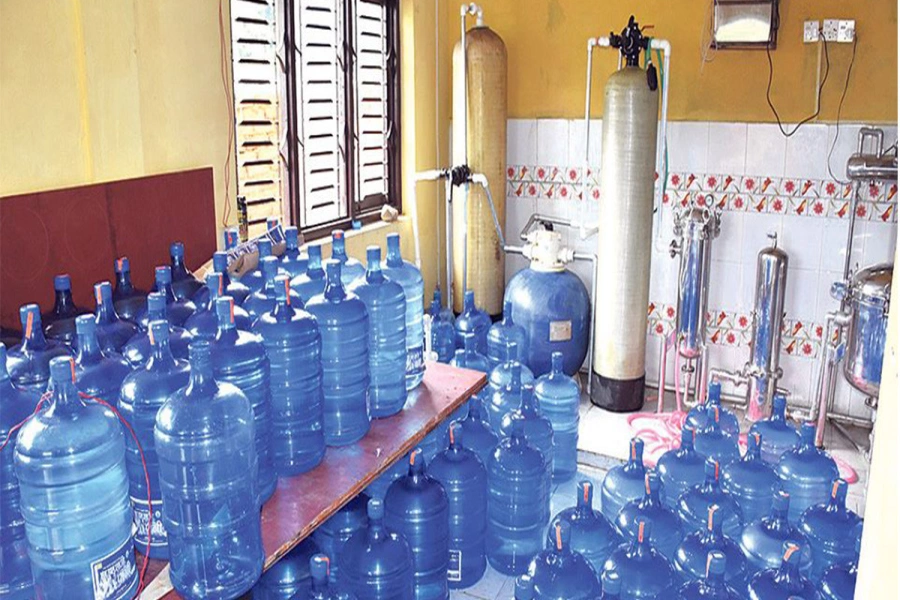
KATHMANDU, Feb 12: For many households across Kathmandu and beyond, jarred drinking water has become a daily necessity — a convenient alternative to unreliable taps and polluted sources. The blue jars stacked in kitchens and offices carry an unspoken promise: safety. But recent inspections suggest that this promise is not always being kept.
The Department of Food Technology and Quality Control (DFTQC) has uncovered alarming lapses in several jarred water companies. Violations of the Drinking Water Production Standards Directive, 2074 BS, range from the use of old and damaged jars to poor hygiene practices and failure to maintain mandatory records. More troubling, mobile food lab tests detected ammonia in water samples from at least one supplier — a chemical experts describe as highly dangerous to human health.
“Even small amounts of ammonia in drinking water can pose serious health risks,” experts warn.
According to DFTQC spokesperson Balkumari Sharma, inspections conducted in recent days revealed that some companies were continuing to use crushed and worn-out jars while ignoring basic safety protocols. Workers were seen filling jars without gloves — a direct violation of hygiene standards.
Technical teams visited Shital Jal Udyog in Kageshwari Gothatar and Krishna Beverage in Manohara. At Krishna Beverage, ammonia was detected in jar samples during mobile lab testing. The sight of workers handling drinking water without protective gear further raised concerns about consumer safety.
Govt bodies trade blame for not exposing bottlers of contaminat...

In response, the DFTQC has directed all drinking water companies to strictly comply with the directive, ensure cleanliness, and sell only safe and quality water. The department says intensified monitoring will continue.
But the issue extends beyond jarred water.
Recent inspections of hotels, restaurants, grocery stores, and meat shops have revealed stale food, improper storage, and unhygienic conditions. Officials admit that in the rush for quick profits, some businesses are compromising public health. As commercialization expands, substandard and unsafe products are becoming more widespread in the market.
Daily inspections frequently uncover common violations — from mismatched package weights to improperly stored cooked food. For consumers, this means growing uncertainty about the safety of everyday products.
The legal framework
The Food Hygiene and Quality Control Act, 2081 BS, sets strict standards and penalties for violations. The law differentiates between substandard food and contaminated food, with harsher punishment for the latter.
“Using substandard food may not be fatal, but contaminated food can be deadly. That is why penalties differ,” Sharma explained.
Cases involving substandard food are handled by the Chief District Officer’s office, while contaminated food cases are sent to district courts. Severe cases may result in imprisonment.
The Act prohibits the production, processing, storage, import/export, and sale of food that is rotten, toxic, chemically contaminated, or unsafe. It bans excessive pesticide residues, veterinary drug residues, bacterial toxins, hormones, psychotropic chemicals, and radioactive substances. Adulteration — mixing low-quality or inedible substances into food — is also strictly forbidden. All products must be clearly labeled in Nepali or English.
What makes ammonia dangerous?
Ammonia is a toxic compound made of nitrogen and hydrogen, known for its sharp, pungent smell. It is widely used in fertilizers, refrigeration systems, plastics, and chemical manufacturing. However, when present in drinking water above safe limits, it becomes a serious health hazard.
Exposure can cause burning and irritation of the skin, eyes, nose, and throat. High levels may lead to breathing difficulties, vomiting, lung damage, and even harm to internal organs. Environmental leaks can also contaminate air and water sources.
Health experts advise that anyone exposed to high levels of ammonia should be moved immediately to fresh air and seek medical attention without delay.



-1200x560-1779899638.webp)








-1779842101.webp)



-1779943688.webp)





